Search the Community
Showing results for tags 'blueblack'.
Found 9 results
-
Tintenlabor (Ink lab) is a new Swiss ink company specializing in iron gall-based inks. The website is in German, so you must use the translation app in your browser. https://tintenlabor.mycommerce.shop/products Note how the iron content is marked in each bottle: Inks come in 30 or 50-ml bottles, and some specialty inks are only in 10-ml bottles. Disclaimer: The owner and wizard, Inkmeister David, kindly sent me bottles (with my participation in shipping) to test. He patiently responded to my numerous questions and gripes, and insisted that I be as transparent as possible about my experience. This ink experience has been one of the most fun, challenging, and ultimately rewarding ink journeys. What is special about these inks is that the iron and dye content is known to the user, so that you can choose your ink depending on your risk tolerance, use, and preference. As of this posting, several colours are available in various iron and dye content: Green, Purple, Blue, and blue-black, and two specialty grey and gold inks. I’ll be reviewing these inks in detail for each colour family. I’ve come to realize that each colour family is distinctly different. For example, Dark Green 2 and Dark Purple 2, while having the same iron and dye content, are distinctly different in behaviour. So today, I will give an overview of the green inks and post separate reviews of each ink on the Reviews forum. Over time, I will post my notes on the other inks here. A note about cleaning: Do not use ammonia-based cleaning solutions with these inks. The best way is to use a pinch of ascorbic acid or common lime/ lemon juice (filtered, obviously ) or a ratio of 1/10 vinegar. The lower the iron content, the more user-friendly the ink is for the average user. High-iron content inks are more challenging and require patience and perseverance. Dark Green inks come in three declinations, and in 30/50 ml bottles. 1. Dark Green 1 (High dye, low iron content (3 gr/l). Low maintenance, Excellent flow, good behavior, lovely color, and low oxidation. 2. Dark Green 2 (Low dye, medium iron content (4 gr/l), medium maintenance, Low lubrication, immediate oxidation, from bright green to charcoal. 3. Aprilis Argente (high dye, highest iron content 6 gr/l), high maintenance, low lubrication, sluggish flow. Ink oxidation from medium green to charcoal from 20 seconds to 24 hours, depending on the paper (slowest on Midroi/ and TR 68 gsm) I love all three inks for different reasons. Note: I misnamed the swatches by marking the iron content. You can see the actual dye and how it oxidizes over time. These swatches have oxidized over one month: Col-O-ring paper is very water repellent, so oxidation takes time. (The more water resistant the paper is (think watercolor paper), the longer the oxidation. ) After a month: Dark Green 1 is a gorgeous shade of green. It is easy to use and has lovely shading. Cleaning is easy with modern pens that can be dismantled, but vintage pens are more time-consuming. Everyone can use this ink. Dark Green 2 is a pure Iron gall ink with a low dye content that oxidizes magically into charcoal immediately. Cleaning was easy in most cases. The ink only left some iron deposit on one nib, but it disappeared. This could be remedied by dipping a Q-tip in any solid cleaning paste, (Putzstein, Pink Stuff, Pierre d’Argent etc) and rubbing it on the nib. Aprlis Argentes is a specialty ink made for cheap paper, hence its sluggish flow. It took a lot of pens and testing to find the right combination. I needed to prime some pens regularly. The only analogy I can see is taming and training a wild horse. It was an ink rodeo, rewarding but not for everyone. Paradoxically, it’s the ink I used most (half a bottle). Which ink did I love most? It’s a difficult question to answer. I think I loved them all equally. Which one do I recommend? It all depends on your personality, pens, and risk tolerance. Dark Green 1 is for most people and pens. Dark Green 2 is for those who want immediate oxidation and don’t mind low-lubricated inks. Aprilis Argente is for those who like a challenge and use copy paper. What pens? This is a tricky one to answer. It depends on the ink. The higher the iron content, the wetter the pen should be. Inks range from water-resistant to waterproof. The dye content can be washed away with the lower the iron content. I'm now in the process of testing the purple inks, which are pretty different. In a week or two, I'll post my general comparisons here. And here are several test drawings: Dark Green 1 (Talens Mixed Media paper) S Strathmore Paper Dark Green 2 (Talens Mixed Media paper) and Aprilis Argente Talens Mixed Media Paper and here is a combination of the three. It's challenging to distinguish Dark Green 2 from Aprilis Argente, but whatever, from light grey to near black, can be either of the two. Paper is Strathmore. Final notes: It is my understanding that some of the flow issues might be fixed in the future...
-
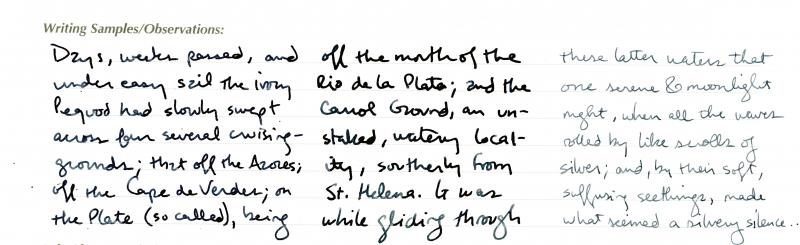
Anderson Pens' Oshkosh Denim is a discontinued ink, given to me graciously by a FPNr who had received a whole bottle thanks to the generosity of another FPN member. I enjoyed using this ink at first, when inking my trusty Lamy Safari for sketching, taking notes, etc. However, I forgot the pen for about 2 weeks, with the convertor half full. It refused to write even after priming. Finally, I just refilled the pen and it was still sluggish. It was a disappointment to put it mildly. The next day, I had the same startup problems but a little priming and the pen was writing well, afterwards. I won’t tell you how excruciating it was coaxing ink from the dry Osmiroid, but the pen is problematic and is only tamed by very wet and well lubricated inks. However, it gives an idea about the inks inherent behaviour. On the positive side for now it has behaved well in Pilot Kakuno. I know many rave about the shading of this ink, but for me it’s a blessing that the ink is unobtanium, as it's also slow to dry. I'm sure there are many better options available. Let's start by the intriguing chroma: Writing samples: I decided to take use quotes by indigenous leaders as I assume that chief Oshkosh gave his name to the cities and the denim brand. Rather well behaved on copy paper, despite what the scan wants you to believe: Photo: Comparison: Watertest: Decent water resistance under running water (10 seconds) The minima I let the wateriest to "cure" is 24 hours. And finally an art work: A tipi · Pens used: Pilot Kakuno Ef, Lamy Safari (EF/F/M/B/1.1), Osmiroid Copperplate · What I liked: Only writing with a broad nib. · What I did not like: Flow issues. · What some might not like: Same as above, dryness. · Shading: Yes. · Ghosting: Not much. · Bleed through: Faint. · Flow Rate: Good when used, awful after two weeks. · Lubrication: Dry · Nib Dry-out: Yes · Start-up: Yes. · Saturation: Not bad. · Shading Potential: Good. · Sheen: No. · Spread / Feathering / Woolly Line: Not noticed. · Nib Creep / “Crud”: No. · Staining (pen): No · Clogging: I’m not so sure · Cleaning: Yes. · Water resistance: Ok · Availability: Unobtanium Please don't hesitate to share your experience, writing samples or any other comments. The more the merrier
-
Thorough coverage of a range of blue-blacks. Well worth the watch. English subs.
-
I have an old, pre-reformulation glass bottle of Diamine Blue-Black, and a pre-reformulation glass bottle of Diamine Onyx Black. Both of these inks were purchased around 2010 and have been used periodically since then, but not very often as I don't particularly like the purple undertone of the black, and the teal undertone of the blue-black. Recently, I have noticed that both inks are drying out in multiple different pens' feeds after they have been unused for a day or so. If the pen is shaken then some ink enters the feed and a dozen or so words can be squeezed out before the pen runs totally dry again. Even then, ink flow is much reduced and proper flow can only be restored by priming the feed. For many years these inks flowed perfectly. I wonder if perhaps the inks have thickened, so to speak, as air has evaporated. Or perhaps they have just chemically degraded. I have noticed that the blue black appears to have some small solids that are adhering to the inside of the glass, even through the ink itself looks perfectly liquid otherwise. Both have been stored in a dark and relatively humid closet with a stable environment. Does anyone else have experience of inks degrading over time like these Diamines? Is this, perhaps in part, why they were reformulated?
-
-
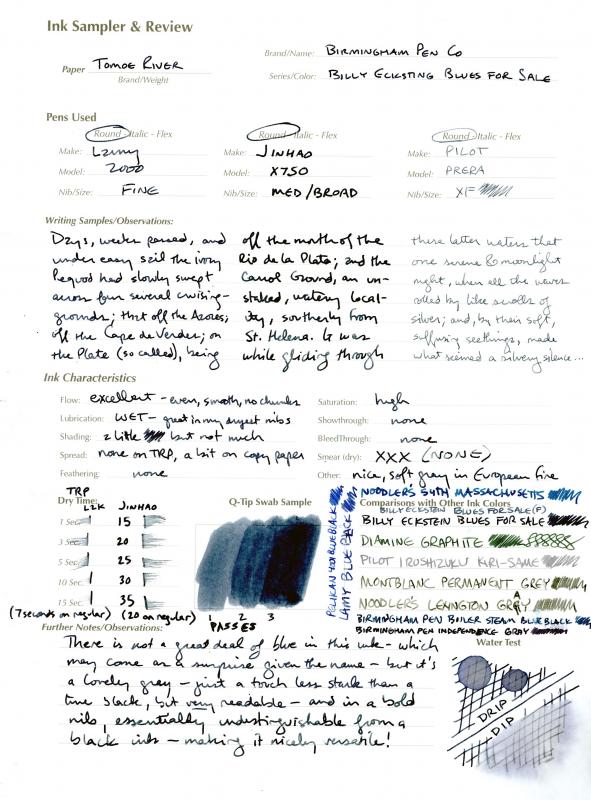
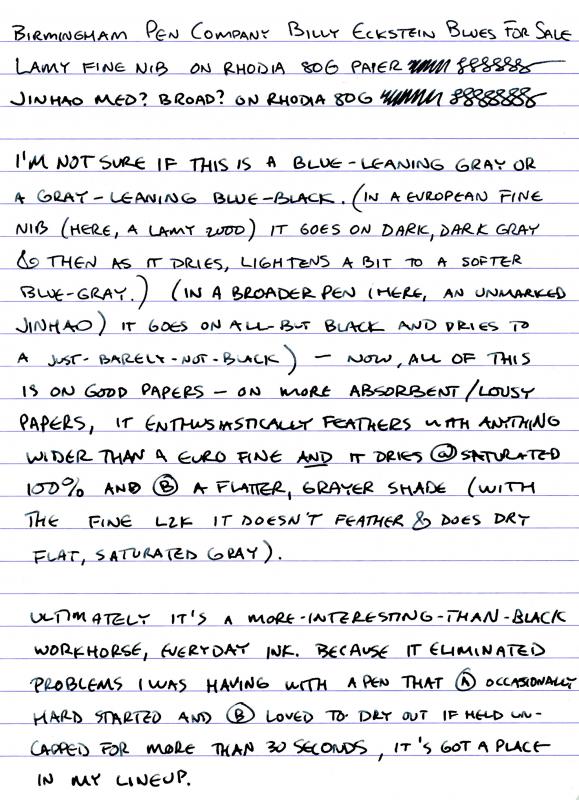
These inks continue to integrate themselves into my regular use. I'm not sure anyone in my family would have suggested I should grab a few more blue-blacks, but there's a few Birmingham inks that lean that way that are different enough from what's out there that I've found uses for them. Billy Eckstine Blues for Sale is one. This is a wet ink that I've wed to a couple of dry writers and hard-starters to good effect. Pardon the misspelling of the name in the images below... On Tomoe River it is highly variable depending on nib width, going from an all-but-black to a silvery blue-gray: It takes some time to dry on TRP and coated papers like Rhodia: And although shading is not its marquee feature, it does a little; on TRP: and on Rhodia: At the end of the day, this adds something to a fairly vast world of blue-black/dark-dark-blue inks, and the variability available with different nib widths makes it like two or three inks in one bottle; I'll be picking up a full bottle when my sample runs out.

-
I thought I'd share an ink mix which I am really enjoying at the moment (I hope this is the correct sub forum). I bought a bottle of Pelikan 4001 Turquoise because I wanted something different in my blue ink collection, however I found it to be un useable for my office work; far too light and bright. In my ink draw I had a bottle of Pelikan Blue Black to hand so I used an empty cleaned out Pelikan Edelstein bottle and combined measures of the two in order to make a fantastic ink which I can use in the office. This ink is within my personal boundaries of what is "office friendly", obviously everyone is different, but this works for me and I thought I would share. I've been using this for aprox. 2 months and I've had no clogging issues, and the mixed contents of the Edelstein bottle appears to be fine. Let me know your thoughts??? http://i1287.photobucket.com/albums/a633/MattRegan/Photo%2020-07-2015%2017%2001%2002_zpsp6swcjpb.jpg http://i1287.photobucket.com/albums/a633/MattRegan/Photo%2020-07-2015%2017%2027%2034_zpsp5lttj0p.jpg http://i1287.photobucket.com/albums/a633/MattRegan/Photo%2020-07-2015%2017%2027%2053_zpsptus3o5a.jpg http://i1287.photobucket.com/albums/a633/MattRegan/Photo%2020-07-2015%2017%2002%2003_zpstupsalbk.jpg
-
My quest for the perfect everyday use blue black ink continues... When I got (back) into fountain pens, the first ink I bought was a blue black, Hero 232 blue black. At the time I didn't know much about different types of ink, but later, while trying to figure out why my pen behaved badly, I found out this was an iron gall ink. I love the colour of this ink (so far my favourite of all blue blacks I tried), but it is just too finicky for everyday use. Then I bought some Waterman Mysterious blue, but it turns out this ink has fairly little to do with blue black. Grey teal would be a better description. Next was Sailor Jentle blue black (the regular one), this looked like a winner. The colour was quite close to the Hero 232, it works just fine in most of my pens (although my Twsbi 580AL w. 1.1 stub doesn't seem to play nice with it) and while not the cheapest (here in the Netherlands), still affordable enough for everyday use. I thought I had found my EDC ink... But... Then I got caught out in the rain, and ended up with all my paper (a Midori passport size notebook, a Rhodia Webbie and an Aurora A4 notepad) slightly damp. And none of my Sailor Jentle blue black inked pens would write. I switched to another ink (J. Herbin Eclat de Saphir) and my pens wrote like normal again. As i live in the Netherlands, where rain and high humidity aren't exactly uncommon, this 'damp paper'-behaviour is pretty much unacceptable for an everyday ink. What blue black ink to try next? I'd like a nicely saturated blue black, that is a quite dark blueish grey or greyish blue. Easy flowing, not afraid of damp paper, it doesn't have to be waterproof or quick drying, but those qualities are appreciated. And of course something that is for sale in the Netherlands (so not Noodlers )and not too expensive (< $25 per 50ml). I'm looking forward to your suggestions, pictures of sample writing are much appreciated.
-
I am looking for at black ink to use with my Lamy Safari. I have 2 nibs (fine and medium), both are very wet writers, I have tried with Diamine Jet Black and Onyx black. They both feather a lot with the Safari and Onyx Black takes up to a minute to dry. I am not trying to bash the two Diamine inks - they are wonderful in my Picasso pens, but they do not go well with my Safari. I have inked the Safari with Pelikan 4001 Blueblack and that is just perfect; clear outline and almost instant drying. So my question is, if the 4001 Brilliant Black is as dry as the Blueblack? Or if someone could recommend a good, black (DRY) alternative...