Jump to content

Ink Recommendation For Vintage Pens


fitz123

Recommended Posts

I've been using Pelikan 4001 Blue-Black in all my vintage pens for the past month and it is really lovely.

It works on every kind of paper I throw at it and I just can't get it to feather or bleed. The water resistance is also quite decent, although there will be some fading. For me it is the perfect professional-looking ink for vintage pens and the color is actually quite nice.

fpn_1451608922__truthpil_signature_small

Link to comment
Share on other sites

  • Replies 25
  • Created
  • Last Reply

Top Posters In This Topic

  • Runnin_Ute

    2

  • truthpil

    2

  • Brianm_14

    2

  • Sandy1

    1

  • 1 year later...

I've been using Pelikan 4001 Blue-Black in all my vintage pens for the past month and it is really lovely.

It works on every kind of paper I throw at it and I just can't get it to feather or bleed. The water resistance is also quite decent, although there will be some fading. For me it is the perfect professional-looking ink for vintage pens and the color is actually quite nice.

I realize this is an old thread but I have a question:


I recently bought some Pelikan Turquoise and Violet inks. After I got them, I found out the have very low pH (2.3 and 3.7 respectively). Are these safe for vintage pens? If not, why does Pelikan market them at all?

Link to comment
Share on other sites

I have to dispute the J.Herbin neutral claim, since I just took my pH probe, calibrated it with distilled DI water, and tested six of my J.Herbin regular lineup inks and they all read below pH 4, so definitely acidic and not neutral. Most of Waterman, Aurora, Montblanc and Sheaffer lineup of inks I have also read in that same ballpark of weak acidic pH.

For vintage pens, J.Herbin and Pelikan are safe and dry inks, so less chance of feathering on cheap paper. Other than that, Montblanc, Waterman, Aurora, Parker and Sheaffer modern inks are all considered safe for vintage pens with a few singular exceptions in their lineups.

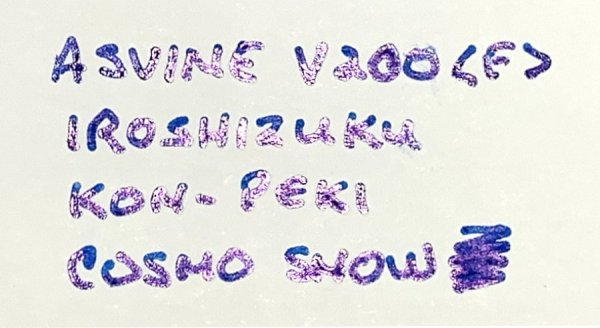
Avoid Japanese inks inside vintage pens, especially ones that come in contact with celluloid directly inside the pen (Vacumatic), as they are very alkali/basic in nature, reading as high as pH 9-10 for the Iroshizuku lineup.

Parker 51 I believe is the sole exception of a vintage pen that can use just about any ink, and was originally designed to take the alkali superchrome ink that even had almost as high as 30% alcohol in it too. However, for the sake of preservation, avoid using Japanese inks in those Parker 51s too.

WRONG, wrong, wrong! Your data on the Herbin and other inks is useless. Calibrating your pH meter with distilled DI water is not correct. You need to use a buffer (or two). The pH of the water you used can be easily affected by things such as carbon dioxide (which redily dissolves in stored water) and other factors. You need a buffer present to maintain the pH in the face of these various factors.

Brian

Link to comment
Share on other sites

I realize this is an old thread but I have a question:


I recently bought some Pelikan Turquoise and Violet inks. After I got them, I found out the have very low pH (2.3 and 3.7 respectively). Are these safe for vintage pens? If not, why does Pelikan market them at all?

Exactly how were these pH values determined? What sort of buffer, and at what pH value, was used to calibrate the pH probe?

Brian

Link to comment
Share on other sites

  • 4 months later...

Hi,


In addition to the excellent suggestions above, kindly consider:


> Montblanc Royal Blue, while not profoundly water resistant is worth a shufti

> Sheaffer BlBk, which is a bit of a yawn, so I often add a whisper of a simple Blue/Indigo ink, such as Diamine Sapphire or their Denim.

> R&K Salix is in there too. It is a small bore iron-gall ink, having just enough I-G to reap most benefits of that family of inks, without the greater maintenance burden of the large-bore Registrars inks. Also, the R&K FP inks, save Sepia, can be intermingled, so should Salix alone not jangle your bangles, then blending with other R&K inks might have you dancing till dawn. Note that I-G inks both oxide and react with the paper stock over time, and there some reports of the hue of Salix fading / becoming quite Grey.

>> As a personal nuance, which is most likely unnecessary, I pair I-G inks with Snorkies that have a 14K filler tube.


But don't you really want a jeroboam of Pelikan Edelstein Topaz?


Please let us know of your inky adventures. :)


Bye,

S1


Reviving this topic, but I just ordered my first vintage pen and was caught by the bit where you said that the R&K inks other than Sepia could be intermingled. What is it about Sepia that causes problems?

Link to comment
Share on other sites

Create an account or sign in to comment

You need to be a member in order to leave a comment

Create an account

Sign up for a new account in our community. It's easy!

Register a new account

Sign in

Already have an account? Sign in here.

Sign In Now


×
×
  • Create New...