Search the Community
Showing results for tags 'pelikan edelstein'.
-
Pelikan Edelstein is the proof of Pelikan employees marketing efficiency. Beautifully packaged inks bear promise of amazing writing experience. The line is popular all around the world and concurs with the likes of Pilot Iroshizuku or Graf von Faber-Castell. http://imageshack.com/a/img540/2076/YtmFPx.jpg The packaging is really impressive. The outer cardboard box is, more or less, standard. It's not overisized and made from cardboard.The front panel has a slightly slanted extra facet with a colored panel that corresponds to the ink color inside. Care was also taken to keep ink secure in the box - the pair of styrofoam pads rest between the neck of the bottle and the box. The bottle itself is really, really nice. The glass is thick, heavy and rectangular but with slightly concave sides. The lettering fits the design. I believe Caran d'Ache Chromatics inks bottles are more interesting, Iroshizuku probably nicer but Edelstein offers great and solid cap. The inks can be bought in 12 colors, seven standard. Aventurine Jade Mandarin Onyx Sapphire Ruby Topaz And 5 LE inks of the year Turmaline Ink of the Year 2012 Amber Ink of the Year 2013 Garnet Ink of the Year 2014 Amethyst Ink of the Year 2015 Aquamarine Ink of the Year 2016Sapphire form standard Edelstein line is, in my opinion, the least interesting og the group. It behaves well and has reasonable drying times. However I can't help but notice it's incredibly boring and generic. When I look at this ink I just can't see anything interesting. Sometimes and for some people it can be an asset. For me though it's unforgiveable sin Frankly if you like such colors Diamine Sapphire Blue or J. Herbin Eclat de Saphire will be much cheaper and more interesting choices. Drops of ink on kitchen towel Software ID Tomoe River, Kaweco Classic Sport, B Leuchtturm 1917, Kaweco Classic Sport, B Kokuyo Campus, Diplomat Depeche, B
-
Ink Mix – Depuydt Green 2 parts : Pelikan Edelstein Tanzanite 5 parts : Pelikan Edelstein Golden Beryl A colleague of mine is entering retirement shortly, and I wanted to present her with a personalized greeting card for this occasion. And to make it even more personal, I decided to create a special-edition green colour using a mix of the Pelikan Edelstein inks Tanzanite and Golden Beryl. I tried out some combinations in an Ink Shift experiment, and the current mix turned out to be a beautiful muted moss-green. And because it’s a personalized ink, it gets her name: “Depuydt Green.” “Depuydt Green” is brewed by mixing 2 parts of Edelstein Tanzanite with 5 parts of Edelstein Golden Beryl. This mix resulted in a stunning muted grey-moss-green colour that totally fits my taste and that is worthy of the occasion. For the writing samples in this review, I used a mix without the Golden Beryl shimmer particles. For the drawing, Golden Beryl’s golden shimmer was allowed into the mix (and I must admit that it works quite well within this Depuydt Green). See below for a swab with the golden shimmer particles included. This new ink writes fairly wet and well-lubricated in my Safari test pens. Contrast with the paper is excellent, even with EF nibs. This Depuydt Green shades nicely too – not harsh, but with a soft presence and aesthetically very pleasing. I like this mix a lot! To show you the impact of saturation on the ink’s look & feel on paper, I made some scribbles where I really saturated portions of a piece of 52 gsm Tomoe River paper with ink. This gives you a good idea of what the ink is capable of in terms of colour range. Depuydt Green has a medium tonal range. Contrast between light and dark parts is not too harsh, resulting in soft and elegant shading. For me, the sweet spot for this ink lies in the less saturated range – which translates to dry-writing pens and/or finer nibs. I prefer to use this mix with EF/F/M nibs, where the moss-green colour comes out the best. The resulting mix shows fairly good water resistance, undoubtedly inherited from its Tanzanite heritage. Short exposures to water flush away the yellow component dyes, leaving a blue-grey residue behind that remains perfectly readable. This is also clear from the bottom part of the chromatography. This added water resistance makes Depuydt Green a good ink for use at the office. I have tested the ink on a variety of paper – from crappy Moleskine to high-end Tomoe River. Below I show you the ink’s appearance and behaviour on different paper types. On every small band of paper, I show you: An ink swab, made with a cotton Q-tip 1-2-3 pass swab, to show increasing saturation An ink scribble made with an M-nib Safari fountain pen The name of the paper used, written with a B-nib Safari A small text quote, written with the M-nib Safari Source of the quote, written with a Pelikan M200 with M-nib Drying times of the ink on the paper (with the M-nib Safari) The Depuydt Green mix behaved perfectly on most of the paper types I used, with excellent behaviour all-around. It even works with the notoriously bad Moleskine paper: just a tiny bit of feathering, but you still get bleed-through (so you won’t be able to use the backside of the paper). Drying times with the M-nib are fairly short in the 5-10 second range. The ink looks good on both white and cream-coloured paper, but the muted grey-green look works best with pure white paper. The scan above shows a bit too much yellow. I therefore add a photo of the same writing, which is almost spot-on colourwise. Related inks To compare this mix with related inks, I use my nine-grid format with the currently reviewed ink at the center. This format shows the name of related inks, a saturation sample, a 1-2-3 swab and a water resistance test – all in a very compact format. Depuydt Green looks fairly similar to Graf von Faber Castell Olive Green (which has a touch more yellow in the mix). Inkxperiment – A History of ICTS I always enjoy doing a small drawing using only the ink I’m reviewing. In this case, the inkxperiment was used on the invitation card for the thank-you party we’re organizing. The drawing summarizes the history of our university’s IT department. Its origins are pictured in the circles on the left: the University Computing Centre (abbreviated URC in Dutch), the Computer Science group and the Administrative Information Processing group (abbreviated AIV in Dutch). These groups merged over time to form the current IT department (ICTS in Dutch, symbolized by the pyramid on the right – and written out in ASCII code on the pyramid), with Annemie as our CIO. With the help of all our co-workers, we built a smoothly running organization that is prepared for the future. Our department’s one-liner motto’s are enscribed in Pigpen cypher code on the drawing. Oh… and you may have noticed the little fisherman in the drawing … it’s not always work-work-work, we sometimes take a break 😉. For this inkxperiment, I started with an A4 piece of HP photo paper. I taped out the pyramid and some other parts with washi tape, and used water-diluted ink to fill in the background, with a darker region at the bottom. After removing the washi tape, I used a piece of cardboard with pure Depuydt Green (with shimmer particles) to draw in the lines – resulting in a nice shimmer effect. Next I drew the circles on the left and filled circles and pyramid with ink. I added the circuit-board lines with a dip pen and bleach (this ink mix reacts really well with bleach). Finally I drew in my co-workers, and added the capping stone to the ICTS pyramid (which symbolizes the end of a career). The result is a one-image history of our university’s IT department, that also shows what can be achieved with this Depuydt Green ink mix in a more artistic context. In my opinion, this ink is simply great for drawing! Inkxpired – computational art I love experimenting with pen/ink/paper, and have added another layer as part of the hobby. I’m exploring computational art, inspired by the ink drawings I do during ink reviews. Another fun offshoot of the hobby… and all that starting with a few drops of dye-coloured water on paper. For this computational derivation, I applied a couple of filters that zoomed in on the main subject, and added a mosaic of colours, that I toned down to a more muted pallet. The end result is not too bad, but in this case I like the green original more. Conclusion Depuydt Green is an ink mix that really impressed me: it is a stunningly beautiful muted moss-green that works well with all kinds of nibs and papers, and that is especially nice for drawing. Fabulous!
-
Re-review : Pelikan Edelstein Tanzanite In 2011 Pelikan introduced the Edelstein series of high-end inks, available in a variety of colours. The theme of the Edelstein concept is the gemstone – each ink corresponds to the beautiful colour of a gem. The Edelstein line of inks is presented in 50 ml high-value bottles, that are truly beautiful, and worthy of a place on your desk. A short while ago, @LizEF did an excellent EF-nib review of Tanzanite, a standard colour in the Edelstein line of inks. I then realised that I hadn’t used this blue-black for a really long time. I did a review of it back in 2016, when I was just starting out with the hobby. Since then, I have used lots of other inks, giving me a broader spectrum for comparison. So I got to wondering: will I still appreciate this blue-black as much as I used to? To find out, a re-review is in order… So, here we are again – getting close and comfy with Tanzanite, the blue-black ink of the Edelstein line. My first impressions after all these years: this looks really nice: well-saturated, beautiful colour with lots of character, and – oh my – lots and lots of red sheen that substantially enhances the inks loveliness. For such a saturated ink, Tanzanite still exhibits some aesthetically pleasing shading, which I can even see when using an EF nib. The ink lays down a wet line, which looks fairly purple but then dries to a true blue-black. Well… more of a blue-leaning blue-black. To my eye, the blue dominates and that is a good thing: Pelikan really nailed it with this Tanzanite. And for the cherry on the cake: there is that strong red sheen that easily appears on many of the papers in my test set, and that definitely lifts this ink above the crowd. To show you the impact of saturation on the ink’s look & feel on paper, I made some scribbles where I really saturated portions of a piece of 52 gsm Tomoe River paper with ink. This gives you a good idea of what the ink is capable of in terms of colour range. Tanzanite has a medium colour span, ranging from a well-saturated blue to a much darker blue-black. The light-to-dark ratio is just right, with really great aesthetics. You get prominent but well-balanced shading, that looks absolutely gorgeous. And – with hard-surface paper – that red sheen easily surfaces in those parts of your writing where the ink pooled a bit. The chromatography shows the complex nature of this Edelstein ink. There are the expected grey and dark blue component dyes, but I also see yellow-green and maybe a hint of rose. From the bottom part of the chroma, you can see that the grey component firmly attaches to the paper. The result is an ink with fairly good water resistance. Most of that lovely blue washes away, but what remains on the paper can still be read without too much trouble. Not bad. Technically, the ink has the typical Edelstein feel: well lubricated, good saturation. It looks pleasing on both white and cream paper, and can handle even lower-quality paper well. With Moleskine, there is only a tiny amount of feathering. Just don’t expect to use the backside of cheap paper: there will be lots of see-through and bleed-through. Tanzanite’s red sheen appears almost effortlessly on most hard-surface paper, and looks absolutely great – it adds an extra dimension to your writing, and makes it look interesting without even trying. Below you’ll find photos of the writing samples on loads of different paper types. This should give you a good feel for the ink. On each scrap of paper I show you: An ink swab, made with a cotton Q-tip 1-2-3 pass swab, to show increasing saturation An ink scribble made with an M-nib Safari fountain pen The name of the paper used, written with a B-nib Safari A small text sample, written with the M-nib Safari Title of the quote, with an Edison Collier 1.1 stub Drying times of the ink on the paper, with the M-nib Lamy Safari I’ve also added a scan of some writing samples to give you another view on the ink. Scanned images and photos often capture different aspects of the ink’s colour & contrast. That’s why I present them both. In this case, both photo and scan capture the colour well. Below you also find some blow-ups on coated paper that really show you the ink’s shading & sheen capabilities. I also added a zoomed-in pic on Moleskine paper to illustrate the tiny amount of feathering that you can expect. Writing with different nib sizes The picture below shows the effect of nib sizes on the writing. The top samples were written with a Lamy Safari, which is typically a dry pen. I also added a few visiting pens. I personally like the ink best with the finer nibs and the dry pens. With the wet-writing Edison 1.1 combo, a bit too much ink accumulates on the paper, and the red sheen becomes a lot more prominent (not visible in the photo, but if you look at an angle, that red sheen is all over the place – especially in the dark and saturated parts). Related inks To show off related inks, I use my nine-grid format, with the currently reviewed ink at the center. This format shows the name of related inks, a saturation sample, a 1-2-3 swab and a water resistance test – all in a very compact format. Tanzanite absolutely delivers: it doesn’t deviate to other colours than blue/black, and – to my eye – leans more to the blue than the black side. The result is a serious writing ink, with still a bit of playfulness that exhibits itself through shading & sheen. Inkxperiment – blue moon rising I’ve put myself a challenge to try to produce interesting drawings using only the ink I’m reviewing. I find this to be a fun extension of the hobby, and have found these single-ink drawings ideal for experimenting with different techniques. And creating these monochrome paintings is simply fun, and a couple of hours well spent. For this drawing I had no plan or concept in mind. I simply started doodling and painting some lines, and let the process play out itself. The result is a more-or-less abstract town-on-a-sea-platform with a blue moon rising above the horizon. I found Tanzanite a pain to draw with, which is due to its heavily saturated nature. This makes it difficult to control the colour saturation – it’s too easy to oversaturate and drown the painting in blue. I started with an A4 sheet of HP photo paper, drawing some random lines and areas on it with heavily water-diluted ink. I then decided to steer the drawing to an urban setting, by adding the buildings. Finally, I added the top and bottom bands to create some contrast, and make the drawing look a bit more interesting. The result gives you an idea of what can be achieved with Tanzanite as a drawing ink. The composition itself is a failure – random painting is not my thing 😉 – I definitely need to sketch out a concept first. Inkxpired – computational art I love experimenting with pen/ink/paper and have added another layer as part of the hobby. I’m exploring computational art, inspired by the ink drawings I do during ink reviews. Another fun offshoot of the hobby… and all that starting with a few drops of dye-coloured water on paper. To salvage the original piece, some heavy duty digital wizardry is needed. I started by applying a comic-book filter, that added some grit & contrast to the painting. Next I did a square cut-out and heavily colour-filtered this. I then added a black-background urban-art filter, and finally used a negative filter to obtain the abstract end-result. I do like the final result, which still features the “blue moon rising”, but without all the clutter of the original drawing. Conclusion After all these years, I still consider Pelikan Edelstein Tanzanite to be one of the best blue-blacks around. This is due to several factors. First, it’s a true blue-black that doesn’t lean purple (at least to my eye and compared to other blue-blacks). Second, it is a blue-leaning blue-black and that results in a really nice colour that just nails it. Last but not least: shading & sheen lift the aesthetics of this Edelstein ink, and work their magic to enhance its loveliness. A well-executed ink, that deserves a bottle in your collection. Technical test results on Rhodia N° 16 notepad paper, written with Laban Rosa Lilac, F-nib Backside of writing samples on different paper types
-

-

-

-

-

-

-

-

-

-
Pelikan Edelstein Apatite (Ink of the Year 2022) In 2011 Pelikan introduced the Edelstein series of high-end inks, available in a variety of colours. The theme of the Edelstein concept is the gemstone – each ink corresponds to the beautiful colour of a gem. The Edelstein line of inks is presented in 50 ml high-value bottles, that are truly beautiful, and worthy of a place on your desk. In this review I take a closer look at Apatite, the Edelstein Ink of the Year 2022. This is a limited edition ink, that will probably be gone in the near future. Apatite is a blue-turquoise shade of colour, that – according to Pelikan – “leads to an association with the natural element of water, an ink colour that lets all thoughts flow…” Hmm… that sounds a bit over-the-top to me. In reality, the colour was more of a bummer (personal opinion): I don’t hate it with the same intensity as I do Edelstein Jade, but a full page of Apatite is still too much for me. Nevertheless, I collect these Edelstein inks, so I had to get this one, even if it’s not my cup-of-tea. And – as always – I will do my best to give you an honest technical review. The chromatography shows the blue & green components of the ink. It’s definitely a blue with green undertones, but I wouldn’t call it a teal. From the bottom part of the chroma, you can already deduce that Apatite is not a water resistant ink. This Edelstein ink can handle all nib sizes with ease, always showing an easily readable line. I do prefer this ink with the broader nibs (M,B), where it becomes more saturated and leaves a darker line on the paper. Regardless of nib size, a full page of text written with Apatite remains overwhelming. Too bright and in-your-face for me… this ink could use some toning down. To show you the impact of saturation on the ink’s look & feel on paper, I made some scribbles where I really saturated portions of a scrap of 52 gsm Tomoe River paper with ink. This gives you a good idea of what the ink is capable of in terms of colour range. Apatite has a medium dynamic range, with not too much difference between the light and darker parts. But the ink makes the most of it: in writing Apatite mainly uses the extremes of this spectrum, resulting in fairly heavy shading. Personally, I find this one of the few strong points of this blue-turquoise ink. The ink copes well with a wide variety of paper, both white and more creamy ones. Apatite prefers higher quality paper. With the cheaper variety, you get a tiny amount of feathering, and a fair amount of see-through and even some bleed-through. I had expected the ink too look ugly on yellow-leaning paper, but that’s not the case. The ink’s colour remains fairly consistent across paper types. Below, you’ll find the writing samples. On each scrap of paper I show you: An ink swab, made with a cotton Q-tip 1-2-3 pass swab, to show increasing saturation An ink scribble made with an M-nib Safari fountain pen The name of the paper used, written with a B-nibbed Lamy Safari A small text sample, written with the M-nib Safari Source of the quote, written with a wet-writing Laban Rosa Lilac M-nib Drying times of the ink on the paper, with the M-nib Lamy Safari I’ve also added a few photos to give you another view on the ink. Scanned images and photos often capture different aspects of the ink’s colour & contrast. That’s why I present them both. In this case, the photos capture Apatite’s colour best – the scans of the writing samples are little bit too bright, and definitely exaggerate the shading. Writing with different nib sizes The picture below shows the effect of nib sizes on the writing. As you can see, Apatite works well in all nib sizes, even the finest ones. I personally prefer using it with broader nibs, where the colour becomes more saturated, and more to my liking. With broader nibs, the shading becomes more pronounced, and can be quite good-looking. In my opinion, this prominent shading is the saving point for the ink. Related inks To show off related inks, I use my nine-grid format, with the currently reviewed ink at the center. This format shows the name of related inks, a saturation sample, a 1-2-3 swab and a water resistance test – all in a very compact form. This allows you to easily compare the ink with its eight direct neighbours, which I hope will be useful to you. Apatite sits somewhere between Kaweco Paradise Blue (greener) and Robert Oster Clearwater Rain (more blue). Personally, I prefer the Robert Oster ink over Apatite: only minute differences in the amount of green, but Clearwater Rain simply look better to me. Inkxperiment – Green City As a personal experiment, I try to produce interesting drawings using only the ink I’m reviewing. For me this is an incredibly fun extension of the hobby, and one that continuously challenges my drawing skills. Inspiration for this drawing comes from a town project in my home town. To mitigate the effect of “heat islands” in the town center, one of the central market squares will be turned into a city forest (from the current situation where it is a huge slab of concrete – a superb heat absorber that drives up air temperature with a few degrees). A fine geo-engineering project, that I fully support. I started with an A4 piece of 300 gsm watercolour paper, on which I first drew an outline of a town street leading up to the market square. I then used water-diluted ink with ever more saturation to fill in the street and buildings, using Q-tips as a drawing tool. Next I used more or less pure Apatite to draw the tree trunk. Foliage was added with the rough end of a dishwashing sponge dipped in ink. Final touches of the drawing were done with the M-nib Lamy Safari. This Apatite ink turned out to be rather difficult to draw with. Not much dynamic range, which made it fairly difficult to add texture to the drawing. Definitely not my favourite drawing ink! Inkxpired – computational art I love experimenting with pen/ink/paper, and have added another layer as part of the hobby. I’m exploring computational art, inspired by the ink drawings I do during ink reviews. Another fun offshoot of the hobby… and all that starting with a few drops of dye-coloured water on paper. For this computational derivation, I abstracted the scene a bit, and used a colour palette that adds some contrast to the drawing. The result is definitely an improvement over the original, somewhat bland, Apatite drawing. Conclusion This Edelstein ink of the year 2022 with its blue-turquoise colour is not a must-have in my book. The colour fails to convince me, and the ink has some issues with lower quality paper. Shading looks great though, and is the one saving feature of this ink – in my opinion. A decent ink, just not for me. To salvage my bottle, I already explored some ink mixes with last year’s Golden Beryl, that result in several beautiful greens. Never let a bottle of ink go to waste! Technical test results on Rhodia N° 16 notepad paper, written with Lamy Safari, M-nib Back-side of writing samples on different paper types
-

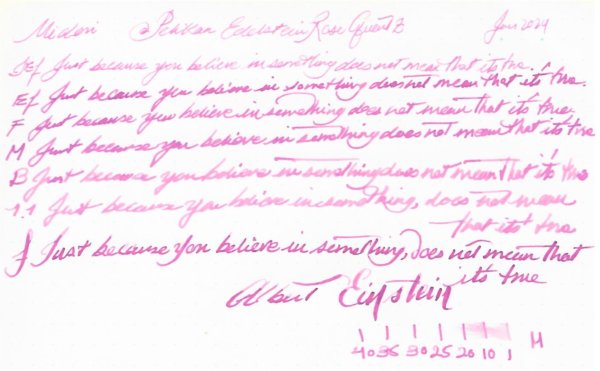
Quick Look - Pelikan Edelstein Rose Quartz (2023 Ink of the Year)
namrehsnoom posted a topic in Ink Reviews
Quick Look - Pelikan Edelstein Rose Quartz (Ink of the Year 2023) The Pelikan Edelstein Ink of the Year 2023 "Rose Quartz" is available. A full review might be coming, but I wanted to give a quick look at the ink for those of you who are wondering what it looks like. The first thing you'll notice is that the promotion pics of the ink bottle are a big lie - totally Photoshopped. In reality, the bottle looks green! Fortunately, the ink within the bottle is still the promised light rose colour. No idea why it looks green - it must have something to do with the breaking index between ink and glass (my guess). Below is a saturation picture of the ink - showing both photo and scan. The colour is best represented in the photo. The scan is definitely too purple. The ink itself is best described as a light pastel-tinted rose. The inks saturation on the page is fairly low. Not totally unusable, but for me it's borderline tolerable, especially in drier pens. The chomatography looks really delicate. Below, I show you some writing with the ink (photo), and a comparison with some other rose/pink inks I have in my collection. Overall, I like the colour - I just wish it would be a little bit more saturated. But compared to the previous two Inks of the Year, this one is definitely an improvement. -
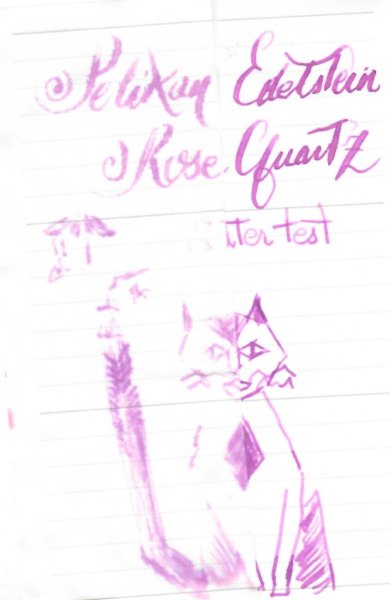
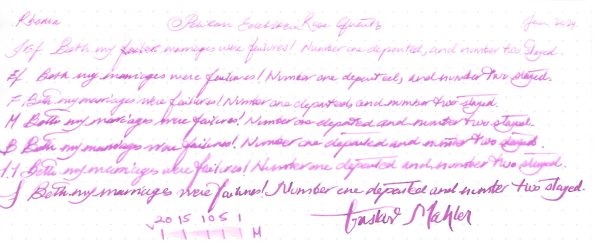
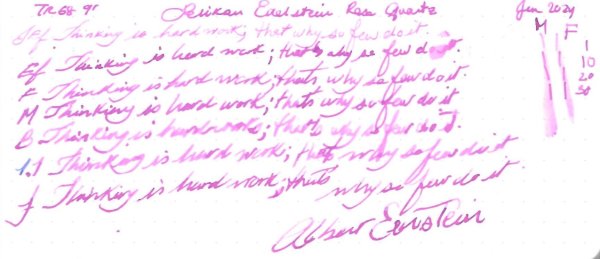
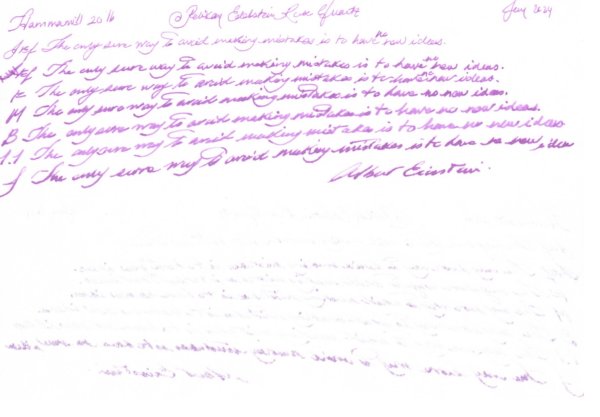
Pelikan Edelstein Rose Quartz Ink of the Year 2023 Many thanks to @Lithium466for the sample. It’s a chameleon of an ink. It has a lot of character with Ef to M nibs and gorgeous with flex, where the halo effect is accentuated. However, with Japanese Ef, B & Stub nibs it was just a plain boring pink. It doesn’t like copy paper. Ink is wet with slightly below average lubrication. You can check this excellent overview by @namrehsnoom Let's start with the chorma: Writing Samples: Quotes are at best attributed. As far as I know Mahler had only one wife. Photo: Comparison: Water test: And finally an art work, inspired by a Japanese vintage photograph and block prints: Other inks used are Platinum Carbon Black and Kuretake Shimbashi Iro · Pens used: Pilot Kakuno Ef, Lamy (EF/F/M/B, 1.1), Kanwrite with an Ahab nib. · What I liked: The halo effect and murky pink. · What I did not like: With B/ Stub nibs. Very Pale with Japanese Ef · What some might not like: The colour, paleness. · Shading: I didn’t see much. · Ghosting: Yes, on copy paper · Bleed through: Same as above. · Flow Rate: Wet · Lubrication: Below average. · Nib Dry-out: Did not notice. · Start-up: Did not notice. · Saturation: Not saturated. · Shading Potential: With flex nibs. · Sheen: Hint of halo. · Spread / Feathering / Woolly Line: Yes, on copy paper. · Nib Creep / “Crud”: Did not notice. · Staining (pen): Did not notice. · Clogging: Did not notice. · Cleaning: Should be easy. · Water resistance: Not so good. · Availability: 50 ml bottles. Please don't hesitate to share your experience, writing samples or any other comments. The more the merrier
-

Pelikan Edlestein Aquamarine from M800M and Smoky Quartz from M400M on Oxford Optik.jpeg
Mercian posted a gallery image in FPN Image Albums
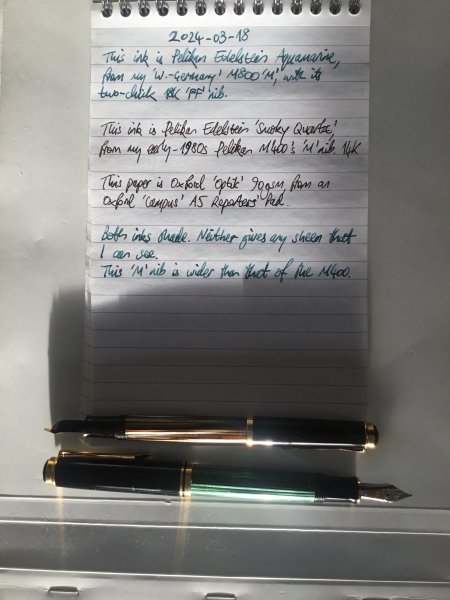
From the album: Mercian’s Miscellany
In response to a request for a picture of these inks and pens. Apologies for the very low angle of the watery English sunlight! And for my hastily-rushed scrawl too!© Mercian
- 0 B
- x
-
Edelstein Aquamarine M800M & Edelstein Smoky Quartz M400M on Oxford Optik v1.jpeg
Mercian posted a gallery image in FPN Image Albums
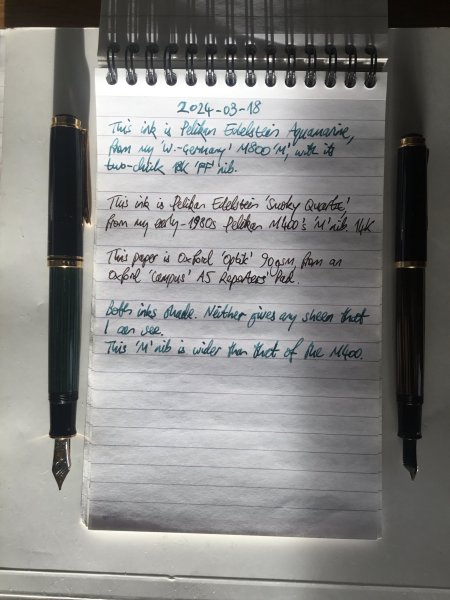
From the album: Mercian’s Miscellany
In response to a request for a picture of these inks in these pens.© Mercian
- 0 B
- x
-
-
-
-
-
-

-

-