Jump to content

Unusual vacumatic jewel?


Jacurutu

Recommended Posts

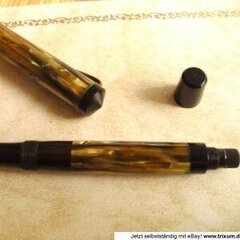
I recently acquired an emerald pearl streamlined standard second generation vacumatic. At first I thought the blindcap jewel was black, but on a closer look it’s machined from the emerald pearl celluloid, but not in the usual orientation. Is this a common thing?

I'll attach some photos, but it’s difficult to capture and it’s visible only from a shallow angle.

IMG_0243.jpeg

IMG_0244.jpeg

IMG_0247.jpeg

Link to comment
Share on other sites

  • Replies 6
  • Created
  • Last Reply

Top Posters In This Topic

  • Jacurutu

    3

  • Ron Z

    2

  • es9

    1

  • VacNut

    1

Top Posters In This Topic

Posted Images

Common.  It's often referred to as a bullseye jewel.  Instead of a separate jewel that screws into the blind cap and holds the tassie on, the jewel is part of the blind cap and the tassie is permanently fixed in place. 

spacer.png
Visit Main Street Pens
A full service pen shop providing professional, thoughtful vintage pen repair...

Please use email, not a PM for repair and pen purchase inquiries.

Link to comment
Share on other sites

13 hours ago, Ron Z said:

Common.  It's often referred to as a bullseye jewel.  Instead of a separate jewel that screws into the blind cap and holds the tassie on, the jewel is part of the blind cap and the tassie is permanently fixed in place. 

“Permanently fixed in place” that was Parker’s intent but the celluloid shrinks over time and the tassies spin in place. It is almost impossible to reattach the tassie without swaging it in place (let’s not talk about adhesives). Just curious, why did you try to remove the jewel?

Link to comment
Share on other sites

2 minutes ago, VacNut said:

“Permanently fixed in place” that was Parker’s intent but the celluloid shrinks over time and the tassies spin in place. It is almost impossible to reattach the tassie without swaging it in place (let’s not talk about adhesives). Just curious, why did you try to remove the jewel?

I wanted to polish it. Now the pen is fully restored and a joy to write with (if only the nib was more flexible! But nothing is perfect I guess)

Link to comment
Share on other sites

On 12/27/2023 at 9:50 AM, VacNut said:

“Permanently fixed in place” that was Parker’s intent but the celluloid shrinks over time and the tassies spin in place. It is almost impossible to reattach the tassie without swaging it in place (let’s not talk about adhesives). Just curious, why did you try to remove the jewel?


I’m sure others will tell me why I’m wrong, but this is a place where I’ve used epoxy. 

Link to comment
Share on other sites

13 hours ago, es9 said:

I’m sure others will tell me why I’m wrong, but this is a place where I’ve used epoxy. 


That or Hypo-cement.  Hypo-cement released more easily with heat if it needs to be removed in the future.   But Parker never intended them to come off, so why not?  The only other option is cut the jewel off on a lathe,  and drill and tap to take a standard jewel.

spacer.png
Visit Main Street Pens
A full service pen shop providing professional, thoughtful vintage pen repair...

Please use email, not a PM for repair and pen purchase inquiries.

Link to comment
Share on other sites

Create an account or sign in to comment

You need to be a member in order to leave a comment

Create an account

Sign up for a new account in our community. It's easy!

Register a new account

Sign in

Already have an account? Sign in here.

Sign In Now


  • Most Contributions

    1. amberleadavis
      amberleadavis
      43972
    2. PAKMAN
      PAKMAN
      35351
    3. inkstainedruth
      inkstainedruth
      30447
    4. Ghost Plane
      Ghost Plane
      28220
    5. Bo Bo Olson
      Bo Bo Olson
      27744
  • Upcoming Events

  • Blog Comments

    • inkstainedruth
      Thanks for the info (I only used B&W film and learned to process that).   Boy -- the stuff I learn here!  Just continually astounded at the depth and breadth of knowledge in this community! Ruth Morrisson aka inkstainedruth 
    • Ceilidh
    • Ceilidh
      >Well, I knew people who were photography majors in college, and I'm pretty sure that at least some of them were doing photos in color,<   I'm sure they were, and my answer assumes that. It just wasn't likely to have been Kodachrome.  It would have been the films I referred to as "other color films." (Kodachrome is not a generic term for color film. It is a specific film that produces transparencies, or slides, by a process not used for any other film. There are other color trans
    • inkstainedruth
      @Ceilidh -- Well, I knew people who were photography majors in college, and I'm pretty sure that at least some of them were doing photos in color, not just B&W like I learned to process.  Whether they were doing the processing of the film themselves in one of the darkrooms, or sending their stuff out to be processed commercially?  That I don't actually know, but had always assumed that they were processing their own film. Ruth Morrisson aka inkstainedruth   ETA: And of course
    • jmccarty3
      Kodachrome 25 was the most accurate film for clinical photography and was used by dermatologists everywhere. I got magnificent results with a Nikon F2 and a MicroNikkor 60 mm lens, using a manually calibrated small flash on a bracket. I wish there were a filter called "Kodachrome 25 color balance" on my iPhone camera.
  • Chatbox

    You don't have permission to chat.
    Load More
  • Files


×
×
  • Create New...