Jump to content

The Matador Thread


christof

Recommended Posts

The invention of the Matador Click


As explained in the previous post, there was almost a standstill in production (only the Matador Standard) was produced in 1949, there was severe shortage in raw materials and invention did not take place.

This radically changed in 1949. Matador applied for no less than 4 different inventions, all in the form of a so-called utility model or Gebrauchsmuster, a light specific German way of securing property rights for
inventions or adaptations to existing solutions,


In 1949, the German Patent Office (DPA) was just reopening in Munich. Many applications from the 1945–1949 "interim" period were later re-registered or merged into new West German (DBP) filings. We wiil later
discuss the other 3 inventions. But the fourth one was the invention of the Matador Click, called in German:

"Füllhalter mit gewindelosem Halterschaft und entsprechend ausgebildeter gewindeloser Schützkappe, in welche ein mit federnden Lippen versehener Metallring eingebaut ist."


Translated this means: 
“Fountain pen with a threadless barrel and a correspondingly designed threadless protective cap, into which a metal ring provided with springy lips is installed.”

The application was done on the 4th of July 1949 by Marga Löwen. It was published under number 1616350 on the 28 th of October 1950.


Here are the most important insights from these data:

  • Early Priority: the priority date of July 7, 1949, proves that the technical solution was ready immediately following the currency reform and the re-establishment of the patent system in West Germany.
  • The metal ring with spring-loaded lips: This description in the title is the most technically precise definition of the "Click." it refers to a mechanical snap-fit connection that simultaneously generates the contact pressure required for the seal.
  • Utility Model (Gebrauchsmuster) vs. Patent: Marga Loewen’s choice of a utility model was a strategic decision. It offered faster protection (registration without a lengthy examination process), which was crucial for legally securing the market launch of the "Matador Click" in 1949/50. It was not only faster, it was cheaper than a regular patent application.
    The consequence however was a much shorter runtime for the new DBGM (Gebrachsmuster). The protection would only last for a maximum of 6 years.

Matador was eager to produce and market the new product in Germany and abroad. Even in 1949, before the formal acceptance of the Gebrauchsmuster it was introduced.
 
The Dutch advert here was published in december 1949, shortly before the important Christmas sale.


image.png.80a07ed76ae95f8965587a1197f28ecd.pngimage.png.fd61a5a09eead08cfaf093497b164d07.png


The advert clearly high-lighted the unique selling points of the pen.


The pen was an immediate success in the market during the 1950's. 

There were various versions of the Matador Click. Among them:

  • the 003: stil with a steel clip and cap ring
  • the 004: the rare model (with model 1953 imprinted on the shaft)
  • the 120-124: known for flexible 14 kt. gold nibs
  • the model Click 421-424: with guilloche pattern
  • the click 620: with rolled gold cap and guilloche

These were accompanied by different types of mechanical pencils some with rolled gold cap (the Star).


Of course there was also attention for accessories in marketing / distribution:

  • dummy pens of the Click fountain pen
  • all clear demonstrrator with te number 007

image.thumb.png.0feaae4948602dfbe7282dcd3eafc5d3.png


The invention was so succesful, that it was licensed by other producers. One was Presbitero in Italy, who was (producing and/or assembling) Matador pens for decades.


The invention of the click-system was considered groundbreaking because is was not only simple to use but also prevented the ink in the pen from drying out.
Years later producers like Lamy adapted the same principle to the Modell 2000 in 1966. 

 
As stated earlier, the runtime of the Gebrauchmuster was limited to 6 years. Shortly before the expiration, Matador applied for a regular patent (3th of May 1956). It was published on the 25 th of October 1956, 
with number 951426.
 

image.png

Link to comment
Share on other sites

  • Replies 359
  • Created
  • Last Reply

Top Posters In This Topic

  • kawuska

    61

  • Azuniga

    57

  • christof

    45

  • Parcival

    34

Top Posters In This Topic

Posted Images

Parcival,

reading your post on the Corona pen, I get the impression that it predates the Matador automatique.
Beautiful reproduction of the drawings and patent.

But regarding your remarks to the Turbo Matador I must correct you.
The extension to the push button principle was first patented in England by Livsey. Subsequently it was bought or licensed by Matador in France, while in Germany they protected it with DRGM (Gebrauchmuster).

The Turbo principle was therefore not an adaptation of a piston-filler (first patented by Kovacs in 1929 for his Penkala company and licensed by Pelikan), but it was applied on top of a regular push-button filler (ink sac). 🤔

Link to comment
Share on other sites

27 minutes ago, Ben Alders said:

Parcival,

reading your post on the Corona pen, I get the impression that it predates the Matador automatique.
Beautiful reproduction of the drawings and patent.

But regarding your remarks to the Turbo Matador I must correct you.
The extension to the push button principle was first patented in England by Livsey. Subsequently it was bought or licensed by Matador in France, while in Germany they protected it with DRGM (Gebrauchmuster).

The Turbo principle was therefore not an adaptation of a piston-filler (first patented by Kovacs in 1929 for his Penkala company and licensed by Pelikan), but it was applied on top of a regular push-button filler (ink sac). 🤔

I meant that the only innovation in the field of pen filling that can be credited to the Germans is the piston filler. Almost everything else was invented in the USA. Including the Turbo Matador system - in 1921 by Corona and patented in 1925. So that's a fact! Subsequently, from whom Matador took it is not particularly important. The same system is also used by Astoria, Goldfink and Mercedes. England also has some contribution to the filling systems - TDLR Onoto and the English Swan, but this was definitely not invented in England.

Screenshot 2026-03-31 at 17-28-03 1499081998042751149-01540763 - US1540763.pdf.png

Link to comment
Share on other sites

Ben, is there any similarity between the Matador Click pens and those Soenneckens with clicking system (I refer to the 1950s 111, 222, 333 and possibly the 444 models)?  I have often seen Matador Clicks offered on the fleabay, but never bitten...


Thanks for all your in-depth input here!  Wonderful.

Link to comment
Share on other sites

2 minutes ago, Christopher Godfrey said:

Ben, is there any similarity between the Matador Click pens and those Soenneckens with clicking system (I refer to the 1950s 111, 222, 333 and possibly the 444 models)?  I have often seen Matador Clicks offered on the fleabay, but never bitten...


Thanks for all your in-depth input here!  Wonderful.


Hello Christopher,
Thank you for asking. The principles are quite different.

The Matador Click uses an unconcealed turning know for the piston filler, whereas the Soennecken 111, 222 use a click system on the turning knob, thereby preventing the unintended use of the piston-filler. It uses a regular screw on cap with windings.

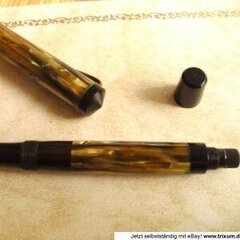
The Matador Click uses a snap-principle (producing a click sound) when closing the cap over the penholder. Therefore the Click has no winding between section and body.
image.thumb.png.48f3806f81f335e5d2bc451b199b3014.png

Link to comment
Share on other sites

19 minutes ago, Parcival said:

I meant that the only innovation in the field of pen filling that can be credited to the Germans is the piston filler. Almost everything else was invented in the USA. Including the Turbo Matador system - in 1921 by Corona and patented in 1925. So that's a fact! Subsequently, from whom Matador took it is not particularly important. England also has some contribution to the filling systems - TDLR Onoto and the English Swan.

Screenshot 2026-03-31 at 17-28-03 1499081998042751149-01540763 - US1540763.pdf.png


It is clear that many inventions / improvements are adaptations or leapfrog on existing solutions. The fountain pen industry is crowded with them, while most of them are not even known to the world because they never reached implementation.

But the ones we discuss here are most often worthwhile. I have no intention to discredit the inventions made in the US. 

So don't let us prolong this discussion. I'm looking forward to the patents from the US you refer to with respect to the Turbo. 
 

Link to comment
Share on other sites

26 minutes ago, Ben Alders said:


It is clear that many inventions / improvements are adaptations or leapfrog on existing solutions. The fountain pen industry is crowded with them, while most of them are not even known to the world because they never reached implementation.

But the ones we discuss here are most often worthwhile. I have no intention to discredit the inventions made in the US. 

So don't let us prolong this discussion. I'm looking forward to the patents from the US you refer to with respect to the Turbo. 
 

The patent is in the name of Corona since 1921 and was registered in 1925 in the USA - I have attached the photo to my above post - the system is 100% identical to the one used by Matador for the Turbo model, as well as by other German pen brands, including Mercedes, which was founded by a former Matador employee. It is possible that some Englishman stole the idea, registered a patent in England and sold it to Matador, which does not matter who actually invented it and introduced it into the production of pens, which is the American company Corona. You can read more about Corona and the patent for this filling mechanism here: https://leadheadpencils.blogspot.com/2025/08/the-corona-pen-company.html

Link to comment
Share on other sites

And as I said, the Mercedes pen company was founded by a former Matador employee, so it makes perfect sense that they would produce pens similar to the Matador Turbo model. Of course, these are very rare pens and very hard to find.

2.jpg

5.jpg

4.jpg

6.jpg

DSC00582.JPG

DSC00583.JPG

Link to comment
Share on other sites

Lovely pens, those Mercedes, too: thanks.


Re this: <The Matador Click uses a snap-principle (producing a click sound) when closing the cap over the penholder. Therefore the Click has no winding between section and body>  Thank you: I had misunderstood completely -- now I get it.


Dank U wel -- op nieuw.

Link to comment
Share on other sites

21 hours ago, Parcival said:

And as I said, the Mercedes pen company was founded by a former Matador employee, so it makes perfect sense that they would produce pens similar to the Matador Turbo model. Of course, these are very rare pens and very hard to find.

2.jpg

5.jpg

4.jpg

6.jpg

DSC00582.JPG

DSC00583.JPG


Thank you Parcival,

beautiful contribution. I was awear that a former employee of Matador started Mercedes. 
I too have a Mercedes pen, black quilloche, no imprint on the cap or body, but Mercedes imprinted on the cap top. It also has a Matador clip (did Mercedes buy clips from Matador at some time ?), but with a Le Tigre nib. 
I assumed it was a marriage, but hey in the early days of a start-up anything was possible.

The pen is not in great shape I have to restore it (luckily I know how to do that).

image.thumb.png.0e2e43a81a4c475dfdaafbabce15b478.png


Link to comment
Share on other sites

On 3/31/2026 at 5:42 PM, Parcival said:

The patent is in the name of Corona since 1921 and was registered in 1925 in the USA - I have attached the photo to my above post - the system is 100% identical to the one used by Matador for the Turbo model, as well as by other German pen brands, including Mercedes, which was founded by a former Matador employee. It is possible that some Englishman stole the idea, registered a patent in England and sold it to Matador, which does not matter who actually invented it and introduced it into the production of pens, which is the American company Corona. You can read more about Corona and the patent for this filling mechanism here: https://leadheadpencils.blogspot.com/2025/08/the-corona-pen-company.html


As I explained to Parcival in an email, after studying the patents and the blogpost Parcival mentioned, this is definitely something that should be added to the story of the Turbo Matador. 
The second patent of Corona shows a high resemblance to the patent application of Livsey in England and therefore the patent filed by Siebert and Löwen in France.

It's possible that it came to Livsey through an obscure way after the fire at the Corona premises or Livsey has just studies relevant patents from foreign counties (in this case the US) and filed did an application with some alterations in England.

Well done Parcival for unraveling this part of the story.

Link to comment
Share on other sites

On 3/31/2026 at 5:42 PM, Parcival said:

The patent is in the name of Corona since 1921 and was registered in 1925 in the USA - I have attached the photo to my above post - the system is 100% identical to the one used by Matador for the Turbo model, as well as by other German pen brands, including Mercedes, which was founded by a former Matador employee. It is possible that some Englishman stole the idea, registered a patent in England and sold it to Matador, which does not matter who actually invented it and introduced it into the production of pens, which is the American company Corona. You can read more about Corona and the patent for this filling mechanism here: https://leadheadpencils.blogspot.com/2025/08/the-corona-pen-company.html


As I explained to Parcival in an email, after studying the patents and the blogpost Parcival mentioned, this is definitely something that should be added to the story of the Turbo Matador. I will do so.
The second patent of Corona shows a high resemblance to the patent application of Livsey in England and therefore the patent filed by Siebert and Löwen in France.

It's possible that it came to Livsey through an obscure way after the fire at the Corona premises or Livsey has just studied relevant patents from foreign counties (in this case the US) and filed an application with some alterations in England.

Well done Parcival for unraveling this part of the story.

Link to comment
Share on other sites

Matador betting on two horses in 1949 ? - looking at the ballpoint


In 1949 Matador did not only look at launching the new Matador Click.

As everyone in the business they saw the growing numbers of ballpoints. Especially because of the production and trade regulation, countries in Western Europe (not only Germany) saw an influx of British (for instance Reynolds) and also US made ballpoints.


The quality and reliability of the early generation of ballpoints was often to be questioned. 


As we have seen earlier, Matador tried to make their one stance in this domain, in order to become competitive.


In 1950 Marga Löwen also filed an application for a Gebrauchsmuster in this field.
It was filed on the 24 th of June 1950 and published on the 29th of November in 1950 under no. 1617912.

Matador signalled the weak points of existing ballpoints. Difficult to manufacture, a small ball in the bearing of the tip required high precision. 
The ink transport had to be unhampered at high writing speed, and many bearings started to leak because of wear before the filling was empty and/or under  influence of environmental conditions (temperature).


Therefore Matador came up with the following invention:
"Writing tip of a ballpoint pen with a welded, spherical slotted or drilled tip"


In German: "Schreibspitze eines Kugelfüllers mit angeschweißtem, kugelförmiger, geschlitzten oder gebohrten Iridium-Korn".


We will not dive into the specifics, because not all declared inventions (Gebrauchsmuster) made it to successful products. In this case it didn't -as far as we know- made it to production.


The difficulities in coming to reliable ballpoint tips were overcome in the early 1950's. Therefore the Matador invention was not viable und couldn't compete in price with the mass-production of ballpoint fillings.


In the ballpoints Matador produced -and they did- there were regular ballpoint fillings used. 
The first is a Matador Star with rolled gold cap from the Click line (to accompany the Fountain pen and possibly the mechanical pencil)

The second is a silver guilloche ballpoint (imprint M on the cap screw) with silver markt 925. This almost resembles the pencil with a similar model from the late 1930's (included in the well known catalog).


image.thumb.png.3e8132ffce5f9a8aa5d5e66e31e7bc52.png


This was not all. They also tried to export their ballpoints. The following shop display with 8 Matador Dokumentals (the fillings also carry the name Dokumental) were aimed at the French market. This also clears the question whether Matador has tried to re-enter the French market after the war. 


image.thumb.png.cf9951cff428e690d67fcf58a3449591.png


Link to comment
Share on other sites

On 4/1/2026 at 11:11 PM, Ben Alders said:

Therefore Matador came up with the following invention:
"Writing tip of a ballpoint pen with a welded, spherical slotted or drilled tip"


In German: "Schreibspitze eines Kugelfüllers mit angeschweißtem, kugelförmiger, geschlitzten oder gebohrten Iridium-Korn".


We will not dive into the specifics, because not all declared inventions (Gebrauchsmuster) made it to successful products. In this case it didn't -as far as we know- made it to production.


I assumed that this invention never made it to production. 

Going through old documentation on the Click product-line I discovered there was a fountain pen -the Series 130- called Carat, that had a spherical tip . 


image.png.224b6b6a64f3843542d9d83ac64bdbd3.png


It was part of the Click-line and shared the same outward appearance with the other Click-pens. Property rights were guarded by the Gebrauchsmuster of 1950.


But unlike the regular Click fountain pen, this pen was not well accepted.


Link to comment
Share on other sites

On 4/1/2026 at 11:11 PM, Ben Alders said:

Therefore Matador came up with the following invention:
"Writing tip of a ballpoint pen with a welded, spherical slotted or drilled tip"


In German: "Schreibspitze eines Kugelfüllers mit angeschweißtem, kugelförmiger, geschlitzten oder gebohrten Iridium-Korn".


We will not dive into the specifics, because not all declared inventions (Gebrauchsmuster) made it to successful products. In this case it didn't -as far as we know- made it to production.


I assumed that this invention never made it to production. 

Going through old documentation on the Click product-line I discovered there was a fountain pen -the Series 130- called Carat, that had a spherical tip . 


image.png.224b6b6a64f3843542d9d83ac64bdbd3.png


It was part of the Click-line and shared the same outward appearance with the other Click-pens. Property rights were guarded by the Gebrauchsmuster of 1950.


But unlike the regular Click fountain pen, this pen was nog well accepted.


Link to comment
Share on other sites

Development of the Matador Click - part two


As described in the first post on this subject, the Matador Click was launched in 1949. Using an application for a DBGM (Gebrauchsmuster), describing the key features of the pen, it could be launched quickly. Production and marketing were arranged in order to have the product in the shop by December.


The application for the Click pen focussed on the cap, to be closed without the use of windings.


This does not mean there were not other key features to the invention of the Matador Click.

Matador came up with significant alterations to the piston-filling procedure.


This was already developed and described by July 1947. Unfortunately the patent office was still closed and the earlies opportunity to file the application was in 1950.

On the 5th of June it was filed and published on the 7th of October 1950 with the number 1615288.


The titel was: "Vorschub-Gewindespindel mit Mutter für Füllhalter mit Saugkolben" or in English "Feed screw spindle with nut for fountain pens with psiton suction"


On face-value it is hard to tell what the improvement is, but it is clarified in the application.

The available piston sunction systems are being discussed, including the solutions to prevent unintended use of the piston feed. It was custom to conceal the turning

knob with a blind cap or secured by means of a locking thread or by an automatically releasable bayonet closure (rotary longitudinal closure).

Furthermore, threaded spindles are known in which a limitation of the stroke of the push button is achieved in that either the thread of the spindle is reinforced in a

step-like manner toward the rear end, or a disc with a stop is inserted into the threaded spindle, in order to prevent a stroke exceeding a predetermined extent.


Apart from limitations in daily practical use, all these constructions are complicated and expensive to manufacture.


Therefore the object of the innovation was to provide a solution (amongst other a threaded spindle) which made, a special locking device no longer required,

and unintentional actuation of the feed spindle is prevented.


Together with the innovation on the cap (snap mechanism), this made the entire concept of the Matador Click.
 

By 1951 all the series of the Matador Click were available (100, 130, 120, 200, 400 and 600).


image.thumb.png.ff6d9019cdfa4ca150caf28af8abd839.png


The experience with producing and practical use resulted in a revision of the cap and its closure system in 1953.

This re-engineered pen was called Modell 1953. The re-engineered cap was implemented in all existing series. Outward the appearance hardly changed,

apart from slight changes to the with of the cap ring.


The very core of the improvement is described as:

there are no longer separate spring lips inserted into the cap.
Instead there are: segments cut from the sleeve; multiple, evenly distributed spring segments.


More spring segments meant:

  • better distribution of force
  • less point loading
  • smoother click action

The overhaul of 1953 was of course also implemented / described in the patent that was filed in 1956 


The main problems with the engineering in the original Gebrauchsmuster were identified as:

  • Wear and fatigue of the spring elements
  • Manufacturing tolerances → poor fit
  • Unreliable sealing
  • Excessive force required to close
  • Sensitivity to deformation of components

The innovation on the cap resulted in:

  • a more robust system
  • extends service life
  • makes production more consistent with less fear of tolerance issues
  • and even refines the user experience (less pressure, softer click)

This a clear demonstration of ongoing optimisation and continuous engineering during implementation.


Link to comment
Share on other sites

On 4/1/2026 at 11:01 PM, Ben Alders said:


As I explained to Parcival in an email, after studying the patents and the blogpost Parcival mentioned, this is definitely something that should be added to the story of the Turbo Matador. 
The second patent of Corona shows a high resemblance to the patent application of Livsey in England and therefore the patent filed by Siebert and Löwen in France.

It's possible that it came to Livsey through an obscure way after the fire at the Corona premises or Livsey has just studies relevant patents from foreign counties (in this case the US) and filed did an application with some alterations in England.

Well done Parcival for unraveling this part of the story.

Livsey has filed patents for all sorts of filling systems, probably with some very minor modifications. You can see the patents here, in the Lang - Curzon - Summit section. https://www.fountainpen.it/Brevetti#Lang_-_Curzon_-_Summit

Link to comment
Share on other sites

🙏

10 hours ago, Parcival said:

Here's another rare one. A #72 Presto Matador pencil. I'm not sure if the clip is original.

1.jpg

3.jpg

6.jpg

11.jpg


Beautiful contribution Parcival.
Keep it going. There is so much still to be discovered about Matador. 👍

Link to comment
Share on other sites

Create an account or sign in to comment

You need to be a member in order to leave a comment

Create an account

Sign up for a new account in our community. It's easy!

Register a new account

Sign in

Already have an account? Sign in here.

Sign In Now


  • Most Contributions

    1. amberleadavis
      amberleadavis
      43972
    2. PAKMAN
      PAKMAN
      35597
    3. inkstainedruth
      inkstainedruth
      31475
    4. Ghost Plane
      Ghost Plane
      28220
    5. Bo Bo Olson
      Bo Bo Olson
      27747
  • Upcoming Events

  • Blog Comments

    • Misfit
      Oh to have that translucent pink Prera! @migo984 has the Oeste series named after birds. There is a pink one, so I’m assuming Este is the same pen as Oeste.    Excellent haul. I have some Uniball One P pens. Do you like to use them? I like them enough, but don’t use them too much yet.    Do you or your wife use Travelers Notebooks? Seeing you were at Kyoto, I thought of them as there is a store there. 
    • A Smug Dill
      It's not nearly so thick that I feel it comprises my fine-grained control, the way I feel about the Cross Peerless 125 or some of the high-end TACCIA Urushi pens with cigar-shaped bodies and 18K gold nibs. Why would you expect me or anyone else to make explicit mention of it, if it isn't a travesty or such a disappointment that an owner of the pen would want to bring it to the attention of his/her peers so that they could “learn from his/her mistake” without paying the price?
    • szlovak
      Why nobody says that the section of Tuzu besides triangular shape is quite thick. Honestly it’s the thickest one among my many pens, other thick I own is Noodler’s Ahab. Because of that fat section I feel more control and my handwriting has improved. I can’t say it’s comfortable or uncomfortable, but needs a moment to accommodate. It’s funny because my school years are long over. Besides this pen had horrible F nib. Tines were perfectly aligned but it was so scratchy on left stroke that collecte
    • stylographile
      Awesome! I'm in the process of preparing my bag for our pen meet this weekend and I literally have none of the items you mention!! I'll see if I can find one or two!
    • inkstainedruth
      @asota -- Yeah, I think I have a few rolls in my fridge that are probably 20-30 years old at this point (don't remember now if they are B&W or color film) and don't even really know where to get the film processed, once the drive through kiosks went away....  I just did a quick Google search and (in theory) there was a place the next town over from me -- but got a 404 error message when I tried to click on the link....  Ruth Morrisson aka inkstainedruth 
  • Chatbox

    You don't have permission to chat.
    Load More
  • Files


×
×
  • Create New...