Jump to content

Charles Dickens


Bob Cratchet

Recommended Posts

  • Replies 15
  • Created
  • Last Reply

Top Posters In This Topic

  • encremental

    3

  • Bob Cratchet

    3

  • QM2

    2

  • JakobS

    2


here's a quote from a conservation of some of his papers, it would appear that he used different inks and different papers. Probably best way to figure out would be to see what inks were easily available in the UK at that time- maybe Diamine?


but it is also witness to a gradual change from iron gall ink to blue ink and from cream to blue writing paper in a time of developments in paper production and artificial pigments.
Edited by Titivillus
Link to comment
Share on other sites

Dickens would most probably have used Stephens ink. The company pretty much had the ink business in Britain sewn up for the whole of the 19th century, and I was even using it as a child in the UK in the 60s before the brand weakened - and can still remember the beautiful violet smell of their 'Radiant Blue'!


As for Diamine, well - call me an old cynic, but to me their 'since 1864' shtick has a whiff of Moleskine - style history about it. Tens of thousands of bits of Victorian writing ephemera, - bottles, print ads etc. etc. survive over here, and I've been interested in pens, inks and stationery all my life and have yet to see anything with the name Diamine on it. Always happy to be corrected though, and there's no doubting that today's Diamine is definitely a Prince among inks!


John

Link to comment
Share on other sites

Would the "Writing Fluid" manufactured by P & J Arnold of London be a good candidate? I have read that it was so widely available and so inexpensive here in the USA that it nearly drove all of our domestic ink manufacturers out of business. Was it as popular in the UK in the 19th Century?


Paddler

Can a calculator understand a cash register?

Link to comment
Share on other sites

Does anybody know what ink, Brand and colour ink that the writter of all those wonderful novels used?


When mine arrives next week, I will ask him and let you know : )


http://www.montblanc.de/media/edition/dickens_H_01.jpg

[photo taken from montblanc.de]


Edited by QM2
Link to comment
Share on other sites

As for Diamine, well - call me an old cynic, but to me their 'since 1864' shtick has a whiff of Moleskine - style history about it. Tens of thousands of bits of Victorian writing ephemera, - bottles, print ads etc. etc. survive over here, and I've been interested in pens, inks and stationery all my life and have yet to see anything with the name Diamine on it. Always happy to be corrected though, and there's no doubting that today's Diamine is definitely a Prince among inks!


Based on what I have read, Diamine's name has been changed from the original:


Now based in Liverpool, the history of Diamine dates back to 1864 when the company was founded by T Webster and Co. in London. The business moved to Liverpool in 1925 and T Webster and Co. changed its name to Diamine in 1964. However, changes of company ownership had all but killed the brand until its recent resurrection.


[taken from the WritingDesk]


Link to comment
Share on other sites

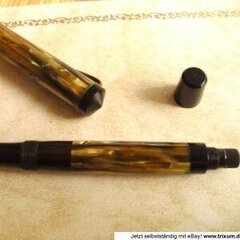
If you want a practically exact match with the resin, I'd recommend Diamine Emerald :)

If you make people think they're thinking, they'll love you; But if you really make them think, they'll hate you.


Don Marquis

US humorist (1878 - 1937)

Link to comment
Share on other sites

As for Diamine, well - call me an old cynic, but to me their 'since 1864' shtick has a whiff of Moleskine - style history about it. Tens of thousands of bits of Victorian writing ephemera, - bottles, print ads etc. etc. survive over here, and I've been interested in pens, inks and stationery all my life and have yet to see anything with the name Diamine on it. Always happy to be corrected though, and there's no doubting that today's Diamine is definitely a Prince among inks!


Based on what I have read, Diamine's name has been changed from the original:


Now based in Liverpool, the history of Diamine dates back to 1864 when the company was founded by T Webster and Co. in London. The business moved to Liverpool in 1925 and T Webster and Co. changed its name to Diamine in 1964. However, changes of company ownership had all but killed the brand until its recent resurrection.


[taken from the WritingDesk]


Exactly what I was thinking too. So T Webster and Co. would be the name to look for if you are looking for Diamine ink in the 19th century.


This is an interesting question, and I am sure it will take a little detective work to figure out, if I have time I may do a little research to see if I can come up with anything as Dickens is one of my favorite writers.


FP Ink Orphanage-Is an ink not working with your pens, not the color you're looking for, is never to see the light of day again?!! If this is you, and the ink is in fine condition otherwise, don't dump it down the sink, or throw it into the trash, send it to me (payment can be negotiated), and I will provide it a nice safe home with love, and a decent meal of paper! Please PM me!<span style='color: #000080'>For Sale:</span> TBA

Link to comment
Share on other sites

As for Diamine, well - call me an old cynic, but to me their 'since 1864' shtick has a whiff of Moleskine - style history about it. Tens of thousands of bits of Victorian writing ephemera, - bottles, print ads etc. etc. survive over here, and I've been interested in pens, inks and stationery all my life and have yet to see anything with the name Diamine on it. Always happy to be corrected though, and there's no doubting that today's Diamine is definitely a Prince among inks!


Based on what I have read, Diamine's name has been changed from the original:


Now based in Liverpool, the history of Diamine dates back to 1864 when the company was founded by T Webster and Co. in London. The business moved to Liverpool in 1925 and T Webster and Co. changed its name to Diamine in 1964. However, changes of company ownership had all but killed the brand until its recent resurrection.


[taken from the WritingDesk]


Exactly what I was thinking too. So T Webster and Co. would be the name to look for if you are looking for Diamine ink in the 19th century.


This is an interesting question, and I am sure it will take a little detective work to figure out, if I have time I may do a little research to see if I can come up with anything as Dickens is one of my favorite writers.

I am pleased that my little mind teaser has a fair response, Dickens is also one of my favourite writers, and has been since I was a child,

My favourite being Christmas Carol, thus the non deplume of Bob Cratchet on the forum,


Living in an age gone bye

Link to comment
Share on other sites

Dickens would most probably have used Stephens ink. The company pretty much had the ink business in Britain sewn up for the whole of the 19th century, and I was even using it as a child in the UK in the 60s before the brand weakened - and can still remember the beautiful violet smell of their 'Radiant Blue'!


As for Diamine, well - call me an old cynic, but to me their 'since 1864' shtick has a whiff of Moleskine - style history about it. Tens of thousands of bits of Victorian writing ephemera, - bottles, print ads etc. etc. survive over here, and I've been interested in pens, inks and stationery all my life and have yet to see anything with the name Diamine on it. Always happy to be corrected though, and there's no doubting that today's Diamine is definitely a Prince among inks!


John

Since you have studied such maters, how does T Webster and Co. in London. Sit with you as a possible candidate for Dickens ink of choice?

As suggested below.

Bob


Living in an age gone bye

Link to comment
Share on other sites

I saw a short feature on TV, a few months (or more) ago, about the history of the cheque. Some of Charles Dickens's cheques have survived, and I'm pretty sure that one of them was written out in blue ink. I'm pretty sure about it, because I was so surprised to see blue ink being used on C19th documents. All other (non-Dickens) documents that I've seen from that side of the first world war have been written in a black ink that has usually deteriorated into a brownish-greyish shade.


Link to comment
Share on other sites

Bob, I'm afraid I still think the timescale is against Websters / Diamine. By 1864, Dickens' writing career was almost over, wasn't it? Wikipedia says there was only Our Mutual Friend and The Mystery of Edwin Drood to go. Similarly, aniline dyes (which give the colour to modern inks) were only invented in 1856, and I don't know how long it took for them to make their way to ink - I am sure that a member of the Writing Equipment Society (several FPN members) could put you right, it's meat and drink to them!


I've can't remember seeing any Webster's ephemera, but then it's not a name that sticks in the mind like Diamine - I certainly don't think they can have been in the same league as Stephens, Herbin or Pelikan who have made branded ink for a very long time.


There is a small museum in Finchley which I must get round to visiting. Someone on here did, - I remember a post about it. In fact, I'm almost sure the Writing Equipment Society used to have meetings there.


The brand still exists, and there is some Indian Ink, but although the logo is similar to that on the ink I remember, I think the name has been sold on a few times. It's a bit sad, really :crybaby:


John

Link to comment
Share on other sites

The documents that I was able to find online that Dickens wrote are mostly written in a rather nice blue ink, so at some point in his life he was using a blue ink, it seemed more blue than blue black. Still have no idea what brand of ink it could be. Dickens actually wrote Little Dorrit, A Tale of Two Cities, Great Expectations, Our Mutual Friend, and the incomplete Mystery of Edwin Drood after 1856 so a number of his works, many classics could have been written with aniline dyes if they were introduced into inks at that time. But again, he could of been writing with a number of inks, some not even british since he did travel in Europe a lot as well.

FP Ink Orphanage-Is an ink not working with your pens, not the color you're looking for, is never to see the light of day again?!! If this is you, and the ink is in fine condition otherwise, don't dump it down the sink, or throw it into the trash, send it to me (payment can be negotiated), and I will provide it a nice safe home with love, and a decent meal of paper! Please PM me!<span style='color: #000080'>For Sale:</span> TBA

Link to comment
Share on other sites

Here in London, the British Library has a fantastic permanent free exhibition of autograph manuscripts by British and other authors, including Dickens (also interesting stuff like a letter from Lenin applying for a library ticket!). It's well worth seeing, and yet not somewhere a visitor might put at the top of their list. I've been a few times, but have never gone while wearing my FPN head. I have inspected Jane Austen's writing slope (mine is nicer, I think :happyberet: ), but never checked out her ink. Next time I go, I shall be looking at everything in a new light and trying to spot early signs of brighter colours. Naturally, I will report back.


Mr Cratchet - if you haven't done so, I think you should get yourself down to the Charles Dickens Museum in Doughty Street. I see that they have what they call 'handling sessions' and visitors can actually have a go at writing with Dickens' own pen!! :yikes: You can also wander round the house alone and sit and have a glass of wine in his library. Gosh and golly. While you're at it, I'm sure that there would be people there who could give you a definitive answer about his inks.


John

Link to comment
Share on other sites

Create an account or sign in to comment

You need to be a member in order to leave a comment

Create an account

Sign up for a new account in our community. It's easy!

Register a new account

Sign in

Already have an account? Sign in here.

Sign In Now


×
×
  • Create New...