Jump to content

My handwriting and my signature


DerMann

Recommended Posts

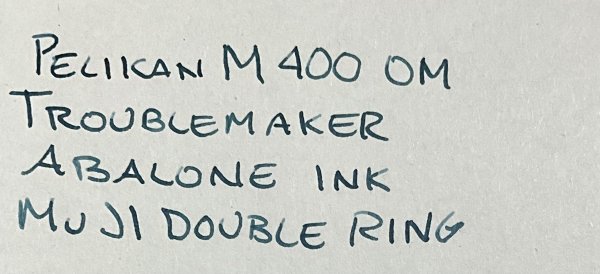
I've never liked my handwriting, neither in cursive nor print. My print looks particularly juvenile and my cursive looks jagged and rushed.


The sample isn't going to express my handwriting 100%, as when I speed up I don't lift the pen (while printing) and things start looking worse. I'll see if I can find any of my notes from school to show what I mean.


post-13280-1215731801_thumb.jpg


I am in the process of trying to switch over to cursive, and I can write at a pretty good speed without losing readability. What I would really like to do is learn standard Spencerian, i.e. the business hand, not the ornamental hand. Most of my capital letters are already taken from Spencerian, and I can do a bit of ornamental hand.


As for my signature, I have two versions. The first is the quicker one done with any style of pen (in this case, Parker Vacumatic). The second is one I do when I sign a letter or important document (when I have more time), and it is done with a flexible nib (either my Waterman or an off set copperplate nib). Usually there is a bit of variation between signatures, but that's how it looks most of the time. Also, is there a way to do more flourishes on a "J," as letters like "F" and "G" are fun to write and are very easy to add loads of flourishes to, but not so much to "J."


One question about Spencerian, though. It seems that most of the exemplars I've seen show line variation on the down stroke going vertically. It may just be the way I'm holding the pen, but it is literally impossible to create the proper thickness even when flexing. Does one hold a pen differently when writing in Spencerian?


Essentially, I'd like to improve my daily printing and cursive by making them less "bleh" (I believe that's the technical term...).

Collection:

Waterman: 52V BCHR, 55 BCHR

Sheaffer: Peacock Blue Snorkel Sentinel, Black Snorkel Admiral, Persian Blue Touchdown Statesman

Parker: Silver 1946 Vacumatic, 1929 Lacquer red Duofold Senior, Burgundy "51" Special

Misc: Reform 1745, Hero 616, two pen holders and about 20 nibs.

Link to comment
Share on other sites

  • Replies 9
  • Created
  • Last Reply

Top Posters In This Topic

  • DerMann

    3

  • Renzhe

    1

  • Hans-Peter Ording

    1

  • calliej

    1

Top Posters In This Topic

Posted Images

You may find that you can improve your pen control if you change the grip you are using. As someone that suffers from writers cramp/fatigue due to arthritus I have been experimenting with different ways to hold the pen that eases tension and supports the pen without any tightness around the fingers.


I actually found that if you hold the pen between your index and middle finger (so that you index finger is ontop of the pen) and support it with the thumb not only do I not suffer the usual fatigue but I have much more control over the movement of the pen and therefore neater more consistent letter forms. It does take a bit of practise but once you get going its quick too.....


I dont use it all the time, but I find it particularly good with italic nibs to get the full benfit of the nib.

So I'm opinionated - get over it!!.......No, really - get over it!!

Hmmmm I was going to put up a WANTS list - but that's too long as well ......


http://img525.imageshack.us/img525/606/letterji9.png

Link to comment
Share on other sites

  • 2 weeks later...
Does one hold a pen differently when writing in Spencerian?

Essentially, I'd like to improve my daily printing and cursive by making them less "bleh" (I believe that's the technical term...).


I believe one either needs to use an oblique nib holder or turn ones hand so that the tines are parallel with the slope of the letters. Also, I think it's a good idea to use the grip recommended by the book you're following. They probably know what you're doing.


Your handwriting has a pretty consistent slope. I find your ascenders and descenders a bit excessive. Have you ever tried writing with a broad-tipped writing instrument (such as a felt-tipped marker)? I suspect it might help you.

Renzhe

Link to comment
Share on other sites

I think the irregular slant of your printing and the irregular shaped loops of your cursive suggest the assumption that you are holding the pen too tight. But I may be wrong.


Regards

Hans-Peter

Link to comment
Share on other sites

I would be very interested to hear/read Kate Gladstone's advice to this writer...it is o different from mine that I wouldn't know what to advise, although a lighter grip might well be a good starting point.


Much improvement can generally be attained by slowing-down and daily practice.

If you make people think they're thinking, they'll love you; But if you really make them think, they'll hate you.


Don Marquis

US humorist (1878 - 1937)

Link to comment
Share on other sites

Does one hold a pen differently when writing in Spencerian?

Essentially, I'd like to improve my daily printing and cursive by making them less "bleh" (I believe that's the technical term...).


I believe one either needs to use an oblique nib holder or turn ones hand so that the tines are parallel with the slope of the letters. Also, I think it's a good idea to use the grip recommended by the book you're following. They probably know what you're doing.


Your handwriting has a pretty consistent slope. I find your ascenders and descenders a bit excessive. Have you ever tried writing with a broad-tipped writing instrument (such as a felt-tipped marker)? I suspect it might help you.


I have an oblique nib holder for my dip pen and it is a bit better, but it dumps ink on the down stroke, so I don't use it too often. It might be worth it to spend $3 and buy a proper one.


When I have a lot of space to write, my descenders go quite a distance, just a habit I suppose (it's fun for me).


Funny that you mention broad tips. I am currently house sitting for a friend, and I found some sort of Sheaffer cartridge pen on the desk where I put my laptop. Surprisingly it was a broad point. It does seem to make my cursive more distinctive. Never quite saw what the big deal was with broad nibs, but I might see about having one of my pens re-ground as a broad.


I think the irregular slant of your printing and the irregular shaped loops of your cursive suggest the assumption that you are holding the pen too tight. But I may be wrong.


Regards

Hans-Peter


You may be right. Of course ballpoints are to blame :embarrassed_smile:


Ever since I began writing with fountain pens, I've been trying to loosen up and lessen my grip. Thanks for the input.


I would be very interested to hear/read Kate Gladstone's advice to this writer...it is o different from mine that I wouldn't know what to advise, although a lighter grip might well be a good starting point.


Much improvement can generally be attained by slowing-down and daily practice.

One thing that I've noticed when I slow down is that my lines become jagged and, well, not straight - especially on ascenders, but some with the descenders as well. I should have mentioned that my hands shake quite a bit, even at a resting position. I've tried eliminating caffeine and sugar, but they just keep on shaking. That is the main reason why I try and write as quickly as possible.

Collection:

Waterman: 52V BCHR, 55 BCHR

Sheaffer: Peacock Blue Snorkel Sentinel, Black Snorkel Admiral, Persian Blue Touchdown Statesman

Parker: Silver 1946 Vacumatic, 1929 Lacquer red Duofold Senior, Burgundy "51" Special

Misc: Reform 1745, Hero 616, two pen holders and about 20 nibs.

Link to comment
Share on other sites

I have to ask a question, apologize me if it is stupid :"did you ever broke your wrist or your elbow?" I know a man who has broken his elbow and who writes like you. I think you should focus for a medium broad oblique or a broad cursive italic nibbed fountain pen, also you don't need to grip or hold your fountain pen as if it was a hammer. Ball points give bad habits that is why when you use a fountain pen, forget that you are using a ball point and relax your grip.

What else can I add? To hold the pen correctly is something important and also to use an ergonomic pen is also another thing that matters.

Pens are like watches , once you start a collection, you can hardly go back. And pens like all fine luxury items do improve with time


Link to comment
Share on other sites

You need to do this right away:


Go to pendemonium.com, and order "At Home with Artistic Penwork: Book One, Business Writing" by Stephen A. Ziller. And then you follow the directions. It isn't hard; it just takes patience and a willingness to improve. This book will help you. You will not be sorry.


Good luck,

Don

Link to comment
Share on other sites

I have to ask a question, apologize me if it is stupid :"did you ever broke your wrist or your elbow?" I know a man who has broken his elbow and who writes like you. I think you should focus for a medium broad oblique or a broad cursive italic nibbed fountain pen, also you don't need to grip or hold your fountain pen as if it was a hammer. Ball points give bad habits that is why when you use a fountain pen, forget that you are using a ball point and relax your grip.

What else can I add? To hold the pen correctly is something important and also to use an ergonomic pen is also another thing that matters.


Never broken a bone in my body, luckily. I will continue to try and relax my grip.


You need to do this right away:


Go to pendemonium.com, and order "At Home with Artistic Penwork: Book One, Business Writing" by Stephen A. Ziller. And then you follow the directions. It isn't hard; it just takes patience and a willingness to improve. This book will help you. You will not be sorry.


Good luck,

Don


Included it with my order this week, quite a deal at $6.


Thanks.

Collection:

Waterman: 52V BCHR, 55 BCHR

Sheaffer: Peacock Blue Snorkel Sentinel, Black Snorkel Admiral, Persian Blue Touchdown Statesman

Parker: Silver 1946 Vacumatic, 1929 Lacquer red Duofold Senior, Burgundy "51" Special

Misc: Reform 1745, Hero 616, two pen holders and about 20 nibs.

Link to comment
Share on other sites

  • 1 month later...
I would be very interested to hear/read Kate Gladstone's advice to this writer...it is o different from mine that I wouldn't know what to advise, although a lighter grip might well be a good starting point.


Much improvement can generally be attained by slowing-down and daily practice.


Since this writer has more than one style, to begin with I'd advise him/her to pick the most easily controlled one (the first of the several, I judge) and to somewhat modify it.

How to modify it:


--- Keep the capitals as sober as possible (no twirly-whirliness in the top of that "T", for instance). Similarly, whenever a letter has a printed and a cursive shape that "disagree" significantly (capital letters and lower-case bf/k/r/s/z), replace the cursive version of the letter with something more like the printed version: but of course at the same slant as the letters around it (and possibly joining into/out of the letters around it where this does not require difficult curves within the joins to make it possible: see the next tip).


--- Whenever two letters join (or try to join) by a curved rather than a straight motion, instead of permitting that curved join LIFT THE PEN briefly from the paper WITHOUT slowing down during the lift. (If possible, speed up during the lift). This will permit and encourage a time-saving, less accident-prone faster movement between letters that otherwise would require a slow, carefully wrought curving join as the motion between them.


Given the state of the best of your several handwritings at present (the first one in the sample), I believe that just working the above two tips into that handwriting will take you very far -- and will even enable you to go quite a bit farther on your own.


I hope you don't too much mind having had to wait so long for this! This half-year has seen, for me, many personal difficulties including most recently (a month ago) the death of my father (an old Esterbrook aficionado whom I had reintroduced to the fountain pen -- he took well to calligraphic nibs -- as part of helping him with his own handwriting. He had had strict Palmer training in boyhood, but for him it had never worked anywhere nearly as well as advertised, no matter how hard he worked at it: something the teachers blamed entirely on him.)

<span style='font-size: 18px;'><em class='bbc'><strong class='bbc'><span style='font-family: Palatino Linotype'> <br><b><i><a href="http://pen.guide" target="_blank">Check out THE PEN THAT TEACHES HANDWRITING </a></span></strong></em></span></a><br><br><br><a href="

target="_blank">Video of the SuperStyluScripTipTastic Pen in action
Link to comment
Share on other sites

Create an account or sign in to comment

You need to be a member in order to leave a comment

Create an account

Sign up for a new account in our community. It's easy!

Register a new account

Sign in

Already have an account? Sign in here.

Sign In Now


×
×
  • Create New...