Jump to content

Quill knife, Pen knife, ink eraser Knife? / Strange mechanism


designbydecade

Recommended Posts

Durolite mechanical pencil with ? Quill / Nib knife?

What is on the top? Age? And material – satiny lovely pearlescent


(I think I posted this question on the wrong board. I am going to try here with the history questions. Thanks.)


I cannot find anything like this on the web. I am hoping that someone can tell me what the retractable knife is for, type of covering on the pencil, and approx. date. I found some sites that delved into the different spiral type pencil mechanism on some Autopoint and Dur-O-Lite pencils, but nothing like this top.


First, I just probably preface by saying I am a real newbie in this area but I have been reading for almost a month – researching old pens, pencils, etc. I tried to research pen knives, paper knives, quill knives, ink eraser knifes, but that is where I got really really lost.


What is this retractable knife on the top for?


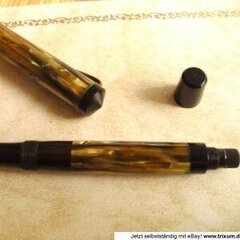
I am intrigued. Besides the design, the covering just feels wonderful - smooth and satiny. It is rather a pearlescent green and black striped satiny feeling vintage plastic. Is this celluloid?


In the striping are the following marks: FREEMAN SHOES FOR MEN, E. D. ADAMS.


The company marking is around the top “silver” band that looks like it is decorated with crescent moons. It says: DUR-O-LITE MADE IN U.S.A., MELROSEPK ILLINOIS, PATENTED & PATS PEND.


When the blade is retraced the length is 5 5/8ths inches.

When the blade is extended the length is approx 6 3/8ths.

(It might actually extend further, but I was afraid to push it to the very top.)


It also looks like it has a different type spiral mechanism than other Dur-O-Lite pencils?


http://i170.photobucket.com/albums/u268/designbydecade/pens/durotopcloseda.jpg

http://i170.photobucket.com/albums/u268/designbydecade/pens/duroknifeb.jpg


http://i170.photobucket.com/albums/u268/designbydecade/pens/durotipona.jpg

http://i170.photobucket.com/albums/u268/designbydecade/pens/duropencillonga.jpg

http://i170.photobucket.com/albums/u268/designbydecade/pens/duromidname.jpg

http://i170.photobucket.com/albums/u268/designbydecade/pens/durofullstraighta.jpg

http://i170.photobucket.com/albums/u268/designbydecade/pens/durofullextendb.jpg

http://i170.photobucket.com/albums/u268/designbydecade/pens/durobottomtwista.jpg


Does anyone have a guess as to what the top knife was used for, the type of covering on the pencil, and an idea of date?

I got really confused when I tried to research the various types of knives or sharpening mechanisms associated with early pens and pencils.


Link to comment
Share on other sites

  • Replies 18
  • Created
  • Last Reply

Top Posters In This Topic

  • designbydecade

    6

  • jbb

    3

  • hardyb

    3

  • Randal6393

    2

That is very cool. I've never seen anything like it. The only knives I'm aware of are the ones used as ink erasers. Thanks for posting such and interesting item. I also hope someone else knows more.

Link to comment
Share on other sites

Thanks for your reply. I hope someone else knows, too. I have been all over the web. I did find an interesting site on Durolite and Autopoint pencils. I really do not know anything about the sharpening tools that went with old writing instruments.


I found a couple of other different type knives in my great uncle's pen / pencil collection. I cannot figure out what they are for, and maybe if there is any interest in this topic I'll post those photos. They are stand alone blades, though.


I wish it gave a patent number instead of just patented and patent applied engraving.

Link to comment
Share on other sites

For what it's worth, it reminds me of an X-acto knife. Which professions would have used something like that?


I browsed through the book "Pen, Ink and Evidence" and none of those pen knives/erasers resemeble yours.

Link to comment
Share on other sites

That was kind of you to check. Thank you.


Before I posted this question I did a search of past board topics, and I saw that book title mentioned. My library would not have a copy, and right now I am not buying anymore books, so I really thank you so much for looking.


I tried a history search on "Freeman Shoes," and if I got the correct one, it was a Cincinnati company that began in 1892. Here is the entry from the 1920’s:


Freeman develops equipment to simultaneously trim and perforate shoe uppers accurately, making the production of “wing tips” and other perforated shoes cost effective. The Company begins a period of rapid growth moving several times to larger quarters in downtown Cincinnati.


(Could this pencil design be company specific with the knife, and not have anything to do with writing?)


Link to comment
Share on other sites

My guess would be a paper knife to be used to make smaller sheets from larger to avoid waste, open letters, that type of thing.

Edited by hardyb

The Danitrio Fellowship

Link to comment
Share on other sites

hardyb, thank you for your response. I tried to research paper knives on the web. The definition I got was a knife used to open closed sheets of a book. With some early books, the sheets had to be slit before you were able turn each page separately to read.


Since this item brought up knife type items associated with pens, etc., do you know what a quill knife looks like, and when they would have quit making them?


Link to comment
Share on other sites

My grandfather, born in 1899, collected advertising pens and pencils for most of his life. He literally had thousands of novel pens and pencils that had been given away as company advertisements. Much as blotter cards with company logos were. This might be an advertising pencil. Someone may have had the idea that it would be interesting to add a small gentleman's knife to an Eversharp-type pencil. So there may be no special purpose to the knife in the top of the pencil.


Best of luck in your hunt.


Yours,

Randal

Yours,
Randal

From a person's actions, we may infer attitudes, beliefs, --- and values. We do not know these characteristics outright. The human dichotomies of trust and distrust, honor and duplicity, love and hate --- all depend on internal states we cannot directly experience. Isn't this what adds zest to our life?

Link to comment
Share on other sites

Thank you for the additional replies. And, thank you for the wonderful sites.


I found the first site during my initial research. That one, besides a couple of others, had me wondering about “quill” knives. Since we are kind of on that topic, I thought I would add some additional photos of knife type items I found in my great uncle’s pen drawer.


I did not want to claim that they were some special kind of “writing” knife, if that was not the case, and I just don’t know enough about this area to tell.


I had not seen the 2nd site you list. What wonderful items are combined with pens / pencils! I am in love with the frog pencil.


The shorter blade with the screw by the blade has the name: ROTTGERS inscribed on the blade. I don’t see a country of origin. It measures approx. 5 3/4ths inches.


The longer skinnier and rustier blade has a hallmark on the base of the handle, but no other markings. (Maybe there are additional marks under the rust?) I tried a close-up. The hallmark is a snake with a crown. The snake is encircling a staff or a baton, or something. You can’t close this blade. It measures: approx. 7 1/8ths inches.


Maybe the longer is just a letter-opener, but the short one does not seem like it could be. Maybe the short one is just an older type exacto?


http://i170.photobucket.com/albums/u268/designbydecade/pens/quillknifelot2a.jpg


Shorter blade:


http://i170.photobucket.com/albums/u268/designbydecade/pens/quillrottgersknifehandle.jpg

http://i170.photobucket.com/albums/u268/designbydecade/pens/quillrottgersknifebladea.jpg

http://i170.photobucket.com/albums/u268/designbydecade/pens/quillrotgersknifea.jpg


Longer blade with logo:


http://i170.photobucket.com/albums/u268/designbydecade/pens/quilllonglogoa.jpg

http://i170.photobucket.com/albums/u268/designbydecade/pens/quilllongfulla.jpg


Link to comment
Share on other sites

Supposedly the mathematician William Hamilton, while in Dublin crossing a bridge carved into the side his idea of the quaternion group. Which was an original mathematical application that is now used today in computer graphics and quantum physics. From his own account he said he used a pen knife. I always wondered what they might have been like.

Link to comment
Share on other sites

Knives had so many uses prior to our modern world. Wood was carved into small tools, leather had to be trimmed, paper had to be cut to size, and ink needed to be scraped to correct written documents. In addition, pencils needed sharpening and quills needed to be cut. So it is no wonder that knife blades showed up everywhere and attached to all sorts of carriers. That's in addition to the folding pocket knives every man carried. We don't have the same needs as our grandparents, so it is no surprise that we don't realize what a given tool is for.


Several years ago, a research team drudged the site of the sinking of an old river boat from the 1890's. The team found over 200 lbs of iron/steel tools (in very poor condition, of course). Less than half of the tools had modern analogs and many could not be assigned any name or task.


The world indeed changes.


Yours,

Randal

Yours,
Randal

From a person's actions, we may infer attitudes, beliefs, --- and values. We do not know these characteristics outright. The human dichotomies of trust and distrust, honor and duplicity, love and hate --- all depend on internal states we cannot directly experience. Isn't this what adds zest to our life?

Link to comment
Share on other sites

As a young man Washington's mother gave him a "pen knife" which was used to prep quills. He used it all his life. See it picture at: http://aw22.org/gwpenknife.html.


The story goes like this:


"Following the death of his father in 1743, a young Washington, then only 11, went to live with his half-brother, Lawrence. While repairs were being done to the family estate at Mount Vernon, George stayed for a time at Belvoir, the home of William Fairfax, a close friend of the Washington family and also Lawrence's father-in-law.


"William Fairfax became very fond of George and gave the young man access to his elaborate library," explains Dr. Claude H. Harris Jr., 32 , K.C.C.H., Archivist of Alexandria--Washington Masonic Lodge, which is located in The George Washington Masonic Memorial. "Through the influence of his brother and the Fairfax family, George obtained a commission as a midshipman in the English Navy."


According to Bro. John P. (Jack) Riddell, Curator of the Alexandria-- Washington Replica Lodge Room of The George Washington Masonic Memorial, Martha Ball Washington, George's mother, corresponded with her brother, John Ball, who lived in England. "John Ball said that the British navy was a floating hell," comments Riddell. "So Washington's mother was convinced not to let George go." Though the details had been worked out and all preparations made, young George respected his mother's wishes, surrendered his commission, and returned to the study of mathematics and surveying.


George's mother ordered supplies from England annually, and in her next order was a request for one good penknife, which she intended to give to her son as a token of appreciation. "This she presented to young George as a reward for his submission to her will with the injunction `always obey your superiors,'" remarks Harris. "He carried the token with him throughout life as a reminder of his mother's command."


Later, during the Revolutionary War, Washington supposedly recounted the knife's history in a conversation with one of his most trusted subordinates, Masonic Brother and Major General Henry Knox. It was Knox who would later play a key role in Washington's military future. As the Commander-in-Chief quietly deliberated over the situation that bleak winter at Valley Forge, it could scarcely have been more critical. His soldiers were fighting for their very lives against the mightiest military power in the world. If they failed, then along with them would perish an ideal.


"When a timid Congress failed to provide food for his starving and ragged army, in desperation yielding temporarily to his feelings, and in sympathy for his men and disgust with Congress, Washington wrote his resignation as Commander-in-Chief of the Continental Army and summoned his staff to notify them of his actions," remarks Harris.


"Among the officers present and sitting in the council was Knox, who reminded him of the knife and his mother's injunction `Always obey your superiors.' You were commanded to lead this army and no one has ordered you to cease leading it," Knox said.


Washington paused and said, "There is something to that. I will think it over." Half an hour later, he had torn up his resignation, determined to fight to the end. Thus, a penknife may have meant the difference between life and death for the fledgling nation. As history tells us, Washington remained at the head of the Continental Army, ultimately leading it to victory with the help of military aid from France. He eventually served two terms as the first President and died peacefully in his bed at Mount Vernon at age 67 on December 14, 1799. Even those close to the penknife agree that parts of the story may be embellished. But there is no doubt the knife belonged to Washington. It was presented to Alexandria-- Washington Lodge No. 22, where Washington served as the first Worshipful Master, by his nephew, Captain George Steptoe Washington, in 1812. The nephew was also an executor of Washington's will. "


Quill Prep: Images 20-23

http://images.google.com/imgres?imgurl=htt...l%3Den%26sa%3DN


Detail steps and pictures:

http://images.google.com/imgres?imgurl=htt...l%3Den%26sa%3DN

Edited by hardyb

The Danitrio Fellowship

Link to comment
Share on other sites

I am not sure about the knife blade in the pencil but of the other two blades you have shown they both look like standard scalpels to me, the sorts that can be used for anything from surgery to crafts.

http://img132.imageshack.us/img132/5775/bickhamuserbar.jpg

http://img40.imageshack.us/img40/9086/quilluserbar.jpg

Flickr photos

Link to comment
Share on other sites

Thank you for the additional replies. And, thank you for the wonderful sites.


I found the first site during my initial research. That one, besides a couple of others, had me wondering about “quill” knives.

The shorter blade with the screw by the blade has the name: ROTTGERS inscribed on the blade. I don’t see a country of origin. It measures approx. 5 3/4ths inches.

The knife with the shorter blade looks like a fairly modern scalpel that uses interchangeable/disposable blades.

Link to comment
Share on other sites

Thanks to one and all for the additional information, history, etc. (I would have never guessed scalpel. Thanks.)


This was just fun. I am so glad I decided to ask the initial question because I got to think about all kinds of different things.


Re: history – yes. I have been going through an estate of a couple that would be in their mid 90’s now, and they also collected antiques. I have boxes of things that I do not have a clue as to what they are. The subject matter of the items is just so broad, too.


I could not access all of the additional links, but my computer is acting up a bit. I will try again later. Thanks, again.


P.S. I had never written with a fountain pen before going through my great uncle's things! It was fun, although I have not found safe ink in town yet. (One more place to check. I did not want to have to order any on-line.)


I did not realize the ballpoint was so recent. I have never not had a Bic! The research in this area has been so much fun. If finances and time allowed, I could get really caught up in this area.


Link to comment
Share on other sites

I am not sure about the knife blade in the pencil but of the other two blades you have shown they both look like standard scalpels to me, the sorts that can be used for anything from surgery to crafts.


My grandfather had something similar to the pencil/blade shown here. This may not be its intended purpose, but he used it to remove staples and rings from ledgers and documents. Does the blade have an edge, or is it smooth on its edges? Of the other two, I would guess that you have a scalpel and a letter opener.

"If I had only known, I would have been a locksmith."

-Albert Einstein


http://img525.imageshack.us/img525/606/letterji9.png http://img244.imageshack.us/img244/5642/postcardde9.png


BP/Pencil set trade

Link to comment
Share on other sites

Of the other two, I would guess that you have a scalpel and a letter opener.


I am pretty sure the long one is a scalpel of some sort not a letter opener, my guess is a dissecting knife... The handles are a very similar design and both the standard shape for "surgical" type knives. I swear I used a knife just like that in Biology lessons for dissection.


http://img132.imageshack.us/img132/5775/bickhamuserbar.jpg

http://img40.imageshack.us/img40/9086/quilluserbar.jpg

Flickr photos

Link to comment
Share on other sites

Create an account or sign in to comment

You need to be a member in order to leave a comment

Create an account

Sign up for a new account in our community. It's easy!

Register a new account

Sign in

Already have an account? Sign in here.

Sign In Now


×
×
  • Create New...