Jump to content

Date Pelikan 140 ST


mycomputerexpert

Recommended Posts

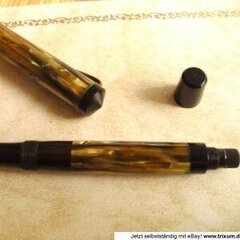
This was my first Pelikan fountain pen and it does not disappoint. It is soft, springy, and very fun to use. I am super impressed and amazed with this nib! So impressed that I want to track the date of this Pelikan. The seller of this pen listed it as "around the 1950s," but after looking around online, particularly on sites like Pelikan-Collectibles, I'm starting to think it might be closer to 1954. Does anyone have more definitive information or pointers on how to accurately date these pens?


The only thing which is not smooth with this pen is the piston. My initial thought for lubricating it was to remove the nib, but my efforts have been in vain. Upon contacting the seller, I was told that the nib is friction fitted. At this point, I don't think attempting to open it further is a good idea, as I don't want to risk damaging it. Having said that, what would be the best and safest way to lubricate the piston without removing the nib?


PXL_20250610_190552062.MP~2.jpg

PXL_20250610_193556904.MP~2.jpg

PXL_20250610_190705101.MP~2.jpg

PXL_20250610_190514177.MP~2.jpg

PXL_20250610_190801193.MP~2.jpg

Link to comment
Share on other sites

  • Replies 14
  • Created
  • Last Reply

Top Posters In This Topic

  • stoen

    4

  • InkyProf

    3

  • mycomputerexpert

    3

  • DougS

    1

Top Posters In This Topic

Posted Images

The best way to lubricate your piston <is> to remove the nib assembly -- and it is not difficult.  You probably need to soak the section and nib in a glass of lukewarm water -- perhaps even overnight.  A few drops of gentle soap solution may help.  Once you have done that, it should be an easy matter to take to nib out.  There are <many> similar descriptions within these pages for your further advice.


After that, remember to grip the nib between ball-of-thumb and forefinger and twist.  The only supplies you need are one cottonbud and some pure silicon grease for the interior of the barrel -- only a little dab well-up into it, so that the piston may distribute it.  You may also like to lubricate the feed judiciously and very sparingly before re-installing it in the section.


I think you <ought> to do it yourself: it will show you how easy Pelikans are to maintain or service.

Link to comment
Share on other sites

There are others more expert than I in dating Pelikans here, but my experience was that it’s hard to do with the 140 unless your pen has one of the features that’s supposed to have changed in 1953 or 1954 (listed on the website you’ve consulted). Within the 1955-63 period (and your nib is pre-1964 in style) the only distinguishing feature I know of is the presence or absence of a security ring in the inner cap, which you’ll easily recognize because it introduces a “click” that feels at first like a malfunction while you’re screwing and unscrewing the cap. That was introduced in 1958. I don’t know (whether anyone knows) how long it lasted. It’s discussed here: https://thepelikansperch.com/2014/10/12/pelikans-secure-locking-cap/


Enjoy your new pen! A 140 was my first vintage Pelikan too. Be careful: they can breed even without a mate.😉

Link to comment
Share on other sites

Oh, and PS, I'd remove the nib unit it as Mr. Godfrey says -- holding the nib and feed firmly together between ball of thumb and forefinger -- except that I'd then keep that hand stationary while rotating the section clockwise, rather than rotate the nib and feed counterclockwise while holding the section stationary. This should reduce the chances of damaging the longitudinal fins on the ebonite feed while twisting.

Link to comment
Share on other sites

Soak, soak, and then soak some more. If the nib unit does not turn without great force it is "glued" with old ink. Don't try to force it or you'll break the feed fins off or break the feed itself-- been there done that.  I've had some pens take two weeks to soften. Don't let the water level go above the black grip section or the green striped binde might be affected.  A ultrasonic treatment might help too.

“Travel is  fatal to prejudice, bigotry, and narrow mindedness, and many of our people need it sorely on these accounts.” – Mark Twain

Link to comment
Share on other sites

One more “dating” hint. Please unscrew cautiously the cap top (which holds the clip in place). If the part underneath has a rounded top, the pen should be pre-1956 (most likely between 1955 and 56, considering other parts), and should not have a polystyrene collar, if made with all original parts.


If the cap top is hard to unscrew, the ink residue must have clotted inside. It’s good to wash it. You shoul soak it in lukewarm water overnight before making a second attempt…

Link to comment
Share on other sites

@stoen I didn't know this one! That's really helpful for me, too, thanks!

Link to comment
Share on other sites

  • 2 weeks later...

Thanks for the replies. I finally managed to take it apart.


First, the nib and then the feed came out. Just as the seller described, this nib is friction-fitted into the pen. I think that also narrows down the date of this pen, as only the early models have this kind of nib.


There was a bunch of plastic-looking strands inside, which I cleaned out. Finally, I greased the pen with the TWSBI silicone grease. The piston is so incredibly smooth now; it's crazy. Now, it can shoot water out like a water gun.


PXL_20250627_201930776.MP.jpg

Link to comment
Share on other sites

On 6/27/2025 at 11:15 PM, mycomputerexpert said:

Just as the seller described, this nib is friction-fitted into the pen. I think that also narrows down the date of this pen, as only the early models have this kind of nib.

This is a wrong assumption. No friction fit nib units for 140 are known. For 400 yes, with entire plug-in nib units, for 140 no, AFAIK.


The plastic shreds shown are broken fragments of the transparent polystyrene collar, which happened to turn fragile and decompose in time, and were installed in late series 140s. The earlier ones were fitted with durable ebonite collars.


All you have to do is contact the seller/manufacturer who makes replacement collars for 140 and 400. Feel free to Google their whereabouts.


Also, please consult the great “Dating Pelikan Fountain Pen” thread in this forum. It has information relevant for dating your pen.

🙂

Link to comment
Share on other sites

1 hour ago, stoen said:

This is a wrong assumption. No friction fit nib units for 140 are known. For 400 yes, with entire plug-in nib units, for 140 no, AFAIK.


The plastic shreds shown are broken fragments of the transparent polystyrene collar, which happened to turn fragile and decompose in time, and were installed in late series 140s. The earlier ones were fitted with durable ebonite collars.

Very correct. No friction fit for 140s.

Remove any and all remains of that collar and buy a new one here: 

https://www.custompenparts.co.uk/gb/pelikan/94-pelikan-compatible-connector.html


They fit very nicely. I used to have to cannibalize a modern M200 nib unit for the collar, these are a blessing. You may want to use a nib block to help putting the three pieces back together.


Congrats on the ST nib they're wonderfully flexy to create old-school shorthand characters.

Link to comment
Share on other sites

13 hours ago, DougS said:

Very correct. No friction fit for 140s.

Thanks for helping point at this, @DougS. For OP’s convenience and information: here is an image of my friction-fit 400, how it should look like. It has been manufactured only for few months and only for 400, back in 1950, while there was no model 140 in sight.

IMG_5169.jpeg.46712d24dc97058ea554a0be4c17965a.jpeg

One can clearly see the complete friction fit nib unit, which was easily plugged into a corresponding 400 section. There was no such thing on 140, because this engineering concept was abandoned in favour of screw-in nib units, two years prior to introduction of 140.

No other Pelikan pens of the classic period (100, 100N, Rappen, Ibis, Ibis 130 or 300 and their variations) were known for this feature.

Link to comment
Share on other sites

17 hours ago, stoen said:

Thanks for helping point at this, @DougS. For OP’s convenience and information: here is an image of my friction-fit 400, how it should look like. It has been manufactured only for few months and only for 400, back in 1950, while there was no model 140 in sight.

IMG_5169.jpeg.46712d24dc97058ea554a0be4c17965a.jpeg

One can clearly see the complete friction fit nib unit, which was easily plugged into a corresponding 400 section. There was no such thing on 140, because this engineering concept was abandoned in favour of screw-in nib units, two years prior to introduction of 140.

No other Pelikan pens of the classic period (100, 100N, Rappen, Ibis, Ibis 130 or 300 and their variations) were known for this feature.

Thank you for the valuable information. I think the collar for my pen is either very stuck or glued to the body. In the image below, the grooves for the socket wrench can be seen. For now, I don't have any idea or solution on how to remove the collar at all.

PXL_20250701_163213424.MP~2.jpg

Link to comment
Share on other sites

This looks like ebonite collar with grooves (sockets). You need a tool (the aforementioned socket wrench) for unscrewing it. Few days of soaking in water could also help. Hopefully there is just some clotted ink. Some times pulling out the nib and feed reduces radial pressure, so water can easier penetrate the gap between the collar and section.


The socket wrench can also be improvised from a small steel tweezer, providing you have the tools and patience for filing the tines to the profile od the grooves (sockets, slots). It should fit without force.


The alternative is sending it to a professional repairperson.


Good luck!

Link to comment
Share on other sites

Create an account or sign in to comment

You need to be a member in order to leave a comment

Create an account

Sign up for a new account in our community. It's easy!

Register a new account

Sign in

Already have an account? Sign in here.

Sign In Now


×
×
  • Create New...