Jump to content

Unusual Pilot nomikomi-shiki


Kirmo

Recommended Posts

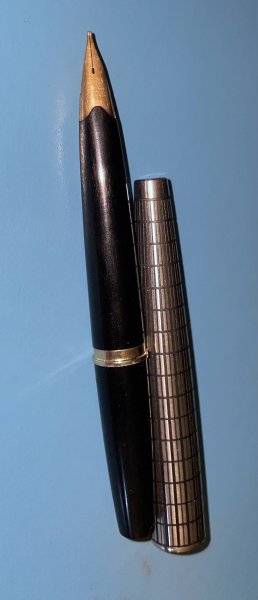
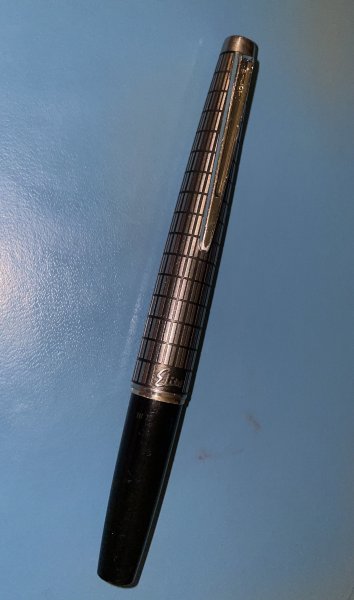
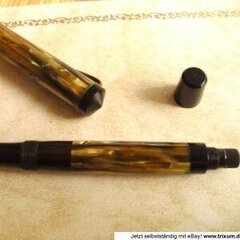
A nice vintage Pilot pen with a transparent clip-less cap. Unfortunately the nib is not original .


Pilot_Nomikomi-1.thumb.jpeg.69b201be99efc692afe80d0d960964b4.jpeg


 Pilot_Nomikomi-3.thumb.jpeg.65ad4eec09e9538033955533f839b13f.jpeg


An interesting fact (at least for me) is the inscription on the cap , that seems to be refer to a patent number with an indication of a "new design/concept" pen


Pilot_Nomikomi-5.thumb.jpg.b21ab999f2abb296e22e56ed9aadfbc0.jpg


Could someone translate the inscription ?

Any information is welcome, thanks ! 

Link to comment
Share on other sites

  • Replies 11
  • Created
  • Last Reply

Top Posters In This Topic

  • Number99

    5

  • Kirmo

    4

  • mke

    3

Popular Days

Top Posters In This Topic

Posted Images

3 hours ago, Kirmo said:

A nice vintage Pilot pen with a transparent clip-less cap. Unfortunately the nib is not original .


Pilot_Nomikomi-1.thumb.jpeg.69b201be99efc692afe80d0d960964b4.jpeg


 Pilot_Nomikomi-3.thumb.jpeg.65ad4eec09e9538033955533f839b13f.jpeg


An interesting fact (at least for me) is the inscription on the cap , that seems to be refer to a patent number with an indication of a "new design/concept" pen


Pilot_Nomikomi-5.thumb.jpg.b21ab999f2abb296e22e56ed9aadfbc0.jpg


Could someone translate the inscription ?

Any information is welcome, thanks ! 

Hi! 

I am not a translator, so my translations of patent-related terminology may not be accurate. The general Japanese interpretation is as follows


「新案ケース鉛筆」

 'New model case pencil.'

When 「新案」 means 「実用新案」.

"Utility model case pencil.”


「特許一二一、三二四号」

“Patent (No.)121、324 "


Is the case an original accessory to the fountain pen…?

I think I posted a couple of times here somewhere a link to a Japanese website about patent searches in Japan.


P.S.

The mystery of the "pencil" will not be answered until you look into the patents. (The possibility remains!)

There is an Japanese article about Nomikomi type fountain pens on Kamisama's blog " Fountain Pen Graph".

https://ameblo.jp/kamisama-samasama/entry-12017888973.html


The "N" in the "N type" is said to be derived from "N" in Namiki. It seems that a special ink bottle is necessary to fill ink, but is it possible to put ink into the inner barrel with a dropper or syringe?


Edited by Number99
Link to comment
Share on other sites

The addition of an image showing the inner view of the pen with the inner barrel removed would be important information to determine if this pen is a Nomikomi type pen.

Link to comment
Share on other sites

More about this pen:

https://forum.fountainpen.it/viewtopic.php?t=33121


There is a LOT of information on that site, including a comment regarding the nib.

Check the comments with links to the original patent (from 1936) and related patents.

Copy the patent number into Google patents if you need translations; or use Google Lens on downloaded pictures.

Link to comment
Share on other sites

I already read the original patent myself and I'm sure the OP has already read it too.

This is the first time I have experienced a case where everything is known, but they hide it and ask questions about it.

I am extremely disappointed in this action by the OP.

Thanks @mke for bringing the situation to my attention.


The following is deleted.

Edited by Number99
Link to comment
Share on other sites

@Number99 I don't hide anythings , the fact is that I didn't ask what type of pen was (I wrote it on the title of the discussion), but instead I asked for the translation on the cap, possibly by a native Japanese mother tongue , in order to be sure if the translation itself .

@mke unfortunately on that site there are several patents related to nomikomi-shiki , but not the patent that appears on that cap inscription (121,324).


Anyway, thank you for the help.

Link to comment
Share on other sites

1 hour ago, Kirmo said:

but not the patent that appears on that cap inscription (121,324).


Back at my desktop: I just checked the Japanese patent from the comments - the number is correct but it seems to be something else from someone else. Sorry.


Eventually, the number could be the application number for a US patent.

https://patents.google.com/patent/US2144296A/en?inventor=Namiki+Ryosuke&sort=old

The application serial number for US2144296A is 192,637 (see pdf page 3). Same style of writing.


If that serial number refers to an utility application of a pen from the 1930s, this serial number is from 1937: https://www.uspto.gov/web/offices/ac/ido/oeip/taf/filingyr.htm

Unfortunately, the text search of USPTO doesn't go back to these years. https://ppubs.uspto.gov/pubwebapp/


Link to comment
Share on other sites

1 hour ago, Kirmo said:

@Number99 I don't hide anythings , the fact is that I didn't ask what type of pen was (I wrote it on the title of the discussion), but instead I asked for the translation on the cap, possibly by a native Japanese mother tongue , in order to be sure if the translation itself .

@mke unfortunately on that site there are several patents related to nomikomi-shiki , but not the patent that appears on that cap inscription (121,324).


Anyway, thank you for the help.

Blind testing without notification is what you do to experimental animals.

Your defense that you wanted to know the native translations shows that I was one of the targets, and this shows that you do not regard the personalities of some members as equal to your own.

Link to comment
Share on other sites

1 hour ago, Number99 said:

Blind testing without notification is what you do to experimental animals.

Your defense that you wanted to know the native translations shows that I was one of the targets, and this shows that you do not regard the personalities of some members as equal to your own.

Sorry for that, was not my intention to be disrespectful to anyone.


@mke , thank you. Concerning known patents on this filling system (US,BG,FR and NL patents) , if you pay attention to the drawings, none of them show the inner barrel that contains ink : the inner barrel is missing and the ink is contained directly on the barrel body of the pen.

So, it would be interesting  to find the original 121324 patent (in the J-PlatPat archive is not present)  in order to verify if inner barrel is reported .

Link to comment
Share on other sites

8 hours ago, Kirmo said:

the original 121324 patent (in the J-PlatP

Ignoring the patent number 121324 for the pencil, do you mean the original patent you refer to for the Nomikomi type fountain pen that Namiki obtained in Japan?

If so, that is patent number 127118 as per the blog post linked above.

https://www.j-platpat.inpit.go.jp/c1801/PU/JP-127118/15/en


I assume that the patent principle essentially does not require the presence of an outer barrel, and that the outer barrel is an added feature intended to prevent ink from being ejected from the nib due to the body heat of the inner barrel.


P.S.

One might think that blind testing is effective when it is done in secret that it is an experiment, but from another perspective, it assumes that you are fooling someone. Research institutions explain to the subject when they conduct it that he or she may be a test subject before doing so.

Imitating a scientist without examining the considerations that are taken into account when conducting a blind experiment that involves the risk of committing such a violation of human rights is problematic.


P.P.S.

Since the patent is written in old Japanese, it uses the same traditional characters as Cantonese and Taiwanese, and the grammar is different from today. If you translate that text using translation software, please note that the translation software may misidentify parts of the text as Chinese or make grammatical mistakes. It is safe to translate it once into modern Japanese and then into English.


Edited by Number99
Link to comment
Share on other sites

7 hours ago, Number99 said:

Since the patent is written in old Japanese...It is safe to translate it once into modern Japanese and then into English.


Nice tip.


Thanks all !

Link to comment
Share on other sites

Create an account or sign in to comment

You need to be a member in order to leave a comment

Create an account

Sign up for a new account in our community. It's easy!

Register a new account

Sign in

Already have an account? Sign in here.

Sign In Now


×
×
  • Create New...