Jump to content

[help] Pen identification and information - Pilot Lady and Platinum Bonito

OldTravelingShoe

Recommended Posts

Dear all, 


I've spent already many hours sifting through books, catalog pages, Ameblo and FPN threads, but I was not able to identify both pens from Figure 1, or to find information about them including manufacturer codes, production years, retail cost, color variations, materials, etc. Could you please help? Ideas, comments, answers are all much appreciated. (I think it is likely that @Number99, @PithyProlix, and @stan have experience with these pens, sorry if tagging here is too much.) 


large.PlatinumBonitoPilotLady(1970s)001OVERVIEW.jpg.f8079d4318ebf46eeb0426f40886fc24.jpg

Figure 1. The two pens, in overview. (left) Likely a Platinum Bonito pen, in black (or dark grey); (right) Likely a Pilot Lady pen, in red. 


What I know, believe, or suspect so far:

  1. I believe both pens were part of richer production lines, with own branding names, started in the 1970s. Both sported 14k nibs, indicative of cheaper production lines - perhaps they cost ¥3,000? 
  2. I suspect Platinum may have started earlier, mid-1960s, with pocket pens of the 'linegold' variety - metal underneath, scrubbed to enhance protuberances, coated afterward with lacquer to produce a speckled (starry) effect as if gold flecks were embedded in the lacquer. 
  3. I believe the black (dark grey?) pen on the left is a Platinum Bonito of the 1970s. The Bonito line was redesigned in the 1980s, so searches for the term may produce confusing results. (I can add photos of the grip and nib, if needed.) 
  4. I believe the red pen on the right is a Pilot Lady sub-category. The nib is marked H678 (Figure 2), so it's made in 1978. The feed (Figure 3) is standard fare for common Pilot pens with small nibs, and also features in pocket pens of that period.
  5. The speckles on barrel and cap of the Pilot pen (Figure 4) are less pronounced than for the Platinum pen.
  6. Colors: I have seen other colors sold on eBay, e.g., red and (iirc) green. I have seen green and blue variants of the Pilot pen. 
  7. I suspect the Pilot pen is related to the "Cursive L" line, where in the 1980s dots were painted under the lacquered coating. 


large.PilotLady-LacquerOverMetal(1970s)002.jpg.3e632551b1988b12bd287ca59d7b3152.jpg

Figure 2. Grip and nib of the Pilot pen. 


large.PilotLady-LacquerOverMetal(1970s)004.jpg.eeedc65afb2a4accc1c592883e802b60.jpg

Figure 3. Feed of the Pilot pen. 


large.PilotLady-LacquerOverMetal(1970s)003.jpg.1f64074c7321a5df217a57df4e9cb70e.jpg

Figure 4. Detail of the lacquer over metal (?) technique in the Pilot pen. 


Many thanks to all! 


Link to comment
Share on other sites

  • Replies 25
  • Created
  • Last Reply

Top Posters In This Topic

  • OldTravelingShoe

    12

  • PithyProlix

    10

  • Number99

    4

The Platinum pen is coated with cashew lacquer, a cheaper alternative to urushi. I have one in red + sparkles. I think I've seen it in an old Platinum catalog online - if I don't find it right away, I will look for it tomorrow. I don't think it is a Bonito but I might be misremembering. Please remind me if I don't post again in the next day or so.


Sorry, I don't know anything about that Pilot.

My pens for sale: https://www.facebook.com/jaiyen.pens  

Link to comment
Share on other sites

Excellent comments and links, @PithyProlix, many thanks!


I gather that:

  1. The Platinum pen is indeed a Bonito, but a top of the line version rather than a more common pen - real gold specks, lacquer albeit not urushi, price tag instead of the cheaper sticker, price set at ¥6,000 and not at ¥3,000.
  2. The Platinum pen's code is PJ-6000. 
  3. The Platinum pen was introduced in October 1976. @PithyProlix, all, if you could find a catalog (even if only one page), it would be wonderful!  
  4. The color is unusual, dark grey (the pen you link was dark blue), with the more common versions being tones of red. (I thought one was orange, but I've only seen it in eBay pictures.) 

This should conclude the inquiry regarding the Platinum pen. 


Many thanks again! 

Link to comment
Share on other sites

Great information, @OldTravelingShoe! May I ask, please, what is the source? 


I downloaded the pages of that Platinum catalog some time ago but it's not where I expected it to be, nor in the backup it should be in. I'll keep looking - it should still be on the web somewhere, though (but, alas, not in my bookmarks, either). It is somewhere around 15 pages and had quite a few different Bonito and BelAge models, if I remember correctly. (BTW, I think we should keep a central repository of Japanese pen catalogs, perhaps on archive.org, depending on copyright issues. I will start a new thread about this when I have some time.)


My PJ-6000 is probably more orange than red. Good catch. It would be nice to have one in each color - I think it is attractive & I don't have a problem displaying it with my urushi pens. I don't recall seeing one in the color you have - I don't remember seeing it in a catalog either, but that might just be my faulty memory. 


So, given the gold powder, would this pen be considered maki-e? Not that I think a maki-e designation adds anything to the pen - just wondering about the boundaries of the term. 


My pens for sale: https://www.facebook.com/jaiyen.pens  

Link to comment
Share on other sites

5 hours ago, PithyProlix said:

Great information, @OldTravelingShoe! May I ask, please, what is the source? 

Thank you for the kind words. 


The information I summarized from several sources:

  1. The most important in my view for identification purposes, the code PJ-6000, comes from two sources, one explicit, the WorthPoint link you shared, the other implicit, the corroborating code and year from the official 100th-anniversary history provided by Platinum
  2. That this is a Bonito and the ¥6,000 price appear on the price tag in the WorthPoint link. 
  3. The others are derived or inferred from the different descriptions, and I believe are consistent with the technology used by Platinum in the mid- to late-1970s. You can see more of it in the "bamboo and pheasant" pen (PSB-6000), various steel versions of the time, their pocket pens, etc. 

Hope this helps! 

Link to comment
Share on other sites

5 hours ago, PithyProlix said:

is somewhere around 15 pages and had quite a few different Bonito and BelAge models

This could be the Platinum Palace, where they saved 15-20 catalog pages from Platinum. Perhaps useful, this material is preserved by archive.org, alas, without page 12 - does anyone have it? The files I could recover do not include this pen, or I might have mossed it. 


Importantly, this catalog features the Platinum Glamour (launched 1987), and none of the new pens in the Platinum 1990s, so in my estimation this is a 1987-9 catalog. This corroborates with the idea that the Bonitos were redesigned in the (late-)1980s, as were their BelAge and Rivière pens. 

Edited by OldTravelingShoe
Clarity hopefully improved.
Link to comment
Share on other sites

50 minutes ago, OldTravelingShoe said:

This could be the Platinum Palace, where they saved 15-20 catalog pages from Platinum. Perhaps useful, this material is preserved by archive.org, alas, without page 12 - does anyone have it? The files I could recover do not include this pen, or I might have mossed it. 


That's it! Thanks for jogging my memory. (In the meantime, I found those images in my backup. BTW, pages 16 & 17 did not exist when I downloaded the images to my computer (perhaps I was looking at different version of the archive) but they are there now so I am glad to revisit it.)


So, you can see the orange cashew lacquer Platinum on page 10. I've hotlinked the image below. The text by the pen is "<カシュー>" ('<cashew>') and "オレンジ" ('orange').


Regarding those images on the archived Platinum Palace site:

  • It says: "The following scans are from various Platinum catalogs in the 1970s." So, there could be multiple catalogs represented (note that not all the images are the same size). Also, note that most of those 3776s did not appear until the 1980s. (And you identify other pens that didn't appear until the 1980s.)
  • Given that each pen is numbered I assume there must have been an index that is now missing.
  • Note that the name "Bonito" does not appear in the pages of that catalog. Not sure when that model name appeared.
  • Also note that you can see what looks like model numbers showing through from the other sides of the images of the pages, so I guess that would indicate some other missing pages, perhaps ones with more descriptive text.

Note that you can also see photos of the orange pen (which is described as red) and the blue pen with ballpoint - with a later nib design, btw, and looks to be gold-plated steel, I think - in the "Collection" part of the archived Platinum Palace site here: http://web.archive.org/web/20010819064152/http://platinumplace.tc/Collect3.htm Also there is an orange one with the later nib design in gold-plated steel + ballpoint linked from the sales page: http://web.archive.org/web/20010828000229/http://platinumplace.tc/eBaypp/PJ700RedSetZ.jpg  Also a blue one with later nib design in gold-plated steel here: http://web.archive.org/web/20020110042336/http://platinumplace.tc/eBaypp/PJ700_Bluez.jpg


I've emailed the address on the archived website and will report back.


spacer.png


My pens for sale: https://www.facebook.com/jaiyen.pens  

Link to comment
Share on other sites

4 hours ago, PithyProlix said:


That's it! Thanks for jogging my memory. (In the meantime, I found those images in my backup. BTW, pages 16 & 17 did not exist when I downloaded the images to my computer (perhaps I was looking at different version of the archive) but they are there now so I am glad to revisit it.)


So, you can see the orange cashew lacquer Platinum on page 10. I've hotlinked the image below. The text by the pen is "<カシュー>" ('<cashew>') and "オレンジ" ('orange').


Regarding those images on the archived Platinum Palace site:

  • It says: "The following scans are from various Platinum catalogs in the 1970s." So, there could be multiple catalogs represented (note that not all the images are the same size). Also, note that most of those 3776s did not appear until the 1980s. (And you identify other pens that didn't appear until the 1980s.)
  • Given that each pen is numbered I assume there must have been an index that is now missing.
  • Note that the name "Bonito" does not appear in the pages of that catalog. Not sure when that model name appeared.
  • Also note that you can see what looks like model numbers showing through from the other sides of the images of the pages, so I guess that would indicate some other missing pages, perhaps ones with more descriptive text.

Note that you can also see photos of the orange pen (which is described as red) and the blue pen with ballpoint - with a later nib design, btw, and looks to be gold-plated steel, I think - in the "Collection" part of the archived Platinum Palace site here: http://web.archive.org/web/20010819064152/http://platinumplace.tc/Collect3.htm Also there is an orange one with the later nib design in gold-plated steel + ballpoint linked from the sales page: http://web.archive.org/web/20010828000229/http://platinumplace.tc/eBaypp/PJ700RedSetZ.jpg  Also a blue one with later nib design in gold-plated steel here: http://web.archive.org/web/20020110042336/http://platinumplace.tc/eBaypp/PJ700_Bluez.jpg


I've emailed the address on the archived website and will report back.


spacer.png


Excellent work, @PithyProlix, more good evidence!


Link to comment
Share on other sites

6 hours ago, PithyProlix said:

Note that the name "Bonito" does not appear in the pages of that catalog. Not sure when that model name appeared.

The name must have appeared in the 1970s, because it appears in the price tag from your link. Kamakura Pens sold the pen, and the code is consistent with the price tag and the style of price tag is consistent with 1970s Platinum pens, so this could be useful evidence. 


Later, around the 1980s (my guess is late-1980s), there was a complete redesign, as this blue pen sold on eBay illustrates:

https://www.ebay.com/itm/394960244584

Edited by OldTravelingShoe
Qualified the level of evidence available so far.
Link to comment
Share on other sites

42 minutes ago, PithyProlix said:

Address not found. Also no items listed on ebay using the seller id the website author was using. 

So it is up to us, or broader the FPN community, to bring this knowledge back and make it widely accessible (and durable). 

Link to comment
Share on other sites

8 minutes ago, OldTravelingShoe said:

Later, around the 1980s (my guess is late-1980s), there was a complete redesign, as this blue pen sold on eBay illustrates:

https://www.ebay.com/itm/394960244584


Yes, that is the same pen I showed along with the orange cashew lacquer pen and the one with what I guess might be called chased aluminum in the link I provided to a different FPN thread earlier. They are all the same basic design and I've never seen them called Bonitos, except for the pen labelled Bonito, of course. Pilot had a very similar slender pen with a slight curve that was the basis of many finishes but I have yet to identify a name.


But would a rose by any other name smell as sweet? 😉


My pens for sale: https://www.facebook.com/jaiyen.pens  

Link to comment
Share on other sites

Regarding the Pilot: it looks like the same nib/feed design as the Celemo, so that might give you a rough idea of the date. That nib & feed design appeared as late as the Cavalier, though in steel. There may be later models with that same nib/feed design - not sure.

My pens for sale: https://www.facebook.com/jaiyen.pens  

Link to comment
Share on other sites

18 hours ago, PithyProlix said:

Regarding the Pilot: it looks like the same nib/feed design as the Celemo,

Interesting observation. I know Celemo pens were already in the market in 1978-9, so this would date the unknown Pilot pen we are studying here to mid-to-late 1970s as introduction date. 


The shape is also consistent with mid-to-late Pilot lineup - rounded, tapered, strongly streamlined. In contrast, pens of the 1980s were much less streamlined and much more flat-top. The closest I can think of for this pen is the 1980s version of the Lady Cursive L (code could be FLM-500M). 


Here are three pics (Figures 1-3) to illustrate what I mean - the unknown Pilot pen next to a Celemo (unsure if code for the 1970s is the modern FCM-500R), and two Lady Cursive Ls, one with 14k-gold nib from the same year as the unknown pen (1978) and another with steel nib of similar structure. I observe that:

  1. The sections (grips) of the unknown pen and the two Cursive Ls are identical. The grip of the Celemo is similar but of higher quality, with an extra ring to snap-on the cap. 
  2. The caps of the unknown pen and the two Cursive Ls are slip-on and provide an identical high-quality, rubbery feel when pushed over the pen. The cap of the Celemo is slip-on but snaps onto an additional ring on the barrel.
  3. The Cursive L and the Celemo pens are flat-top, whereas the unknown pen is fully streamlined. 
  4. The clips of the unknown pen and the two Cursive Ls are similar. The clip of the Celemo is different. 
  5. The unknown pen is smaller than all other pens. 
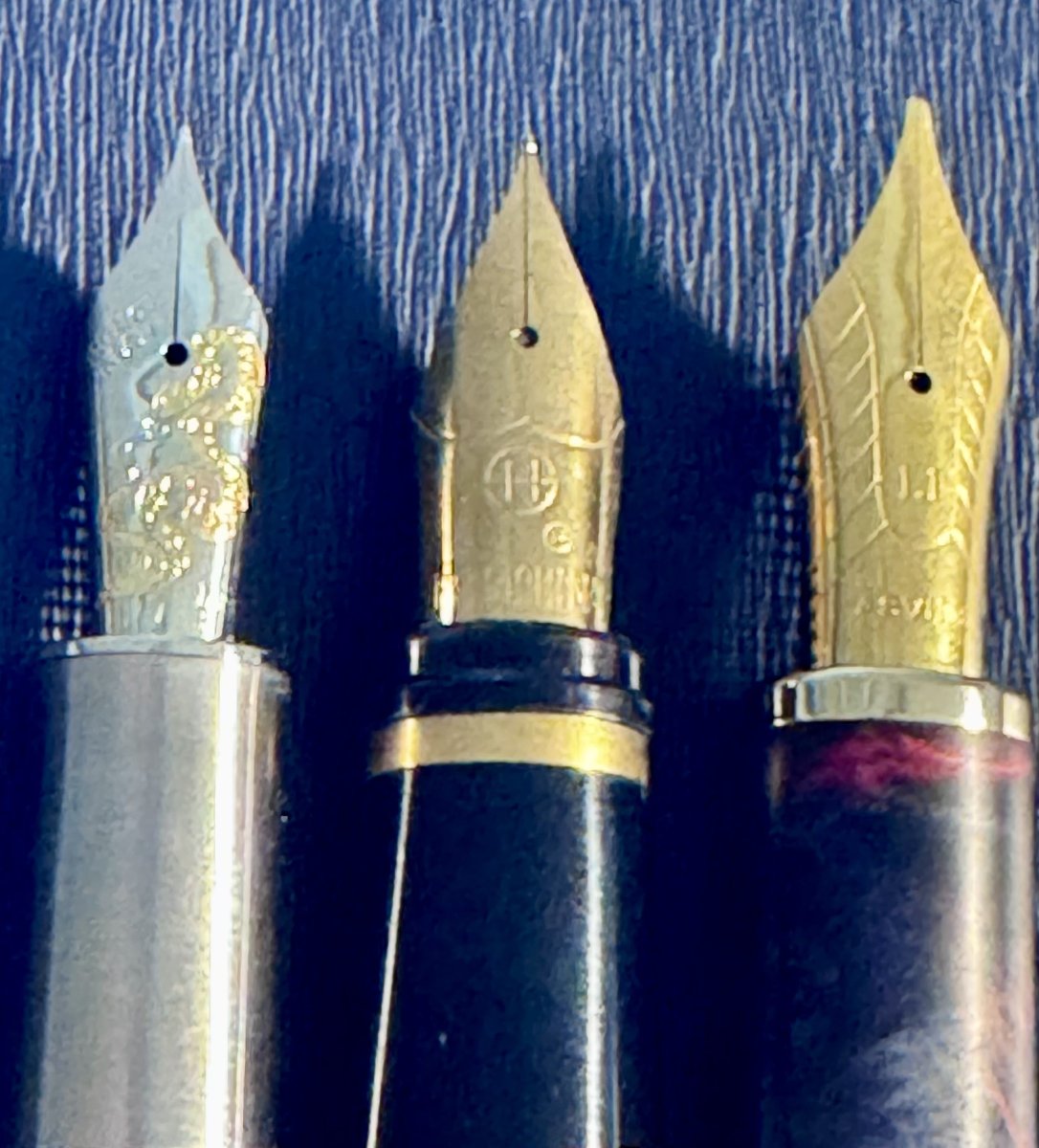
  6. The nib of the unknown pen and the two Cursive Ls are identical in shape. The nib of the Celemo is similar but larger, and also larger relatively to the body size.
  7. The feeds of all pens are identically structured, with the 1970s feed that is found also on the Elite pens with short nibs that are not fingernail-shaped or Customs-shaped. (Update after correction by @PithyProlix.) 
  8. The coating of the unknown pen is lacquer, differently from the other pens: The Cursive Ls are plastic, the Celemo has a special structure. 

In short, the closest pen I can find is the Lady Cursive L, but even that is not close enough and these were contemporary to the unknown Pilot pen. 


large.20231112_225743.jpg.6dfdd7951f21dfa225e33dac2bf59cee.jpg

Figure 1. Pens next to each other, for scale comparisons. This figure also compares section (grip) and nib structure. 


large.20231112_225832.jpg.a41c6f826e4c31544df1c6a1dbc67f34.jpg

Figure 2. Clip comparison. 


large.20231112_225917.jpg.501bc2a6fe67a566b5d3fd3e97cfd6e5.jpg

Figure 3. Nib comparison. 

Edited by OldTravelingShoe
Correction.
Link to comment
Share on other sites

9 hours ago, OldTravelingShoe said:

The feeds of all pens are identically structured, with the 1970s feed that is found also on the Elite pens with short nibs that are not fingernail-shaped or Customs-shaped. 


Not relevant to the topic but none of my Elites have that feed - I have multiple examples of all three nib types.

My pens for sale: https://www.facebook.com/jaiyen.pens  

Link to comment
Share on other sites

46 minutes ago, PithyProlix said:


Not relevant to the topic but none of my Elites have that feed - I have multiple examples of all three nib types.

I just checked and you are absolutely right. I've edited the post to correct my mistake - with due credit. Thank you. 

Link to comment
Share on other sites

On 11/11/2023 at 7:02 PM, OldTravelingShoe said:

Dear all, 


I've spent already many hours sifting through books, catalog pages, Ameblo and FPN threads, but I was not able to identify both pens from Figure 1, or to find information about them including manufacturer codes, production years, retail cost, color variations, materials, etc. Could you please help? Ideas, comments, answers are all much appreciated. (I think it is likely that @Number99, @PithyProlix, and @stan have experience with these pens, sorry if tagging here is too much.) 


large.PlatinumBonitoPilotLady(1970s)001OVERVIEW.jpg.f8079d4318ebf46eeb0426f40886fc24.jpg

Figure 1. The two pens, in overview. (left) Likely a Platinum Bonito pen, in black (or dark grey); (right) Likely a Pilot Lady pen, in red. 


What I know, believe, or suspect so far:

  1. I believe both pens were part of richer production lines, with own branding names, started in the 1970s. Both sported 14k nibs, indicative of cheaper production lines - perhaps they cost ¥3,000? 
  2. I suspect Platinum may have started earlier, mid-1960s, with pocket pens of the 'linegold' variety - metal underneath, scrubbed to enhance protuberances, coated afterward with lacquer to produce a speckled (starry) effect as if gold flecks were embedded in the lacquer. 
  3. I believe the black (dark grey?) pen on the left is a Platinum Bonito of the 1970s. The Bonito line was redesigned in the 1980s, so searches for the term may produce confusing results. (I can add photos of the grip and nib, if needed.) 
  4. I believe the red pen on the right is a Pilot Lady sub-category. The nib is marked H678 (Figure 2), so it's made in 1978. The feed (Figure 3) is standard fare for common Pilot pens with small nibs, and also features in pocket pens of that period.
  5. The speckles on barrel and cap of the Pilot pen (Figure 4) are less pronounced than for the Platinum pen.
  6. Colors: I have seen other colors sold on eBay, e.g., red and (iirc) green. I have seen green and blue variants of the Pilot pen. 
  7. I suspect the Pilot pen is related to the "Cursive L" line, where in the 1980s dots were painted under the lacquered coating. 


large.PilotLady-LacquerOverMetal(1970s)002.jpg.3e632551b1988b12bd287ca59d7b3152.jpg

Figure 2. Grip and nib of the Pilot pen. 


large.PilotLady-LacquerOverMetal(1970s)004.jpg.eeedc65afb2a4accc1c592883e802b60.jpg

Figure 3. Feed of the Pilot pen. 


large.PilotLady-LacquerOverMetal(1970s)003.jpg.1f64074c7321a5df217a57df4e9cb70e.jpg

Figure 4. Detail of the lacquer over metal (?) technique in the Pilot pen. 


Many thanks to all! 


Hello! It's been a while.


I think Bonito needs to be considered together with Bonita.

It is said that Bonita is for women and is a female colored red pen and Bonito is a blue and black male colored pen. I have seen them sold in pairs in cases, and price tags of 4000-6000 JPY.

At the time, Japan was in an inflationary economic period due to two oil shocks and the Afghan conflict in 1979.

Summarizing the descriptions by Japanese bloggers, the pens were painted with a thick coat of transparent lacquer over a lamé coating.

It does not appear to be makie or cashew lacquer.

Wouldn't it be better to treat WorthPoint Corporation's description as a reference tertiary source?

The body is described as being made of aluminum alloy. Is the pen light?


In the process of comparing pens with similar shapes in other finishes, we should also check the size.


I found one blog post about Pilot's Lady balance-type slim fountain pen, but have not been able to read it since last Saturday. (I'm talking to the web site administrator as to why it's unreadable.)

As for the content of the article, it doesn't sound promising…


Platinum Bonito fountain pen.


Platinum Bonita fountain pen.

Link to comment
Share on other sites

19 hours ago, Number99 said:

Hello! It's been a while.


I think Bonito needs to be considered together with Bonita.

It is said that Bonita is for women and is a female colored red pen and Bonito is a blue and black male colored pen. I have seen them sold in pairs in cases, and price tags of 4000-6000 JPY.

At the time, Japan was in an inflationary economic period due to two oil shocks and the Afghan conflict in 1979.

Summarizing the descriptions by Japanese bloggers, the pens were painted with a thick coat of transparent lacquer over a lamé coating.

It does not appear to be makie or cashew lacquer.

Wouldn't it be better to treat WorthPoint Corporation's description as a reference tertiary source?

The body is described as being made of aluminum alloy. Is the pen light?


In the process of comparing pens with similar shapes in other finishes, we should also check the size.


I found one blog post about Pilot's Lady balance-type slim fountain pen, but have not been able to read it since last Saturday. (I'm talking to the web site administrator as to why it's unreadable.)

As for the content of the article, it doesn't sound promising…


Platinum Bonito fountain pen.


Platinum Bonita fountain pen.


Thanks for the links.


There are enough with images of these pens with price tags that I think we can conclude that the orange one is called Bonita and the blue and black ones Bonito. Sample image from https://page.auctions.yahoo.co.jp/jp/auction/p1041767734 below.


As far as I can tell both seem to be the same size. My orange one is the same size as the dark purple metallic one I have that is marked "Bonito" on the cap. I have a few other Platinums with this shape, though only one marked "Bonito", and they are all the same size.


As for cashew lacquer, the Pilot catalog image I hotlinked to above has the text "カシュー" with pen. Though I cannot remember where, I've read it is cashew lacquer in a couple other places but none primary sources.


Note that it seems as if some had 18k nibs, others 14k. 


spacer.png

My pens for sale: https://www.facebook.com/jaiyen.pens  

Link to comment
Share on other sites

On 11/11/2023 at 5:02 PM, OldTravelingShoe said:

I suspect the Pilot pen is related to the "Cursive L" line, where in the 1980s dots were painted under the lacquered coating. 


I missed this the first time I read it. I have the pen I think you are referring to. It has the same clip as your Pilot, has the cursive capital "L" on the cap, and the nib/feed look to be the same, including the size, as yours. It is only ~2 mm shorter than the Bonita, capped - yours looks like it might be much shorter than your Bonito? It has a translucent red lacquer - I think it's a deeper red than yours. Date code H482. I don't think there are painted dots under the barrel - I think it is probably guilloche, with it reflecting light in different ways as you turn the barrel, very similar to my Dupont pens that are translucent urushi over guilloche. (It's a pretty pen!)

My pens for sale: https://www.facebook.com/jaiyen.pens  

Link to comment
Share on other sites

Create an account or sign in to comment

You need to be a member in order to leave a comment

Create an account

Sign up for a new account in our community. It's easy!

Register a new account

Sign in

Already have an account? Sign in here.

Sign In Now


×
×
  • Create New...