Jump to content

A notebook for tinkering/engineering


frotz

Recommended Posts

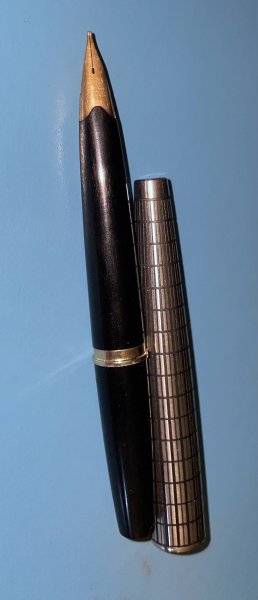
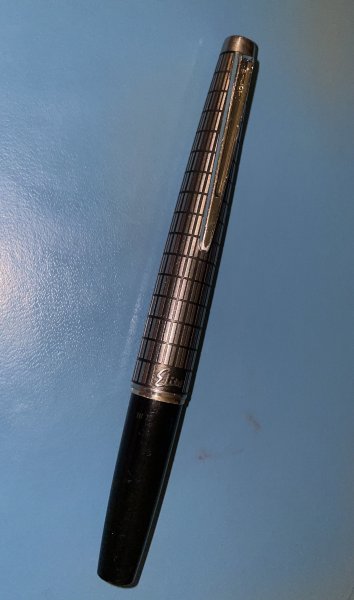
Much of what I do with notebooks is document whatever tinkering or problem I'm working on at any one time.  For instance: computer programming, woodworking, metalworking, directing the construction of a workshop, story ideas, recreational mathematics, and so on.  I got into this habit when I graduated university and got tired of trying to keep track of my notes, both paper and on computer.  My first impulse was to get a "proper" engineer's notebook, but decided to use a 5"x8.5" Moleskine.  This worked so far with little trouble with bleeding and spotty trouble with skipping.  I use Pelikan, Esterbrook, and Preppie fountain pens with Noodler's ink.  Now I'm getting sick of Moleskine because of price for what you get.  Today a fresh notebook arrived with the spine crushed, which will be returned.  I'm just about done with Moleskine.  Now looking at other talk about Moleskine alternatives, I've discovered similar notebooks which include page numbering and a table of contents at the beginning.  With my Moleskines, I've manually set aside some pages for the table of contents and hand-numbered the pages.


Do any of you use your fountain pens and notebooks for documenting things like I do?  What notebook do you prefer?  I'm thinking of specifically going for a proper engineer's notebook.

Link to comment
Share on other sites

  • Replies 12
  • Created
  • Last Reply

Top Posters In This Topic

  • txomsy

    5

  • dipper

    2

  • frotz

    1

  • Karmachanic

    1

A5 dot-grid might do.  Many to choose from.  My preferrence is Stalogy.  368 pages and only 15mm thick.

Add lightness and simplicate.


Link to comment
Share on other sites

I've been using little black notebooks (A6/A7) ever since I was at the University (or earlier) and mostly during my PhD to record Molecular Biology "recipes", computing algonithms, programming languages, system designs and libraries... then to document travel and meeting notes, sketching, ... you name fit. I prefer these sizes for they it in a pocket.


So, yes.


Lately I lean on carrying two leather notebook covers stuffed with a Moleskine craft paper bound, cream colored, thin notebook for sketching, one, and with a usually slightly thicker, yet also thin, often gridded, white paper, Rhodia or similar for notes, the other. Both in the same rear pocket of my jeans. This way I am always ready to take notes or draw sketches. Coupled with a leather pouch where I carry a couple of 5.6mm short mechanical pencils (one a Kaweco Sketch-up) and two fountain pens (Kaweco Sport or Liliput) keep me always ready on the go. From time to time I also add a Kuretake brush pen in a shirt pocket.

If you are to be ephemeral, leave a good scent.

Link to comment
Share on other sites

BTW, I now realize I never made a little pocket book for Cobol (Basic, Logo, C, Fortran, Algol, java and many, many more yes, but somehow not Cobol, even though it was the first computer language I learnt). It may be about time, so I can refresh old memories. And I should refresh high precision algorithms. They may come handy for current multimillion record scientific datasets.

If you are to be ephemeral, leave a good scent.

Link to comment
Share on other sites

On 8/2/2023 at 6:22 AM, frotz said:

Much of what I do with notebooks is document whatever tinkering or problem I'm working on at any one time.  For instance: computer programming, woodworking, metalworking, directing the construction of a workshop, story ideas, recreational mathematics, and so on.

Snap!  My notebooks are filled with Excel spreadsheet schemes, woodworking & metalworking designs and dimensions, design ideas for home and garden improvements, recreational mathematics, and art sketches. Blank unlined pages, hand numbered, and first two pages reserved for compiling a contents list on-the-fly.


Generally I make my own A5 notebooks by folding and sewing A4 sheets. But occasionally treat myself to a "proper" notebook. Earlier this year I used one A5 Moleskine, and one moleskine-like clone made by "Endless".


The "Endless" was rather good. Made in India, using Tomoe River paper. Near identical except that the Endless "A5" pages are about 1cm wider than the equivalent Moleskine.


Checking for a link to post here I see that the supplier I used in the UK still has the same range of Endless products - but the paper is now listed as "Regalia" instead of Tomoe River.


https://www.purepens.co.uk/collections/endless


https://www.purepens.co.uk/products/endless-recorder-a5-notebook-crimson-sky-regalia-paper


Link to comment
Share on other sites

Baron Fig notebooks are great. I spent a long time trying to find just the right one and have settled on them — permanently. They are clothbound, stay open and flat, have good paper, and come in dot grid. They also come in several sizes. I’m never willingly going back to anything else. 

Link to comment
Share on other sites

It's curious.


I also tried at the beginning, long, long ago (in a kingdom far, far away :) ) to keep an index ahead (i.e. reserve some pages for the index in the front -at the beginning- of the notebook. But greed overcame me. And practicality.


There is no way I can know ahead where subjects will fall, or how many there will be. Two sheets may be too short or too much.  So, what I decided to do was just fill the notebook, and when I was close to the end, and I had an idea of all the subjects and topics I had entered, and how much space I would need for the index, make the index at the end. This would allow me to pack maximal information and minimize wasted space.


At some point I tried building the index backwards (start in the last page then continue in the but-last, and so on) until index and contents met, but that made for an awkward index. OTOH, one can more or less keep a count of the topics (index lines) and when one is close to the end, easily estimate the exact number of pages that will be needed for the index even counting the still unfilled pages.


So, for the last many decades, I have placed the index at the end. And also for the last many decades, many of my notebooks have two or three blank pages at the end because I left making the index for later and never actually did it :) , this shamed me for a long time until I found many medieval manuscripts where the space had been left for the illustrated capitals (with a tiny letter to indicate which should go in the void space) but only a few at the beginning had been done and the rest had never been finally drawn in. It is a meager consolation, I know, but it let me feel I am not alone in my procrastination (or time prioritization).

If you are to be ephemeral, leave a good scent.

Link to comment
Share on other sites

21 hours ago, dipper said:

The "Endless" was rather good. Made in India, using Tomoe River paper. Near identical except that the Endless "A5" pages are about 1cm wider than the equivalent Moleskine.


That's 'cos the Moleskine is not A5, but the Endless is.  It's the same height, but narrower than A5 (obviously).


Cheers,

Effrafax.


"It is a well known and much lamented fact that those people who most want to rule people are, ipso facto, those least suited to do it"

Douglas Adams ("The Hitch-Hiker's Guide to the Galaxy - The Original Radio Scripts").

Link to comment
Share on other sites

8 hours ago, effrafax said:


That's 'cos the Moleskine is not A5, but the Endless is.  It's the same height, but narrower than A5 (obviously).


I stopped using Moleskine before I discovered fountain pens: the paper was decent enough for pencil and rollerballs, but once I discovered A5 notebooks it made Moleskine feel positively cramped.  Now, using FPs, it's easy to say they should be avoided because of the bad and inconsistent paper.

Link to comment
Share on other sites

On 8/7/2023 at 9:22 AM, txomsy said:

There is no way I can know ahead where subjects will fall, or how many there will be.

That is an issue. Some of my front-of-notebook index pages are a horrible mess!


There is another thread in this forum describing writing topics on the front page, spaced out in separate rows, and marking the edges of pages throughout the body of the book with ink at the same horizontal level as the relevant topic row(s). No page numbering needed. You look at the page edges to find where the same topic crops up at intervals through the book. I did try that idea for a period, and it does work.


Another method is to cut a piece of thin card to fit neatly inside the notebook. Use that card as a bookmark, and scribble topics and page numbers onto it as the book is being filled up. Finally copy the mess of topics and page numbers from the card into the blank page at the start or end of the notebook, tidying the mess into a rational layout.

Link to comment
Share on other sites

Those are all great advice too. I sometimes miss we had a wiki to organize all the knowledge... but then most likely most people wouldn't care going over it. Or may be they would. I don't know.

If you are to be ephemeral, leave a good scent.

Link to comment
Share on other sites

Leuchtturm A5 or A4 lined notebooks are my current favourite lab-books.  Their paper is smooth but still sufficiently quick-drying for this lefty over-writer.  The line-spacing is 6mm - a bit narrow for my writing if I try to use every line, but it makes a reasonable guide for diagrams.  The binding is good, very strong whilst still allowing the book to lie flat.  The hard covers stand up to quite a bit of being knocked around.


Previously I used Lamy A5 notebooks which have a very handy lined/squared print ideal for lab work.  I stopped when their paper quality deteriorated.  (BTW I contacted Lamy who offered to take a look if I would send them my notebook, although they did not propose to send it back afterwards.  I didn't take up their offer, and in any case I'm sure they are perfectly aware of what paper they are using.)


Clairefontaine Age-Bag notebooks are popular and inexpensive locally, but for me the ink dries too slowly on the very smooth paper.

Link to comment
Share on other sites

6 hours ago, tim77 said:

and in any case I'm sure they are perfectly aware of what paper they are using.)

Not necessarily.


They may possibly (likely, methinks) have subcontracted production of stationery to a third party. They could have selected some quality when entering the agreement, and the third party have changed the quality (or their respective paper source) without notice to make for increasing costs within a previous pre-arranged pre-set cost agreement


It is not uncommon that you agree on a price for X years apportioning costs assuming things will go as usual. Then something unexpected (like an arbitrary war) happens, costs go up and the provider is caught with a contract that assumes old costs and not the new ones. It is not uncommon either that in these cases the provider will cut quality to maintain their revenue, with the expectation it will pass unnoticed. If no one complains then it works and in addition tells them they can use a cheaper source for their future production increasing their returns.


That's what QC and ISO QC standards are for: by default companies assume things continue working as usual and agreed, but when it does not, action is needed, both to detect it (periodical quality controls -which on a well established and lasting association may have become largely spaced) and to solve it.


Since things may happen between QC checks, serious companies also maintain a customer support department, so that if customers complain, they can conduct an extraordinary QC check and fix the problem before the next scheduled one and before the problem dents their reputation.


I'm not saying this is it. It might also have been a bad batch. Or something else. I do not know.


But customer service is there for a reason, if you tell them you feel there is a problem, but do not give them any evidence, you are making them aware but curtailing their ability to detect if it is a batch or a systemic problem, a new or an old issue, if the problem is serious enough for their target user base or not, or in this case if it is a pen, nib or ink issue or a paper one, and what kind of corrective actions are needed.


Do not assume they "know".


Every summer there are food poisonings. Generally (there are always exceptions) I doubt the sellers or providers "know" (their last QC check passed OK) before a user complains. And when it happens, samples are needed to accurately identify the source and the cause.


OK, this is not food poisoning, but it is a similar pattern.

If you are to be ephemeral, leave a good scent.

Link to comment
Share on other sites

Create an account or sign in to comment

You need to be a member in order to leave a comment

Create an account

Sign up for a new account in our community. It's easy!

Register a new account

Sign in

Already have an account? Sign in here.

Sign In Now


×
×
  • Create New...