Jump to content

Correct paper angle when writing with a flexible nib!


Vermonter

Recommended Posts

Hello Everyone.


I have been teaching myself penmanship with rigid-nib fountain pens using the Palmer method, and at the same time practicing some decorative flex writing with a Pilot Custom 743 with a FA nib & with a Montblanc 149 Calligraphy pen. These two types of writing are very different.


That said, I'd like to use my flex pen to write in my journal, too. This would make my daily journalling look nice, and it'd be fun. I know people do this, and have for almost a century — but I'm struggling to find the right paper angle while journaling so that I don't ruin my flex pen (by flexing it at an angle and mis-aligning the tines), and also so I can get maximum flex out of the pen. 


I'm trying to sort out the best angle to rotate the paper (or my journal) for normal, decorative daily writing with a flex pen.


Can you help? 


Here is what I've learned about paper angles so far:


CALLIGRAPHY & DECORATIVE WRITING WITH A FLEX PEN

When pen masters do ornamental writing with a dip or flex fountain pen, they turn their paper at an extreme angle: almost 90 degrees to the table. The idea is that the the angle of your pen should match the up and down of the verticals in letters. This makes it easy for the flexible nib to open up to its maximum amount, and your tines don’t get mis-aligned. As a rule of thumb, you want your pen to naturally point at the same angle as the up-down stroke in letters. If you try this you really have to turn your page a lot!

Here is pen master Michael Sull with a dip pen… note the extreme paper angle at the beginning of the video (also the screenshot attached). Paper is almost turned 90 degrees. 


REGULAR WRITING WITHOUT FLEX

When writing writing normal American cursive, the paper is rotated to a much less steep angle, so that the pen nib points at about a 25-30 degree angle to the vertical lines in letters.  This means that the nib sort of slides across the page sideways most of the time. Here’s an example of someone teaching the Palmer Method. It's much more comfortable for normal writing, since your hand and arm can move left-right much more easily.

I suppose since people you aren't flexing your nib (and are mostly using rigid nibs), then sliding the pen sideways acccross the page won’t damage the pen. But if you do this with a flex pen you'll slowly ruin it as uneven pressure would un-align the nibs.

REGULAR WRITING WITH FLEX

OK, so here is where I’m a bit lost  and could use your help.

I find it very difficult to write in a journal turned at the same extreme angle that people use for calligraphy! The reason is that I would essentially be writing up and down, and could only write a tiny bit before you have to shift the paper for the next word. An angle like this is fine if you’re doing decorative work extremely slowly, but very difficult for writing many lines in a journal at any speed at all.

I do know that people journal with flex pens, however, and I doubt they have their journals at a 90 degree angle to the table. And I've seen @fpupulin who has a beautiful journal that was made with flex, perhaps with the Montblanc 149c (I own one of these pens too!).


What do you do? Am I missing something?

Any ideas?


Thank you!


Paul

Screenshot 2023-03-27 at 3.45.23 PM.png

Screenshot 2023-03-27 at 3.45.42 PM.png

Link to comment
Share on other sites

  • Replies 9
  • Created
  • Last Reply

Top Posters In This Topic

  • Vermonter

    4

  • AAAndrew

    2

  • fpupulin

    2

  • arcfide

    2

Top Posters In This Topic

Posted Images

Are you learning the Palmer method from the original texts or from Youtube or other derived sources? 


If you read the original Palmer method texts [1] you will see significant discussion about the appropriate way to grip the pen and how to orient the pen relative to the paper and then how to orient yourself relevant to the desk and the paper together. There are 3 "canonical" positions in those books which are designed for different needs as they relate to the desk and the size of paper that you are using, but in the end, they all require that the paper slants significantly in a counterclockwise direction to your body, so that the long axis of the forearm is parallel to the vertical axis of the paper. This orientation is compatible with and agrees with the original positioning used in the Business Writing manuals for the shaded script used in Spencerian, which eventually became the ornamental script styles. This is what you see Michael Sull doing, though he has obviously adjusted his own style to match his own needs. For most people, the paper would be oriented around 45 degrees counterclockwise to their body. 


The use of an oblique pen holder was used to orient the nib a little bit more, without requiring a change in the position of the forearm relative to the paper, but these pens were not considered suitable for normal business writing. Thus, you should be quite alright working with your nib oriented vertically to the paper for flex during normal writing or anything that would fall under the typical "Spencerian" levels of shading, which can be quite a lot. 


Regarding the amount of writing you can do before you shift your hand, I am not aware of any modern or traditional method of writing which does not have you shifting your hand or the paper after writing a relatively small amount. In the Palmer method, you are expected to shift your paper, and not your hand, approximately every 2 or 3" worth of writing, so that your paper would be shifted around 2 - 3 times per line of writing. You are expected to hold the paper with your other hand and then shift it as appropriate, while leaving your hand in the appropriate position. This is same basic "writing zone" is that used by the Zaner-Bloser folks and Michael Sull's own American Cursive Handwriting manuals, though I think they are less attached to the idea of shifting the paper instead of shifting the arm. In the manuals for Spencerian that I have read, the recommendation was to keep the paper in the same orientation but to adjust your arm position after about the same amount of writing. In both of these styles, the arm movement dominates, with most of your motion happening on a fulcrum of motion around your elbow, giving you about 3" of freedom of movement on the page.  In modern handwriting which may anchor the hand on the wrist instead of on the arm, or with Italic writing, which does the same, then some of the manuals recommend shifting your hand after 4 - 6 letters worth of writing. I have found this to be roughly the right amount of writing before shifting your hand position for the writing in Briem and Getty-Dubay Italic as well as the American style writing in New American Cursive or Smithhand, all of which have a reduced range of motion because of the fulcrum point being at the wrist. 


Any of the styles that use the Roundhand or American style looping cursive, which is what you are doing, as far as I can tell, have the paper angled usually at least 45 degrees to the left or to your offhand, and have the forearm mostly aligned with the vertical axis of the paper. I don't think there is any such writing method in these traditions that doesn't at least recommend something akin to that degree of slant for writing quickly. The idea being to allow for the horizontal movement of the pen to align with the horizontal movement of the forearm. If you do this, then you will have your flexible nib aligned vertically, which should be sufficient to allow you to flex on the downstrokes without damage to the pen tip, though you may find it slightly easier to gently increase the slant a little bit more if you want to increase the range of flex you can get. You don't have to go to the point of an oblique holder, though. 


[1] https://ia800204.us.archive.org/8/items/palmermethodofbu00palmrich/palmermethodofbu00palmrich.pdf

Link to comment
Share on other sites

I had the impression that Vermonter was just worried about not mis-aligning the tines of his nib by flexing it at an incorrect angle when daily journaling, rather than about the correct angle to do any particular calligraphic script. My guess is that during daily writing the amount of pressure involved is not significant enough to be a possible cause of mis-alignment of the tines due to a less-than-ideal angle of the nib to the sheet. But my impression about the original poster's question could be incorrect. 

Link to comment
Share on other sites

16 minutes ago, fpupulin said:

I had the impression that Vermonter was just worried about not mis-aligning the tines of his nib by flexing it at an incorrect angle when daily journaling, rather than about the correct angle to do any particular calligraphic script. My guess is that during daily writing the amount of pressure involved is not significant enough to be a possible cause of mis-alignment of the tines due to a less-than-ideal angle of the nib to the sheet. But my impression about the original poster's question could be incorrect. 


I think @Vermonter was looking to do some slightly calligraphic writing in his daily journal:


16 hours ago, Vermonter said:

I'm trying to sort out the best angle to rotate the paper (or my journal) for normal, decorative daily writing with a flex pen.


I think the idea is to write with a little more flair than a standard monoline, but not necessarily with the slow, methodical form that comes from more intense styles. That's how I took it at least. Obviously, if you have a light hand and are using no flex, then it doesn't really matter. 

Link to comment
Share on other sites

Hello @fpupulin and @arcfide! Thank you both for your responses. 


To be more clear, I am trying to learn to properly use a flex nib for daily writing in my journal, as a way to give my writing character. At the same time I don't want to hurt delicate nibs by holding my pens at a poor angle.


@fpupulin, your response is perfect and your writing example very helpful, and it confirms what I've been thinking — for normal writing I will use light pressure and a more standard page tilt, similar to what is suggested in my Palmer Method handbook. I won't worry so much about damaging flexible pens. Then, when I add decoration I will turn the page more radically, and work more slowly.


To answer @arcfide's question (and thank you too for your clear advice), I am using a vintage Palmer Method handbook that I picked up on eBay for $15 (pictured), as well as a handbook on American cursive penmanship by Michael Sull. Lately I usually practice with a vintage Montblanc 142 that I was lucky to buy in Japan. It's a tiny pen, and I have giant hands, but there is something magical about it and I'm happy every time I pick it up. Size isn't everything, as they say, and posted the 142 fits my hand like a good school pencil. @como has also been helping me with lots of guidance and advice offline.


I have a degree in art, but my handwriting has always been an illegible disaster. So far and 12 months in my penmanship has improved from "horrid" to "barely legible", but by no means beautiful! Most things I've done professionally in my life have come easy to me — but penmanship is by far the hardest thing I've attempted. This is perhaps why I love it so much, it's the practice that never ends!


And I'll probably have lovely handwriting by the time I'm 95... so 40 years from now. Well, if I never learn to create perfectly consistent and evenly spaced lettering (as @fpupulin does), I can always fall back on having "interesting character"!


Thank you! Paul

IMG_3846.jpeg

Link to comment
Share on other sites

  • 2 months later...

For dip pens, it depends on the angle of the letters. Since dip pen nibs are delicate and are not tipped, it's even more important to keep them aligned and so the angle is more important than it is for tipped fountain pen nibs. That said, the more you can turn the page and write at the angle of the letters the better, so that you're keeping the tines as equally on the page as possible. 


The other important point is to keep your elbows closer in to your body than we normally do. This will make it much easier to point your wrist and thus the pen straight forward. Try it, the more you swing your elbows out from your body, the more your pen swings away from straight. 


In dip pens, they worked towards solving this with oblique holders and oblique nibs, where the tines are automatically pointed away from the center line towards the desired angle.


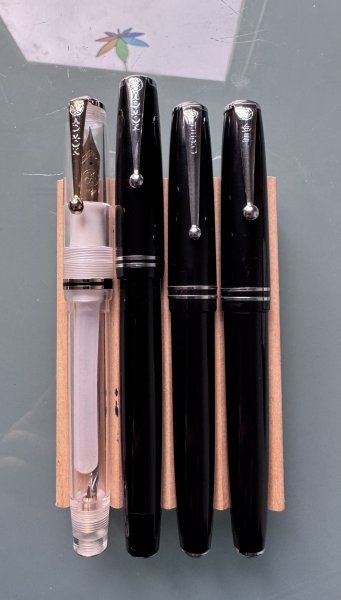
Here is a diagram (copyright) I created for my article on the history of oblique pens. ("The Angles of our Better Writing," The Pennant, Fall, 2019). I've also attached a photo of the four main type of oblique nibs (these are dip nibs) from my collection that also appeared in the article. 


image.thumb.png.e517db23f01eb16f2bb614134a0d8e22.png

image.thumb.png.01b27635c07c5f3a44ef1ffd533c91b5.png


“When the historians of education do equal and exact justice to all who have contributed toward educational progress, they will devote several pages to those revolutionists who invented steel pens and blackboards.” V.T. Thayer, 1928


Check out my Steel Pen Blog. As well as The Esterbrook Project.

"No one is exempt from talking nonsense; the mistake is to do it solemnly."

-Montaigne

Link to comment
Share on other sites

Quote


Thank you @AAAndrew, this is very helpful. I'm using regular fountain pens, mostly 1950's era Omas (with the heart-shaped feeder hole). I've picked up several online that have different levels of flex. Am getting much better at it, and one certainly does want to turn the paper much more when doing more decorative work (and adding more pressure to the pen). 


Your clue about keeping elbows closer is helpful as well, I hadn't considered that!


As for oblique pens, I'll look up your article. I've struggled to use obliques, somehow they always feel a bit off and scratchy.

Link to comment
Share on other sites

Just one point of clarification, because there is often confusion around this, "oblique" when referencing dip pens means that the point of the nib points at an angle to the axis of the pen. When talking about fountain pens, "oblique" means that the nib is a stub that is not cut straig ht across but at an angle. (left oblique and right oblique). My article discusses the origins of the oblique dip pen. I'm attaching a pdf of the article below. 


2020-2 Oblique.pdf


“When the historians of education do equal and exact justice to all who have contributed toward educational progress, they will devote several pages to those revolutionists who invented steel pens and blackboards.” V.T. Thayer, 1928


Check out my Steel Pen Blog. As well as The Esterbrook Project.

"No one is exempt from talking nonsense; the mistake is to do it solemnly."

-Montaigne

Link to comment
Share on other sites

Thank you for posting the article @AAAndrew. I hadn't been able to find it otherwise. Those vintage pens are quite beautiful. It's interesting to imagine all this refinement and development of different pens, most of which is either lost or appreciated by just a few people nowadays.


And yes, it is oblique nibs (cut at an angle) that I've struggled with. I do continually rotate the paper depending on what I'm doing (with a normal nib). 

Link to comment
Share on other sites

Create an account or sign in to comment

You need to be a member in order to leave a comment

Create an account

Sign up for a new account in our community. It's easy!

Register a new account

Sign in

Already have an account? Sign in here.

Sign In Now


×
×
  • Create New...