Jump to content

A practical approach to categorising inks by colour


mhwombat

Recommended Posts

I write with black ink 95% of the time, but I like to use other colours to make certain things stand out, like the date, or column headings, or tasks I need to do. When I get a new notebook, I select the accent colours I want to use with it, and tend to stick with that until the notebook is finished.


When I first started buying ink, I looked for colours that caught my eye. That's how I ended up with more purple inks than I will ever need. I love purple, but don't actually write with it that often.


So then I decided to look for colours that caught my eye but weren't purple. I now have enough sage/olive inks to open my own sage/olive ink store. 🤣 This was progress, however, since I love writing with these colours.


I also looked for colours that I didn't have, so before long I ended up with a couple of reds, a couple of blues, and so on across the spectrum. But I still find that when I'm looking for a colour; I don't have anything suitable. So I want a few more colours to fill the gaps, but I now need to buy strategically. The problem is, I can't easily tell what I'm missing. I needed a better system for keeping track of my inks.


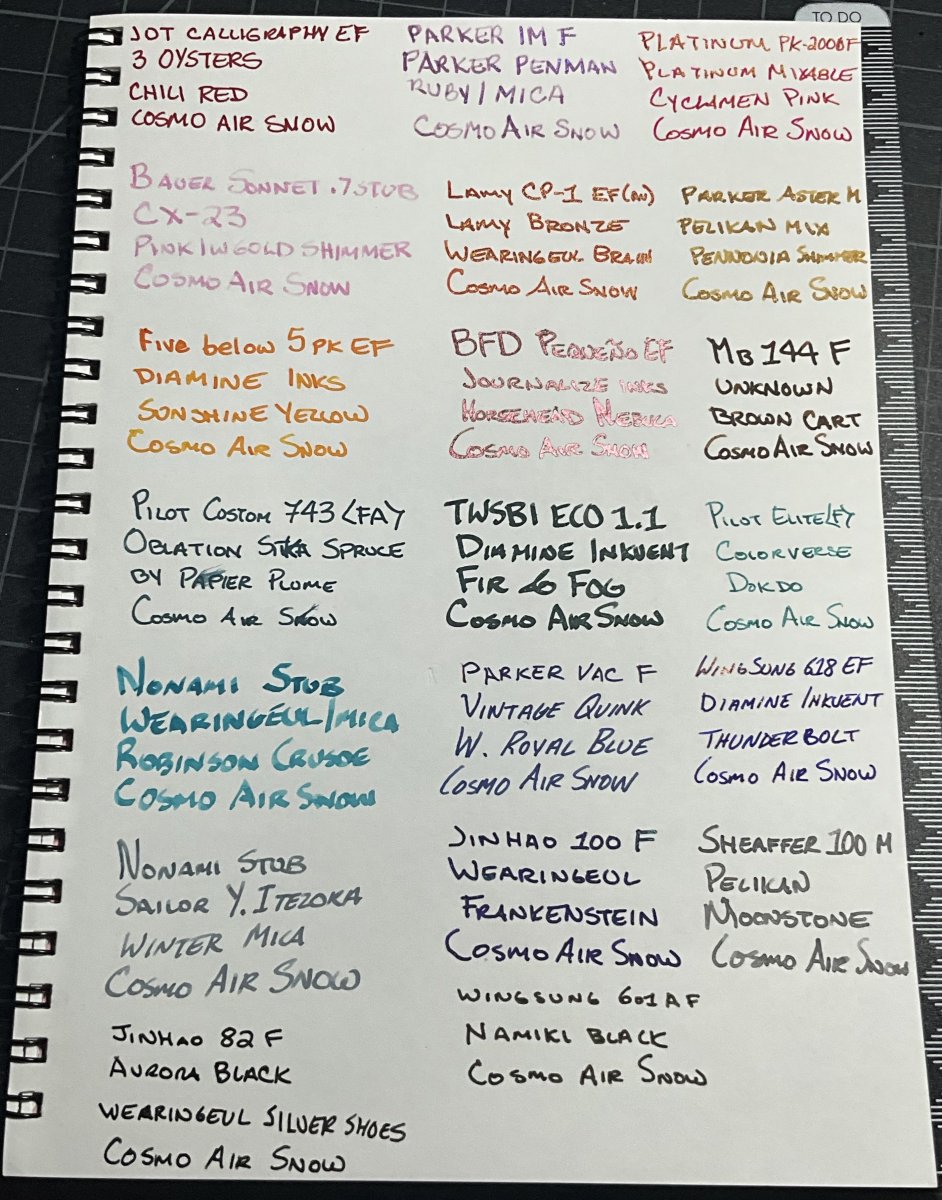
Currently I have swatches of all my inks, paper-clipped together by colour family. This doesn't work well for inks that straddle the line between two colours. For example, I might be looking for a brown, but not notice reddish/brownish Diamine Ancient Copper because I filed it under red.


So I decided to create a spreadsheet that I could filter by colour. That way an ink could be in more than one colour category. However, I quickly found myself debating about undertones and sheen, and so on. I kept changing my mind about which categories to include an ink in. I even experimented with measuring RGB and HSL, but the more precise I tried to get, the less useful the result was.


Finally I figured out a simple solution that doesn't have me bogged down in looking for undertones and the colour of the sheen, and so for. I ask myself a question such as "If I were looking for a red ink, would I consider using this ink?" If so, I include the ink in the red category. I find that a much easier question to answer, and my answer is unlikely to change from day-to-day.


The categories that work for me are red, orange, yellow, green, blue, white, black, brown, grey, purple, pink, and sage/olive (because it's a fave). You might find yourself frequently looking for, say, a turquoise ink, so you might want to add that as a category and include the greenish-bluish inks there.


looking for a pen with maki-e dancing wombats

Link to comment
Share on other sites

  • Replies 12
  • Created
  • Last Reply

Top Posters In This Topic

  • Bo Bo Olson

    4

  • mhwombat

    3

  • midnightblues

    2

  • DrDebG

    1

Top Posters In This Topic

Posted Images

As a seldom buyer of inks, never thought of a spread sheet.


With 100, way to late to even think of starting.


I have a simple system.......I come to inky thoughts or ink reviews and say....oh, I got that nice ink, and soon have way too many pens inked.

The Reality Show is a riveting result of 23% being illiterate, and 60% reading at a 6th grade or lower level.

      Banker's bonuses caused all the inch problems, Metric cures.

Once a bartender, always a bartender.

The cheapest lessons are from those who learned expensive lessons. Ignorance is best for learning expensive lessons.


Link to comment
Share on other sites

At one point I tried to organize my ink samples by color (say, all black/grey inks in one sample vial tray) and have a spread sheet for each tray so I could find what I was looking for.  But I'm so out of date at this point, and keep buying samples so it's sort of a lost cause.

As for categorizing inks by color in general?  I look at the reviews and decide whether it's a ink that's JUST enough different from any other ones in the stash for that color (such as purple) and sort of make a decision as I go....  I do have files on my laptop of inks by color (both as a list and a spreadsheet which include notes and whether or not I've actually tried it yet), and by brand (where the list is by color but in a very generalized fashion).

Ruth Morrisson aka inkstainedruth

"It's very nice, but frankly, when I signed that list for a P-51, what I had in mind was a fountain pen."

Link to comment
Share on other sites

On 2/11/2023 at 1:11 AM, mhwombat said:

So I decided to create a spreadsheet that I could filter by colour. That way an ink could be in more than one colour category. However, I quickly found myself debating about undertones and sheen, and so on. I kept changing my mind about which categories to include an ink in. I even experimented with measuring RGB and HSL, but the more precise I tried to get, the less useful the result was.

just by reading this, I felt like this rabbit hole is SOOO deep that I can't even imagine!  How many hours did you spent tunneling in the dark (but must be colourful) tunnel?

Link to comment
Share on other sites

5 hours ago, AceNinja said:

How many hours did you spent tunneling in the dark (but must be colourful) tunnel?

😂 Only about 4 hours (including the false starts). I'm a computer geek, so I used a few tricks to speed things up.

looking for a pen with maki-e dancing wombats

Link to comment
Share on other sites

I've tried to figure out a way to organize my inks on computer, but I've never found a strategy that made me satisfied. 


As an old person, I have to confess to a deep-seated tendency to go "old-school".  So the method that works best for me is the prehistoric box o' note cards.  I can create a sample card for each ink I have, and put them in the order that makes sense to me. When I get a new bottle of ink, I lay out a series of cards in the color zone, to see where the new one fits.  


Not at all hi-tech or scientific, but it works for this old-fashioned humanist.  😉


Link to comment
Share on other sites

Great question!  


I understand where you are at.  I too have used the swatch cards, the index cards, the spreadsheets (I have 4 different spreadsheets that I have used), and have even used Fountain Pen Companion (fountainpencompanion.com).  But none of these really worked for me.  The swatch cards and index cards took up too much room and I was never up to date with them.  The spreadsheets were also just way too much - and I couldn't put the exact color of the ink into the spreadsheet with the shading/sheen. 


My solution:  I purchased a small (4x6) notebook with Tomoe River paper that had lots of pages (I got mine from Nanami Paper).  I divided the notebook into 2 sections - the first section is by brand, the second section by general color (blues, turquoise, teal, green, yellow, etc.) For the first section, on a separate piece of paper, I wrote down every ink brand that I could conceivably purchase ink from, then alphabetized them.  Then in the first two pages of the notebook, I listed out the ink brands and assigned them a page (oh - I numbered each page before I started).  I knew that with some brands I would have multiple pages and that I would be likely to purchase more colors from certain brands, so these got additional pages.  For the section, I divided up the number of pages into the general colors that I would use.  For me that was 13 colors.  Since I knew I only had lots of blues and very few blacks, I divided the pages accordingly.    


Then, I started out in part 1 listing each ink in that brand and adding a "swipe" of ink color next to the name of the ink.  After the ink dried, I went to that particular color, then added the brand/color name and another "swipe of ink".  Sometimes, I will add small notations to my notebook.  And example is if the ink is water resistant, it will get an H2O and a check mark beside it, or a null sign if it isn't water resistant.  Or, if I have finished the bottle, I will notate "NA" (not available anymore).  


For me, this works out quite well.  I have well over 100 inks now and this helps me stay somewhat organized.  


ink notebook - brand.jpg

ink notebook - color.jpg

"Today will be gone in less than 24 hours. When it is gone, it is gone. Be wise, but enjoy! - anonymous today


Link to comment
Share on other sites

I have a spreadsheet, with brand, colour name and colour family (this one can sometimes be a bit challenging). There's a pivot table that produces a chart of inks by colour as well. This is mainly used for quick reference when I'm fancying a new ink to make sure 1. I don't actually have it already, and 2. how many inks I have already in that colour family, although this rarely dissuades me! 


I then have two boxes of swatches. Mainly because I like swatching 😊 The first one is on Exacompta plain index cards, with a dip pen writing sample and a splodge put on with a paintbrush. If I remember, I'll add a little note with an FP when it's inked with that colour so I can see it in different pens. These are organised by colour, the ones that are a bit in-betweeny I compare with existing, and also consider "what colour would I be looking for" and then file accordingly. The second set are ink splats, because splatting ink is fun. These are on Peter Pauper Press artist's tiles, which are little squares in heavy cardstock. I then write the ink brand and name with whatever pen is handy. These are organised by brand and then alphabetically.  


I like having cards so I can compare different inks easily without flipping pages. 

Link to comment
Share on other sites

10 hours ago, midnightblues said:

Exacompta plain index cards

Are they very good?


10-12 years ago, when I last went tot he States I forgot to buy a pack of the best plain lined index cards...........and occasionally on the German second class index I have a touch of feathering.


Of course I've not asked anyone for the name of first class mainland  Euro index cards.:headsmack:

The Reality Show is a riveting result of 23% being illiterate, and 60% reading at a 6th grade or lower level.

      Banker's bonuses caused all the inch problems, Metric cures.

Once a bartender, always a bartender.

The cheapest lessons are from those who learned expensive lessons. Ignorance is best for learning expensive lessons.


Link to comment
Share on other sites

11 hours ago, Bo Bo Olson said:

Are they very good?


I've found them to be perfect for this - I use the Exacompta Bristol 75x125 Plain, in a blue and white packet. Admittedly I've had these a good while, but Exacompta are part of Clairefontaine I think so the quality should be consistent. I specifically wanted plain ones and they were a bit hard to find! You can slap ink on generously and they behave themselves.

Link to comment
Share on other sites

:thumbup:...................now to ........ gee I'm so old fashioned, it was my last thought, not first to go on line. My first thought was to go to my B&M.....

In I want to keep him in business and every Euro helps.....I can call up and ask.

I'll go down town....he's near a Subway Cookie Joint.....:rolleyes:

The Reality Show is a riveting result of 23% being illiterate, and 60% reading at a 6th grade or lower level.

      Banker's bonuses caused all the inch problems, Metric cures.

Once a bartender, always a bartender.

The cheapest lessons are from those who learned expensive lessons. Ignorance is best for learning expensive lessons.


Link to comment
Share on other sites

1 hour ago, Bo Bo Olson said:

I'll go down town....he's near a Subway Cookie Joint.....:rolleyes:

I'm picturing some guy in a trench coat saying "Psst... wanna buy some stationery?"

looking for a pen with maki-e dancing wombats

Link to comment
Share on other sites

1 hour ago, mhwombat said:

"Psst... wanna buy some stationery?"

B)

I do happen to have a trench coat, bought in the old days, have a fedora also....."Psst...Parisian Ink?"

The Reality Show is a riveting result of 23% being illiterate, and 60% reading at a 6th grade or lower level.

      Banker's bonuses caused all the inch problems, Metric cures.

Once a bartender, always a bartender.

The cheapest lessons are from those who learned expensive lessons. Ignorance is best for learning expensive lessons.


Link to comment
Share on other sites

Create an account or sign in to comment

You need to be a member in order to leave a comment

Create an account

Sign up for a new account in our community. It's easy!

Register a new account

Sign in

Already have an account? Sign in here.

Sign In Now


×
×
  • Create New...