Jump to content

On (not) learning handwriting


Aelfattrum

Recommended Posts

An Atlantic article "Gen Z never learned to read cursive (how will they interpret the past?)" by Drew Gilpin Faust: https://www.theatlantic.com/magazine/archive/2022/10/gen-z-handwriting-teaching-cursive-history/671246/


(And an interesting comment section at Hacker News on the article: https://news.ycombinator.com/item?id=32884213 - containing the full range of views from "missing something vital (that improves learning)" to "antiquated nonsense that no-one needs".)

Link to comment
Share on other sites

  • Replies 18
  • Created
  • Last Reply

Top Posters In This Topic

  • amberleadavis

    4

  • Paul-in-SF

    2

  • IThinkIHaveAProblem

    2

  • arcfide

    2

It strikes me that the need to interpret cursive writing on historic documents is a fairly niche activity, like knowing Latin. I can read cursive, but I don't know how I would do with 19th-century handwriting, even more so anything earlier. 


I learned cursive in grade school, of course, being old, but once I got a typewriter I had no particular need to keep up the quality of my cursive writing, at least not for schoolwork. Then computers came along, and it seemed cursive was even less necessary. By then, when I needed to write something down I printed (in all caps). I got to be fairly fast at that, and my printing was both neat and somewhat expressive. 


Now I do cursive writing because I like doing it, and mine has certainly improved with practice. Come the apocalypse and we are all reduced to writing everything by hand again, I don't think cursive will be the first thing we regret not knowing. 

Link to comment
Share on other sites

1 hour ago, Paul-in-SF said:

It strikes me that the need to interpret cursive writing on historic documents is a fairly niche activity, like knowing Latin. I can read cursive, but I don't know how I would do with 19th-century handwriting, even more so anything earlier.


This may be the case eventually, but what about old family documents? How many people will be unable to read letters and other texts left by their own parents and grandparents?

This may not be sufficient justification for the continued teaching of cursive, but it's not anywhere near as niche as Latin is at this point.


As an aside, I'll add that one advantage of cursive that i rarely see mentioned, which I found useful as a student, was the fact that it allowed me to take notes with only occasional glances down at the paper.

Link to comment
Share on other sites

3 hours ago, Silvicolus said:

As an aside, I'll add that one advantage of cursive that i rarely see mentioned, which I found useful as a student, was the fact that it allowed me to take notes with only occasional glances down at the paper.


I've never tried that, I suspect I would find mine difficult to read. I'm a touch typist, so if I can type in a way that won't disturb other people, I'd rather do that. 


I'm not intending to argue against the teaching or learning of cursive, just trying to introduce some perspective about the view that it's a great cultural loss that so many people can't read or write it, and aren't interested in doing so. 

Link to comment
Share on other sites

I've been rewriting documents like the US Constitution so that my kids can someday learn how to "translate" my handwriting.  Isn't that sad.

Fountain pens are my preferred COLOR DELIVERY SYSTEM (in part because crayons melt in Las Vegas).

Create a Ghostly Avatar and I'll send you a letter. Check out some Ink comparisons: The Great PPS Comparison 

Don't know where to start?  Look at the Inky Topics O'day.  Then, see inks sorted by color: Blue Purple Brown Red Green Dark Green Orange Black Pinks Yellows Blue-Blacks Grey/Gray UVInks Turquoise/Teal MURKY


Link to comment
Share on other sites

5 minutes ago, amberleadavis said:

I've been rewriting documents like the US Constitution so that my kids can someday learn how to "translate" my handwriting.  Isn't that sad.

That’s actually a really neat idea

Just give me the Parker 51s and nobody needs to get hurt.

my instagrams: pen related: @veteranpens    other stuff: @95082photography


Link to comment
Share on other sites

35 minutes ago, IThinkIHaveAProblem said:

That’s actually a really neat idea


Thank you..

Fountain pens are my preferred COLOR DELIVERY SYSTEM (in part because crayons melt in Las Vegas).

Create a Ghostly Avatar and I'll send you a letter. Check out some Ink comparisons: The Great PPS Comparison 

Don't know where to start?  Look at the Inky Topics O'day.  Then, see inks sorted by color: Blue Purple Brown Red Green Dark Green Orange Black Pinks Yellows Blue-Blacks Grey/Gray UVInks Turquoise/Teal MURKY


Link to comment
Share on other sites

My position stems primarily from the perspective that a citizen cannot truly be fully independent and self-governing in the truest sense without the competency and skills to explore and investigate history without the filters of interpretation, selection, and culling of others to do the initial processing work. I think the modern world pays a lot of lip service to history, but criminally undervalues a wide, deep, and popular exposure to and experience of tangible history (in the form of original sources, books, documents, *people*, etc.). History matters, I think, way more than people tend to act like they think it does. 


And that means, for instance, that I actually don't think Latin is as "niche" as people want to make it out to be. After all, one of the most historically significant and politically powerful events to occur in Western civilization (the Great Schism between the Roman Catholic and Eastern Orthodox churches around approx. 1054 A.D.) occurred in part because of a single word in a single Latin "document". A proper understanding of that can only be really appreciated if you at least have something of an exposure to Latin, Greek, and the writings and cultures of that era, yet we are still experiencing the effects of that event today. 


Or what about our ability to read and appreciate the nature of German writings around the Nazi period in the early 20th century, with their particular coopting of the scripts of that time, and how that plays into a number of other cultural effects that we see around the use of fonts and scripts across Europe and the Americas? Those things teach really important lessons that are often easier to learn when they are somewhat distant from us, but close enough to still feel relevant. Or reading the original draft of some of the U.S.'s historical writings from Thomas Jefferson and others? You don't get the same impact reading a version that has been edited out of the original into a typed format. There are lessons in the handwriting. 


Or the difficulties that occurred in preserving certain ideas and essays in Ancient China due to various book burnings and later losses of continuity of skill with regards to the meanings and usage of certain characters/ideographs? That's still a problem today. 


Being able to physical, personally, and individually engage with the past in its authentic form creates a level of connection and potential grounding that can have serious consequences if it is lost. So, I don't think that everyone should be expected to write in cursive these days, but I certainly think that knowing how to read and engage with cursive writing from all the range of eras is a part of basic educational requirements. I also think we ought to encourage a wider etymological skill for much the same reason. 

Link to comment
Share on other sites

3 hours ago, arcfide said:

My position stems primarily from the perspective that a citizen cannot truly be fully independent and self-governing in the truest sense without the competency and skills to explore and investigate history without the filters of interpretation, selection, and culling of others to do the initial processing work. I think the modern world pays a lot of lip service to history, but criminally undervalues a wide, deep, and popular exposure to and experience of tangible history (in the form of original sources, books, documents, *people*, etc.). History matters, I think, way more than people tend to act like they think it does. 


well said

Just give me the Parker 51s and nobody needs to get hurt.

my instagrams: pen related: @veteranpens    other stuff: @95082photography


Link to comment
Share on other sites

3 hours ago, arcfide said:

My position stems primarily from the perspective that a citizen cannot truly be fully independent and self-governing in the truest sense without the competency and skills to explore and investigate history without the filters of interpretation, selection, and culling of others to do the initial processing work. I think the modern world pays a lot of lip service to history, but criminally undervalues a wide, deep, and popular exposure to and experience of tangible history (in the form of original sources, books, documents, *people*, etc.). History matters, I think, way more than people tend to act like they think it does. 


And that means, for instance, that I actually don't think Latin is as "niche" as people want to make it out to be. After all, one of the most historically significant and politically powerful events to occur in Western civilization (the Great Schism between the Roman Catholic and Eastern Orthodox churches around approx. 1054 A.D.) occurred in part because of a single word in a single Latin "document". A proper understanding of that can only be really appreciated if you at least have something of an exposure to Latin, Greek, and the writings and cultures of that era, yet we are still experiencing the effects of that event today. 


Or what about our ability to read and appreciate the nature of German writings around the Nazi period in the early 20th century, with their particular coopting of the scripts of that time, and how that plays into a number of other cultural effects that we see around the use of fonts and scripts across Europe and the Americas? Those things teach really important lessons that are often easier to learn when they are somewhat distant from us, but close enough to still feel relevant. Or reading the original draft of some of the U.S.'s historical writings from Thomas Jefferson and others? You don't get the same impact reading a version that has been edited out of the original into a typed format. There are lessons in the handwriting. 


Or the difficulties that occurred in preserving certain ideas and essays in Ancient China due to various book burnings and later losses of continuity of skill with regards to the meanings and usage of certain characters/ideographs? That's still a problem today. 


Being able to physical, personally, and individually engage with the past in its authentic form creates a level of connection and potential grounding that can have serious consequences if it is lost. So, I don't think that everyone should be expected to write in cursive these days, but I certainly think that knowing how to read and engage with cursive writing from all the range of eras is a part of basic educational requirements. I also think we ought to encourage a wider etymological skill for much the same reason. 

Very well put. 

Link to comment
Share on other sites

Is there a significant difference between

a) writing using standard letter shapes, that are joined together simply because the pen is not lifted from the paper, but are otherwise the same shapes that might be used for separated letters, vs

b) writing in an extreme cursive style where individual letter shapes have become severely abreviated or distorted into curious loops or waves that have little or no resemblance to the shapes that would be used for separated letters?


I hope that my handwriting is as "a)" above, and that it will be legible to future readers. 🤞🤞🤞?


There are old family documents in cursive script that I do find difficult to decipher. Not because they are "cursive", but because the letter forms used are barely different from a continuous slightly wavy line! Often we are reduced to finding a sample word that is of known certain meaning from its context - then saying "OK, so that little loopy thing must be a letter "r" - so this other mystery word seems to have an "r" in it ....... only to later find some other word with an "r" that has lost its loop and degenerated into a vague bump in the line!


I am curious to know what is the source of difficulty predicted with future generations who will be "unable to read" cursive handwriting? Is that all cursive handwriting? Or specifically weird or poorly formed cursive handwriting as described in "b" above?


The links given in the original post of this thread simply use the description "cursive" without any further description.


I also wonder, but will never know, if my grandparents could easily read the cursive script in family letters and postcards that I now find so impenetrable, or if they had exactly the same difficulty reading Aunt Mary's illegible cursive scrawl!


Link to comment
Share on other sites

6 hours ago, dipper said:

There are old family documents in cursive script that I do find difficult to decipher. Not because they are "cursive", but because the letter forms used are barely different from a continuous slightly wavy line! Often we are reduced to finding a sample word that is of known certain meaning from its context - then saying "OK, so that little loopy thing must be a letter "r" - so this other mystery word seems to have an "r" in it ....... only to later find some other word with an "r" that has lost its loop and degenerated into a vague bump in the line!


Some stuff was just easier to decipher because the perversions of the standard cursive of the time would have been similar between people using the same scripts, so there was a familiarity component to it. It's harder to read cursive for many people because they aren't as used to the strange things that occur when you aren't writing perfect cursive script. Combine that with the lack of contextual awareness given the time and era, and you have a difficult to read script. 


But poor handwriting was a problem even in the golden ages of penmanship in various countries, and a lot of competitive programs (at least in the US and Britain) focused on how to improve legibility or speed while retaining legibility. It's also interesting because we are just coming out of an age in which many people did most of their correspondence with pen and paper, and a *wide* number of people were expected to do so. In the even more distant past, we would have had a lot of scribal writings, but not as much everyday "business" writing. 

Link to comment
Share on other sites

I think it is kinda like learning to do basic piping or basic DIY. Of course, one may just throw away everything, buy into the disposable culture, and be a prolific client of "experts" paying for every service every now and then. Come to that, why mow the lawn? Prune? Keep plants when you can have plastic ones that do not need water or caring? Just spray them with the scent of the day and get done. Or why do any sports at all? Most of us do not need the physical strength to carry out our sedentary work.


Much like sport, writing has additional benefits beyond communication or making up strength. Like DIY, the ability to write makes one independent from silly gizmos and is more efficient than either typing the shopping list in your phone or voice recording it in your smartwatch. You cannot identify relevant information at a glance on a linear recording, but you can on a 2D page. I could go on and on...


For me (but then, I am in Europe and here that is not even discussed yet), typing is not a substitute, voice records neither, and even more, as a computer scientist, I've known it (typing) to be a fashion fade since I first used a computer: it is an obsolete interface from scratch. Even letters are, it is far more efficient to use steno.


When my sons were kids, I encouraged them to play outside and ignore computers. My reason? When they grew they would not be using keyboards. And actually now, they don't. Gestures, voice, haptic interfaces are taking over. And brain implants are on the horizon.


By the same reasoning we shouldn't teach them to type. But I find typing has its place too, allowing one to be more efficient at some tasks than other interfaces. I do also find a large screen (or several) more efficient than a smartwatch for some tasks.


So, if we are to keep keyboards for some tasks, large screens for some jobs, small smartphone screens for others and tiny smartwatches for others, why not keep writing? I cannot see any valid  rational argument.


For me there is only one explanation.


When I was studying Medicine we were insistently stressed to avoid painful procedures and reduce hospital times... not because of the patient's recovery (at times even against recovery), but to avert patients hating medical procedures, so they would return and we could help them again in the future. Tonsils and appendectomies were typical cases way back then. If you do not know what I am talking about, ask an elder.


My guess is many people were "forced" to learn to write in the "hard" times when learning was less friendly, and, like getting their tonsils removed, developed an irrational hatred for writing. Their decisions not to return to writing are much like those of others who fear doctors, learning, reading, mathematics, etc... It doesn't mind if they grew to become PhDs, teachers, masters, whatever... they just have an irrational hatred.


Case in point: I am always amazed at the insistence of some communities in the exact shape of letters. A cursory look at a few writing books shows there are not two equal styles, and yet the shape of an 'r' is the source of endless arguments. Writing is for communication (even with oneself), not for showing off. When you have that stress, any deviation becomes unreadable, when you don't, everyone is so used to variation that almost any writing is acceptable. As most teachers from handwriting areas will confirm. Social implications of diversity are easily derived/applied.


Problem with an irrational hatred is it is very difficult to eradicate. It will take constancy and firmness for decades to overcome it. Not doing that (fighting irrational hatred) will result in irreparable losses at all levels.


If you are to be ephemeral, leave a good scent.

Link to comment
Share on other sites

  • 3 months later...

I find it interesting that people tend to equate "handwriting" with "cursive". The two are not the same. I write by hand all the time, and have not willingly used cursive since I was halfway through high school. 

Link to comment
Share on other sites

Maybe the confusion arises because in most of the world and calligraphic/paleographic circles "cursive" is "fast writing", usually referring to joined-letter writing, in opposition to lay English speaking that reserves the word for Engrosser's/Copperplate derived scripts.


If you are to be ephemeral, leave a good scent.

Link to comment
Share on other sites

7 hours ago, MadamBackslash said:

I find it interesting that people tend to equate "handwriting" with "cursive". The two are not the same.


I could not agree more.

I endeavour to be frank and truthful in what I write, show or otherwise present, when I relate my first-hand experiences that are not independently verifiable; and link to third-party content where I can, when I make a claim or refute a statement of fact in a thread. If there is something you can verify for yourself, I entreat you to do so, and judge for yourself what is right, correct, and valid. I may be wrong, and my position or say-so is no more authoritative and carries no more weight than anyone else's here.

Link to comment
Share on other sites

  • 2 weeks later...

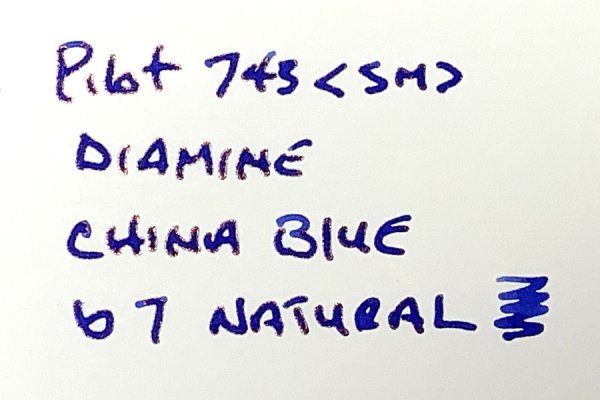
large.PXL_20230123_190159664.jpg.3c8df5cc2582d506498b056deab6c950.jpg

Fountain pens are my preferred COLOR DELIVERY SYSTEM (in part because crayons melt in Las Vegas).

Create a Ghostly Avatar and I'll send you a letter. Check out some Ink comparisons: The Great PPS Comparison 

Don't know where to start?  Look at the Inky Topics O'day.  Then, see inks sorted by color: Blue Purple Brown Red Green Dark Green Orange Black Pinks Yellows Blue-Blacks Grey/Gray UVInks Turquoise/Teal MURKY


Link to comment
Share on other sites

large.PXL_20230123_190208629.jpg.c3197745ffeb9872b71787dcc67fa48c.jpg

Fountain pens are my preferred COLOR DELIVERY SYSTEM (in part because crayons melt in Las Vegas).

Create a Ghostly Avatar and I'll send you a letter. Check out some Ink comparisons: The Great PPS Comparison 

Don't know where to start?  Look at the Inky Topics O'day.  Then, see inks sorted by color: Blue Purple Brown Red Green Dark Green Orange Black Pinks Yellows Blue-Blacks Grey/Gray UVInks Turquoise/Teal MURKY


Link to comment
Share on other sites

Create an account or sign in to comment

You need to be a member in order to leave a comment

Create an account

Sign up for a new account in our community. It's easy!

Register a new account

Sign in

Already have an account? Sign in here.

Sign In Now


×
×
  • Create New...