Jump to content

Identification help - Platinum 3776 Celluloid, tortoiseshell


Fatestorm

Recommended Posts

Hello Pen Friends,


I picked this pen up used, and I thought I'd reach out to you all for help seeing what I have.  The body is clearly Platinum 3776 Celluloid tortoiseshell.  I think there is a plastic inner cap, but I do not think it is the Century spring-loaded mechanism, making me think this an older model of the pen.


The main item of interest is the section, which seems quite dark or even just solid black.  When I look at promotional photos of the current model of the pen, it's quite clear that the section is made of the same sort of celluloid material as the rest of the pen, so. I am curious as to why mine is different.  Do you know if perhaps one of the early releases of this pen came with a solid black section?  Or is this a property of celluloid--maybe the prior owner left the section dunked in water too long and it changed color, for example? (I'm not sure if this can even happen, I'm just wondering out loud.).


Or perhaps the section was taken from another Platinum pen?  The section doesn't seem to match the style of the current 3776 century normal models, but again, perhaps there is an older one?  There is a gold ring around the front end of the section near the nib; but there is no gold ring around the back end of the section where it screws into the barrel.


I'm really happy with this pen's writing, as-is; I just have curiosity about it's provenance!  Thank you for your thoughts and help.

20211022_081849.jpg

With kind regards,
-Matthew

Link to comment
Share on other sites

  • Replies 24
  • Created
  • Last Reply

Top Posters In This Topic

  • stan

    6

  • Fatestorm

    6

  • A Smug Dill

    5

  • JulieParadise

    2

49 minutes ago, Fatestorm said:

I think there is a plastic inner cap, but I do not think it is the Century spring-loaded mechanism, making me think this an older model of the pen.


The current models of the Platinum #3776 Century Celluloid pens (with model number PTB-35000S) are not fitted with the Slip & Seal mechanism, either. That does not preclude the possibility that your pen may be a PTB-30000S; I'm not sure what, if anything, has changed in the transition from the older model number to the newer model number other than the retail price and the name (rebranding to Platinum #3776 Century from just Platinum #3776).


55 minutes ago, Fatestorm said:

When I look at promotional photos of the current model of the pen, it's quite clear that the section is made of the same sort of celluloid material as the rest of the pen,


Indeed; and, as you've pointed out, there should be a gold ring at the juncture between the gripping section and the barrel on the Celluloid models. If you do an image search for Platinum PTB-30000S, you'll see that the same holds true for the pens made several years ago.


I endeavour to be frank and truthful in what I write, show or otherwise present, when I relate my first-hand experiences that are not independently verifiable; and link to third-party content where I can, when I make a claim or refute a statement of fact in a thread. If there is something you can verify for yourself, I entreat you to do so, and judge for yourself what is right, correct, and valid. I may be wrong, and my position or say-so is no more authoritative and carries no more weight than anyone else's here.

Link to comment
Share on other sites

24 minutes ago, A Smug Dill said:


The current models of the Platinum #3776 Century Celluloid pens (with model number PTB-35000S) are not fitted with the Slip & Seal mechanism, either. 


Thank you for this help with precision in the manufacture of PTB-35000S!  This leaves the section and nib as the real curiosity to be solved--I will get to searching for historical photos of Platinum pens.

With kind regards,
-Matthew

Link to comment
Share on other sites

As I do own such a Platinum Celluloid I'd agree that your grip section does not match. In my pen (and probably all other 3776 celluloids) the "golden ring" really _is_ the juncture/backbone of the pen as it connects the grip section with the back end/barrel, forming the inner part of the grip section inside the outer celluloid grip and providing the threads that the barrel screws to. 


See the photo:


2021 09 24 Papier Plume Street Car Green Platinum 3776 Tortoise IB PX.jpg

Link to comment
Share on other sites

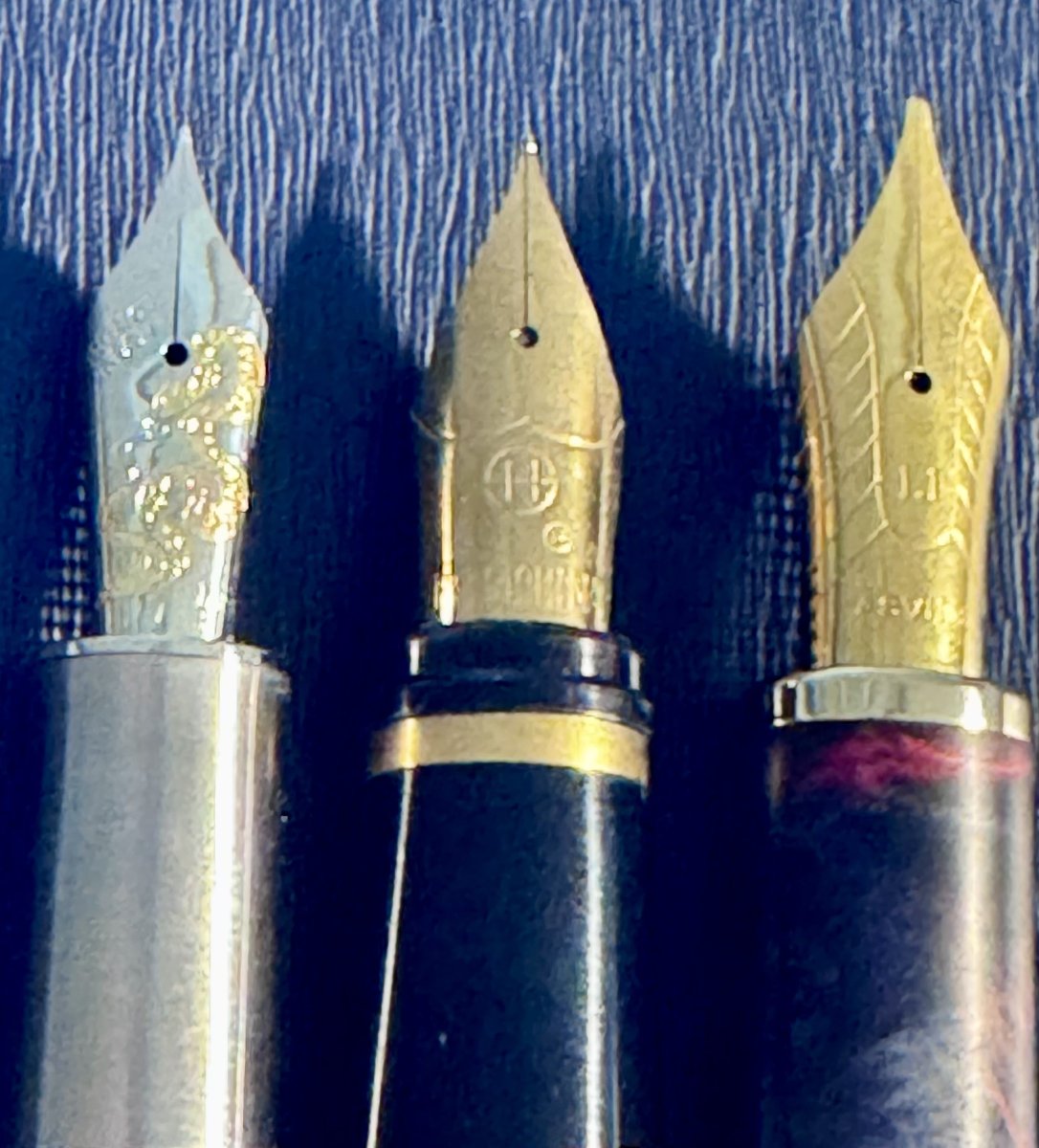
It's hard to discern clearly from @Fatestorm's photo of his pen, but if I'm not mistaken, where the nib width grade marking (e.g. 'B' on @JulieParadise's pen) should be on modern Platinum #3776 gold nibs, there's the old JIS symbol (discontinued late in 2008) instead.

https://images.app.goo.gl/yXpD94fDS2ER1wHi9


That suggests to me the gripping section, inclusive of nib and feed, was transplanted from an older model than any of the Platinum #3776 Celluloid pens as we know them.


I endeavour to be frank and truthful in what I write, show or otherwise present, when I relate my first-hand experiences that are not independently verifiable; and link to third-party content where I can, when I make a claim or refute a statement of fact in a thread. If there is something you can verify for yourself, I entreat you to do so, and judge for yourself what is right, correct, and valid. I may be wrong, and my position or say-so is no more authoritative and carries no more weight than anyone else's here.

Link to comment
Share on other sites

1 minute ago, A Smug Dill said:

That suggests to me the gripping section, inclusive of nib and feed, was transplanted from an older model than any of the Platinum #3776 Celluloid pens as we know them.


This seems likely, thank you!  I have attached two better photographs of the nib.


I notice the feed post (that goes inside the cartridge or converter) just comes directly out of the section--this is similar to some of the Celluloid models currently in production, but unlike the current 3776 models which all have a surrounding metal sort of "cradle".  And you are correct about the JIS symbol.


20211022_102624.jpg

20211022_101626.jpg

With kind regards,
-Matthew

Link to comment
Share on other sites

13 minutes ago, Fatestorm said:

I notice the feed post (that goes inside the cartridge or converter) just comes directly out of the section--this is similar to some of the Celluloid models currently in production,


All of them, actually, if I'm not mistaken.


The nib width grade is given in kanji (‘中’, for Medium) on your pen's nib, which yet again points to a much older design.


Even though your pen isn't a #3776 Gathered model, you may still want to read this thread below in its entirety, especially page 2 of it on which the inline images survived:

https://www.fountainpennetwork.com/forum/topic/312346-older-platinum-3776-nib-inscription/


I endeavour to be frank and truthful in what I write, show or otherwise present, when I relate my first-hand experiences that are not independently verifiable; and link to third-party content where I can, when I make a claim or refute a statement of fact in a thread. If there is something you can verify for yourself, I entreat you to do so, and judge for yourself what is right, correct, and valid. I may be wrong, and my position or say-so is no more authoritative and carries no more weight than anyone else's here.

Link to comment
Share on other sites

I've got two Platinum Celluloid examples and both have sections made of the same material as the body of the pen.


The OP's pen has a 14K nib while mine are 18K. Unfortunately, I can't say much more about the history of these two because I inherited them.


IMG_1683.thumb.JPG.d385e729541465e21c61e56c0505d33c.JPGIMG_1682.thumb.JPG.b1dceb2b569bc639e8df7e6854e2253e.JPG


Edited by andyturk
Link to comment
Share on other sites

33 minutes ago, andyturk said:

I've got two Platinum Celluloid examples and both have sections made of the same material as the body of the pen.


The OP's pen has a 14K nib while mine are 18K. Unfortunately, I can't say much more about the history of these two because I inherited them.


This is incredibly helpful, thank you!


So my nib is 14k, like the current production models; but older than 2008, when the JIS mark was discontinued.

There are also some differences in the cap band--mine is engraved with "Platinum #3776 Japan" around the cap band, with no scroll work or figure-8s on it, while I note that yours have little scrolly-decorations between "Platinum" and "Japan"--and it looks like the engraving has a different order to it, as well.


There is obviously the possibility (likelihood? certainty?) that there is frankenpenning going on here between the body and the section, but we're making good progress!  For what it is worth, the threading seems to be a perfect fit between the barrel and the section, but I'm sure that matching threading is very likely for a wide variety of Platinum pens.

With kind regards,
-Matthew

Link to comment
Share on other sites

New information!  As I've searched around, I found an image on the very popular auction site (I don't believe I am permitted to post direct links).  There is a listing for a "Platinum Fountain Pen 90s old model #3776 Celluloid Bekkō" that matches all the main features of my own pen (with the exception that the pen in this picture seems to have the kanji for fine, whereas mine is medium.


I am now going to see if I can find out more about the release and manufacture of these pens in the 90s!

s-l1600.jpeg

With kind regards,
-Matthew

Link to comment
Share on other sites

Okay here we go with the answer.


When introduced the celluloid 3776s had flat cap bands that read Platinum Japan 3776 and had 14K nibs with the JIS symbol. There was no gold trim ring between the barrel and section. This is the same as the black 3776 models also produced in the same time frame. All of these models had black ebonite (?) sections with ebonite feeds. You can tell by looking at the underside of the feeds - no circles from casting plastic. Also note the celluloid barrels have internal threads. There are three of these celluloid and several plain models in my collection.


Either contemporaneous to this issue or very soon after Platinum released celluloid models with 18K nibs with JIS symbols and with gold trim rings with a curved profile cap band with the three scrolls on each side of the 3776. These models have both ebonite sections in the earlier models and plastic in later models. Sections were made of the same celluloid as the barrel and cap. Barrels have a threaded insert to capture the sections. They are threaded inside of the celluloid barrel. This is a major design difference.


In my opinion Platinum developed a higher-end model to capture more market share - $$$. Heck! They knew they had a good thing going with the 3776 so why not also peddle an upgraded model. As I understand sales of 18K models were limited to Japan. I purchased a number of 3776s from their American dealer about 2000-2001 and do not recall seeing 18K nibs.


The models with 18K nibs appear to have tighter sections due to celluloid shrinkage. Some are easily removed and other require considerable effort or having the celluloid professionally enlarged. I've tried this on three pens and was successful at one. I'm not saying to avoid them but be careful when purchasing. If buying through photographs be sure there is one with the barrel removed with the inner threads of the barrel remaining in the barrel.


I hope the above settles the section questions. If not, please ask.


The celluloid models come in several flavors of which the black horizontal pine needle model is the rarest followed by the brown horizontal pine needle model. Platinum had a flavor noted as Holstein in their original output that I am not sure I have encountered and have not been able to accurately associate with a model modern color name. There are also a few modern models that are becoming increasingly difficult to find. 


Overall they are great pens. In my opinion the older nibs with ebonite feeds write better. The new models have the Slip & Seal cap that is a plus for some. For more it doesn't bring much to the pen.

stan

 R Y O J U S E N 霊 鷲 山 (stan's pens)
The oldest and largest buyer and seller of vintage Japanese pens in America.


Member: Pen Collectors of America & Fuente, THE Japanese Pen Collectors Club


Link to comment
Share on other sites

2 minutes ago, stan said:

The new models have the Slip & Seal cap that is a plus for some. For more it doesn't bring much to the pen.


With all due respect to your deep knowledge of the subject, neither the PTB-30000S nor the (current) PTS-35000S models in the latest incarnation of the #3776 Celluloid pens are fitted with Slip & Seal. Platinum does not advertised them as having the feature, and the two brand new units I bought a couple of years apart don't have it. They have inner caps that are not spring-loaded. The dealing effectiveness of the caps, in my experience, are not ideal and do not come close to that in the #3776 Century models that are fitted with Slip & Seal.

I endeavour to be frank and truthful in what I write, show or otherwise present, when I relate my first-hand experiences that are not independently verifiable; and link to third-party content where I can, when I make a claim or refute a statement of fact in a thread. If there is something you can verify for yourself, I entreat you to do so, and judge for yourself what is right, correct, and valid. I may be wrong, and my position or say-so is no more authoritative and carries no more weight than anyone else's here.

Link to comment
Share on other sites

16 hours ago, A Smug Dill said:


With all due respect to your deep knowledge of the subject, neither the PTB-30000S nor the (current) PTS-35000S models in the latest incarnation of the #3776 Celluloid pens are fitted with Slip & Seal. Platinum does not advertised them as having the feature, and the two brand new units I bought a couple of years apart don't have it. They have inner caps that are not spring-loaded. The dealing effectiveness of the caps, in my experience, are not ideal and do not come close to that in the #3776 Century models that are fitted with Slip & Seal.

My collection consists mostly of older 3776 models that were made prior to introduction to the Slip & Seal cap. There are a number of notable LE and SE exceptions. Don't pretend to be up to speed on when it was introduced however a good number of online dealers advertise celluloid 3776 models with Slip & Seal caps. Whether they are being falsely advertised or all are in error, I don't know. See below.


https://www.nomadostore.com/collections/platinum-izumo/products/platinum-3776-century-celluloid-koi-fountain-pen 


http://www.circleplus.com.hk/product/showproduct.php?lang=en&id=385 


https://www.lacouronneducomte.com/platinum-3776-celluloid-koi-fountain-pen.html 


https://www.andys-pens.co.uk/platinum-3776-fp-jade 


I checked my Japanese 1999 Platinum catalogue and all celluloid models came with 18K niibs, gold trim rings, and curved profile cap rings. This agrees with an earlier undated (assume 1990s) catalogue that shows the same pens. It is of interest earlier flat-top models by Platinum have the flat cap band and only a few makie models have it in the 1990s catalogues. To me this implies it was being phased out as the curved cap bands were being introduced.


In general I believe that if you have a model with a flat cap band it is older than those with curve bands. 


My guess is models with EF and UEF nibs tend to dry out faster. I use a M and F and rarely an EF. I use my pens regularly and do not allow them to sit for more than a day or two with ink in the pen. My philosophy its that pens were made for writing so use them. If you must store them do so with no ink. Even the Slip & Seal cap will not prevent corrosion of trim rings. The two pens regularly - a LE Izumo made for Kingdom Note and a gifted Pilot Silvern. Once in awhile will try another pen.


Regarding rarity of celluloid models do not expect to find any super-rare LE or SE flavors. Have not heard of any. There may have been one or two made with inscriptions or something for corporate clients but, again, not seen or heard of any. The pine needle striped models are the rarest and they were discontinued in 1999. There is a greyish celluloid model that was sold in Japan that is creeping up in rarity. Hardly ever see any for sale in secondary markets any longer. I also suspect the Sakura models to be hard to find in the future. Might be due to limited interest in color. They can still be acquired new at a number of outlets.


Sorry for the long speech. 

stan

 R Y O J U S E N 霊 鷲 山 (stan's pens)
The oldest and largest buyer and seller of vintage Japanese pens in America.


Member: Pen Collectors of America & Fuente, THE Japanese Pen Collectors Club


Link to comment
Share on other sites

On 10/24/2021 at 5:10 AM, stan said:

… a good number of online dealers advertise celluloid 3776 models with Slip & Seal caps. Whether they are being falsely advertised or all are in error, I don't know.


I'm afraid they are in error. I bought a Platinum #3776 Century Celluloid Calico from La Couronne du Comte just two months ago. I physically checked again just now (by pressing on it firmly using a q-tip), and the inner cap is not spring-loaded, ergo there is no Slip & Seal.


When the name of the pen models went from #3776 Celluloid to #3776 Century Celluloid, accompanied by a change in model numbers from PTB-30000S to PTB-35000S and the pricing they reflect, I thought the 16.7% price increase was ‘justified’ by the introduction of Slip & Seal to the pens as a value-add. Disappointingly, it was not so.


On 10/24/2021 at 5:10 AM, stan said:

My philosophy its that pens were made for writing so use them.


When I pull out a fountain pen from my 45-pen ‘display’ box, whether that's two days since its previous outing or only once in a blue moon, I generally don't do so to admire them, but expect to write with it even if only for, say, a third of a page; and I expect the pen to be a writing instrument that is ready to serve its purpose by writing upon being uncapped.


On 10/24/2021 at 5:10 AM, stan said:

If you must store them do so with no ink.


Analogously, I don't inspect, wash and/or sharpen my kitchen knives, or expect any preparatory work needs to be done to them, each time I pull one out to slice up some fruit for breakfast. It'd be a chore if I have to performance maintenance before I put an instrument or tool away so that it'll stand ready for its next use, but that to me at least may be worthwhile. If I have to select, retrieve and open up a bottle of ink every time I'm going to write, then I may as well write with a dip pen instead of a fountain pen with an internal ink reservoir that can supply ink for over a hundred pages of writing easily.


Given how well Sailor Profit, Pilot Custom, Platinum Izumo (which, by the way, does not have Slip & Seal by design), Aurora Optima, etc. almost invariably manage to keep a fill of ink from drying out in less than three months — but often in excess of six months — when capped and unused, without requiring special mechanical enhancements such as spring-loaded inner caps, I personally deem any pen that fail to seal comparably well to be intrinsically inferior. A pen that cannot prevent evaporation of a full fill of ink for at least three months between outings is not fit for purpose, as far as I'm concerned as its owner and user.


Sadly, the #3776 Celluloid models fall into the latter category. So I bought the Calico variant eyes wide open to its shortcoming, expecting to just admire it more than I would ink it and keep it ready to serve and do something useful for me.

I endeavour to be frank and truthful in what I write, show or otherwise present, when I relate my first-hand experiences that are not independently verifiable; and link to third-party content where I can, when I make a claim or refute a statement of fact in a thread. If there is something you can verify for yourself, I entreat you to do so, and judge for yourself what is right, correct, and valid. I may be wrong, and my position or say-so is no more authoritative and carries no more weight than anyone else's here.

Link to comment
Share on other sites

1 hour ago, A Smug Dill said:


I'm afraid they are in error. I bought a Platinum #3776 Century Celluloid Calico from La Couronne du Comte just two months ago. I physically checked again just now (by pressing on it firmly using a q-tip), and the inner cap is not spring-loaded, ergo there is no Slip & Seal.


When the name of the pen models went from #3776 Celluloid to #3776 Century Celluloid, accompanied by a change in model numbers from PTB-30000S to PTB-35000S and the pricing they reflect, I thought the 16.7% price increase was ‘justified’ by the introduction of Slip & Seal to the pens as a value-add. Disappointingly, it was not so.


When I pull out a fountain pen from my 45-pen ‘display’ box, whether that's two days since its previous outing or only once in a blue moon, I generally don't do so to admire them, but expect to write with it even if only for, say, a third of a page; and I expect the pen to be a writing instrument that is ready to serve its purpose by writing upon being uncapped.


Analogously, I don't inspect, wash and/or sharpen my kitchen knives, or expect any preparatory work needs to be done to them, each time I pull one out to slice up some fruit for breakfast. It'd be a chore if I have to performance maintenance before I put an instrument or tool away so that it'll be stand ready for its next use, but that to me at least may be worthwhile. If I have select, retrieve and open up a bottle of ink every time I'm going to write, then I may as well write with a dip pen instead of a fountain pen with an internal ink reservoir that can supply ink for over a hundred pages of writing easily.


Given how well Sailor Profit, Pilot Custom, Platinum Izumo (which, by the way, does not have Slip & Seal by design), Aurora Optima, etc. almost invariably manage to keep a fill of ink from drying out in less than three months — but often in excess of six months — when capped and unused, without requiring special mechanical enhancements such as spring-loaded inner caps, I personally deem any pen that fail to seal comparably well to be intrinsically inferior. A pen that cannot prevent evaporation of a full fill of ink for at least three months between outings is not fit for purpose, as far as I'm concerned as its owner and user.


Sadly, the #3776 Celluloid models fall into the latter category. So I bought the Calico variant eyes wide open to its shortcoming, expecting to just admire it more than I would ink it and keep it ready to serve and do something useful for me.


Uhhhhh...okay!

stan

 R Y O J U S E N 霊 鷲 山 (stan's pens)
The oldest and largest buyer and seller of vintage Japanese pens in America.


Member: Pen Collectors of America & Fuente, THE Japanese Pen Collectors Club


Link to comment
Share on other sites

On 10/22/2021 at 9:31 PM, stan said:

Okay here we go with the answer.


Thank you so much for sharing this extensive knowledge. This is exactly what I was hoping to find! 


The internet can help unearth so much information and so much history, but the 80s and 90s are still recent enough that they exist in living memory, but not recent enough to have well-documented info from the internet (because indeed preceding the internet).  I would love to find some of those 90s-era catalogues myself.

With kind regards,
-Matthew

Link to comment
Share on other sites

On 10/26/2021 at 6:10 AM, Fatestorm said:


Thank you so much for sharing this extensive knowledge. This is exactly what I was hoping to find! 


The internet can help unearth so much information and so much history, but the 80s and 90s are still recent enough that they exist in living memory, but not recent enough to have well-documented info from the internet (because indeed preceding the internet).  I would love to find some of those 90s-era catalogues myself.

The catalogues exist though not many around. Many dealers toss them as they move into the new year. Of a 100+ page catalogue maybe four or five pages are dedicated to fountain pens.


My preference is for the 1930s catalogues that include celluloid models. Some are in color.

stan

 R Y O J U S E N 霊 鷲 山 (stan's pens)
The oldest and largest buyer and seller of vintage Japanese pens in America.


Member: Pen Collectors of America & Fuente, THE Japanese Pen Collectors Club


Link to comment
Share on other sites

  • 5 months later...

Just to (belatedly) add more celluloid to the fire - I bought an old (and unaccompanied by box, manual or anything else that is not seen in the photographs) 3776 with an 18k, JIS-marked, nib. The seller (an auction house) had no idea about pens in general or this pen in particular, beyond the pen's previous owner.


I have not seen this pattern referenced anywhere on the interweb until reading this page and tumbling to the idea that THIS is what is called pine needle design (mine is the brown).


Many thanks all, especially stan.


M

Screenshot 2022-04-19 at 6.16.47.png

Screenshot 2022-04-19 at 6.17.04.png

Link to comment
Share on other sites

I bought the "Fountain Pens of Japan" book a couple of years ago (very expensive, but also a very wonderful and beautiful book - I just couldn't resist at one point...) The 3776 series was introduced by Platinum in 1978, and the photo attached here describes a series of special finish 3776 designs from 1992- 1994, this is the only reference I found that is in any way close to the pine needle design . The reference to the celluloid pattern models says there were 6 colors, including the Koi and Tortoise shell, and they were introduced in 1987.


image.thumb.png.b5a6da996111564522ab131103b0f1a5.pngI happen

Link to comment
Share on other sites

Create an account or sign in to comment

You need to be a member in order to leave a comment

Create an account

Sign up for a new account in our community. It's easy!

Register a new account

Sign in

Already have an account? Sign in here.

Sign In Now


×
×
  • Create New...