Jump to content

Pelikan m200 or m400 nib unit substitutions/modifications using an Esterbrook nib unit


halffriedchicken

Recommended Posts

I recently was able to obtain 3 Pelikan m200 pens for a very reasonable price. I also got a few other fountain pens not relevant to this thread, some old Esterbrook nibs, and several bottles of India ink. From the posting, I imagined that the user was selling everything for cheap because the pens were clogged with dried out India ink. I thought it was worth checking out and I was right because all of the pens were filled with India ink and completely dried out. The pens belonged to the seller's sister and she didn't realize that there is a different ink for fountain pens and dip pens (there were plenty of dip nibs in the set too). I will only address the Pelikans in this post.


I cleaned out the barrels and caps of the m200s and those cleaned out well with Windex. Ammonia works magic when cleaning dried India ink. There were 5 nib units: an italic nib, a 2mm nib, a 1.5mm nib, and two 1mm nibs. 4 out of 5 nibs were clogged. It took some time but I was able to take apart the nib units to clean the nibs and feeds. I cleaned the fins and channels of the feeds with an old dip nib. I find that dip nibs are so thin they can fit into the narrowest of channels and fins and they are strong enough to scrape out dried out India ink. But while I had the nib units taken apart I wanted to see if I could substitute anything and this is what I discovered. 


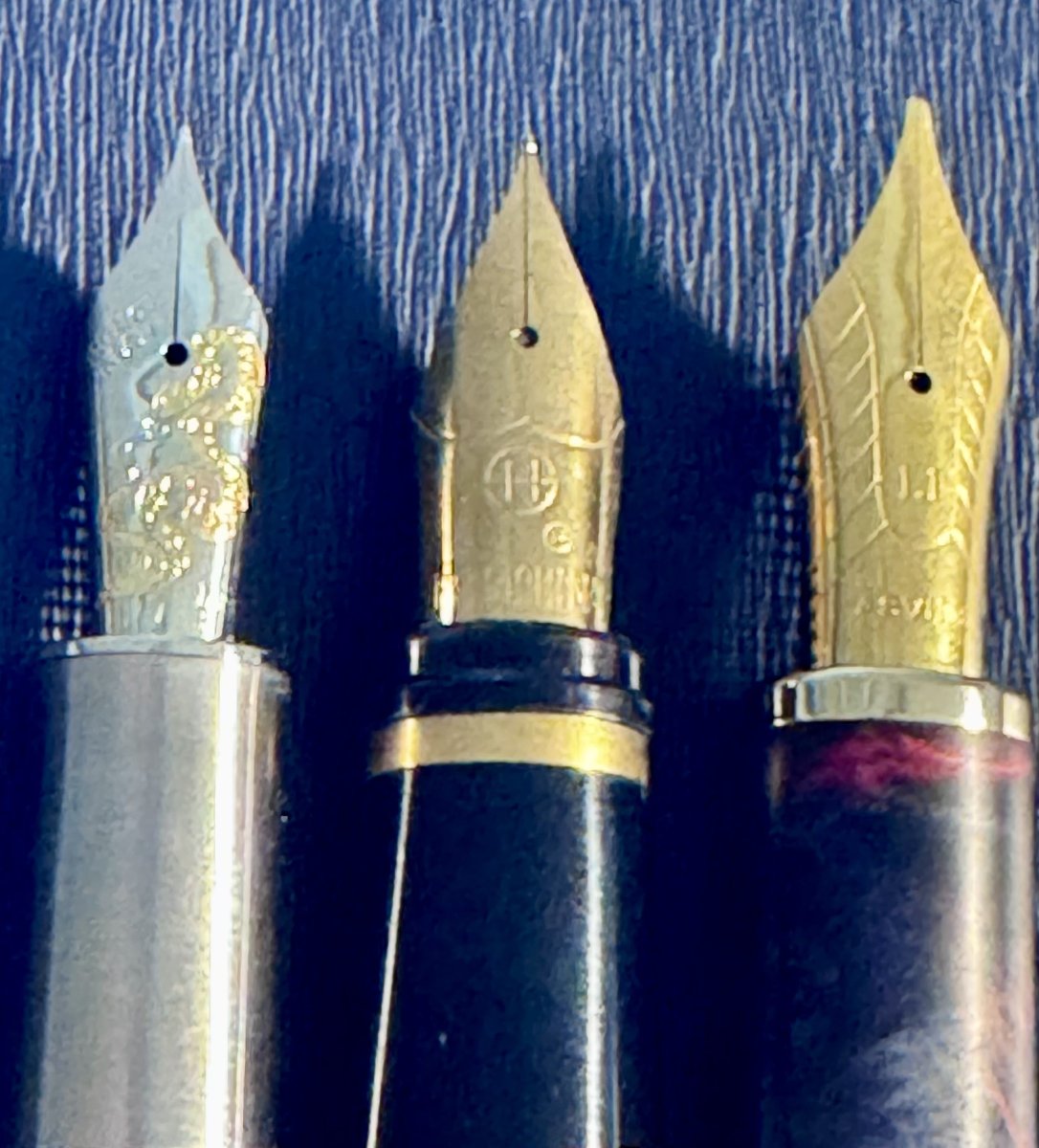
1) You can fit a Waterman Ideal  #2 nib in the m200 nib unit. It's a tight fit like the normal nib and feed in the collar but the Waterman #2 is practically the same size as the Pelikan nib and fits in the m200 nib unit perfectly. Just be careful with the fins on the plastic Pelikan feed because these can be bent out of shape. 

2) You can use the nib collar of a m200 nib unit to fit an Esterbrook ebonite feed but this is a loose fit so the collar might get stuck in the section.  The m200 feed is slightly larger in diameter so the nib unit is tight and snug so it screws in/out without coming apart. But just letting you know it is possible if you want to use a different feed with the m200 collar. A disposable wooden chopstick with the right taper can be used to remove the collar if that happens to you. You just stick it in and twist out the collar.

3) For a Pelikan m200 nib collar replacement, you can use an Esterbrook nib collar with a modification. You measure the Pelikan collar against the Esterbrook collar and cut off the unused portion with a razor blade. This collar obviously fits even better with the Esterbrook ebonite feed so that it is snug with a nib, which means this modified collar screws in and out easily from the m200/400. You use the collar upside down so the threads go into the pen first. I thought about adding some waterproof tape to adjust the thickness of the collar to match the Pelikan collar's metal ring, but I don't flex while writing so it doesn't seem necessary. With the Pelikan pens I also got a few rusted Esterbrook nibs that were crusted with India ink. I knocked out the nibs and feeds and cleaned out the channels and fins with an old dip nib. I used windex for the India ink and vinegar for the rust from the nib. I am planning to put the nibs in some vinegar and clean off the rust. If there's a lot of pitting I will probably throw those nibs away. With the old Esterbrook feeds and modified collars I have been able to fit a Waterman Ideal #2, a Parker Vacummatic nib, and a Swan #2 nib in my m200s.


Hopefully this will be helpful to someone in the future.

Ebonite feeds in m200.jpg

3 Pelikan m200s with Esterbrook ebonite feeds


Comparing Esterbrook and Pelikan collars.jpg

A comparison of an Esterbrook collar with a Pelikan collar


Esterbrook modified collar.jpg

A Pelikan m200 nib unit next to a Swan #2 nib in a modified Esterbrook collar with an Esterbrook ebonite feed


Pelikan m200 with a Waterman nib.jpg

A Waterman Ideal #2 in a Pelikan m200


Pelikan m200 with a Parker nib.jpg

A Parker nib in a Pelikan m200 using a modified Esterbrook collar and the Esterbrook feed


Pelikan m200 with a Swan nib.jpg

A Swan #2 in a Pelikan m200 using a modified Esterbrook collar and the Esterbrook feed

Link to comment
Share on other sites

  • Replies 9
  • Created
  • Last Reply

Top Posters In This Topic

  • halffriedchicken

    4

  • Bo Bo Olson

    3

  • carlos.q

    1

  • eerestis

    1

Popular Days

Top Posters In This Topic

Posted Images

Very good info.

I do have a Waterman Ideal nib laying around somewhere, but don't know if it's a @ 2.

And have enough semi-flex 400 nibs that I'd not have to do any work.


But for someone with out a semi-flex 400, being able to put a semi-flex Waterman Ideal nib in a 200 is a fine fix.

The Reality Show is a riveting result of 23% being illiterate, and 60% reading at a 6th grade or lower level.

      Banker's bonuses caused all the inch problems, Metric cures.

Once a bartender, always a bartender.

The cheapest lessons are from those who learned expensive lessons. Ignorance is best for learning expensive lessons.


Link to comment
Share on other sites

Excellent post and great information! 👍
 

One question: how did you take apart the Esterbrook nib unit?

Link to comment
Share on other sites

@Bo Bo Olson The Waterman #2 is the softest nib that I have. That you call it a semi-flex nib really makes me curious because I can't imagine how much softer a true vintage flex nib is. 


@carlos.q I don't have a knock out block, but the pens I bought also came with a Pelikan nib removal tool which I placed on top of the mouth of a sturdy plastic bottle to make a sort of knock out block. I used a disposable wooden chopstick as a punch to knock out the feed from the Esterbrook housing. I tapped the flat back of the feed with a hammer carefully to not damage the collar. I ruined one collar because I hit it too hard and the threads got crushed. If you don't have a knock out block, I've seen someone use the plastic case from a hex key holder as a makeshift knock out block because it has multiple sized holes and depending on the case it can be rigid enough without damaging the plastic collar. 

Link to comment
Share on other sites

As I said, it was a Waterman Ideal nib...or perhaps just an Ideal nib.....and it was no more than semi-flex. I didn't go look, just from memory.


It wasn't worth looking for a pen that the nib would fit; so it wasn't superflex....back then when I stumbled into that Ideal nib; I might well have been still investigating Swan looking for a superlex nib.


I do have a can't tell the size Waterman Ideal on one of my '52's, the other has just a Waterman #2 ...with no Ideal. Those two are Wet Noodles.

The Reality Show is a riveting result of 23% being illiterate, and 60% reading at a 6th grade or lower level.

      Banker's bonuses caused all the inch problems, Metric cures.

Once a bartender, always a bartender.

The cheapest lessons are from those who learned expensive lessons. Ignorance is best for learning expensive lessons.


Link to comment
Share on other sites

That's okay if you can't remember. I am just curious about vintage flex. I haven't tried enough to know what is the difference from a wet noodle to semi flex.

Link to comment
Share on other sites

I'm curious how well these write. I presume that you experience no leaks and you have satisfactory flow. Have you written with the nibs for how long?

Link to comment
Share on other sites

Nial = 1 X no tine movement. Many Parkers and others, like a modern post'97 Pelikan 800.

Semi-nail = if well mashed 2 X tine spread vs a light down stroke. P-75 modern Pelikan post '97 Pelikan 400/600.


The following are in a 3X tine spread set; if pushed more can result in a sprung nib.

Regular flex.....Modern Pelikan 200, the '82-97 semi-vintage Pelikan 400/600 and often many other pens in it was once a normal issue on Sheaffer, Esterbrook, Wearever pens.


Regular flex, if well mashed can get out to 3 X tine spread vs a light down stroke. One can not write when fully mashed. Soft +. (Like Japanese Soft nibs.)


Semi-flex requires only 1/2 the pressure to reach 3 X than regular flex. Before and '50's-70 German pens, often factory stubs, MB, Pelikan Geha, Osmia and others.....some early50's  Sheaffers....English Parker Jr. Duofold. Pilot Mod'ed pens(half moon ground into both sides of the nib) Soft ++.


Maxi-semi-flex, 1/2 the pressure needed to make semi-flex max at 3X, or 1/4th the pressure needed to mash a regular flex nib to 3X. (My WOG is one of 5 German semi-flex nibs are maxis. Soft +++


Difference between semi&maxi, is the alloy....the gold manufacturer Degussa in Germany who took over Osmia's nib factory for debt in 1932, made both semi-flex and maxi-semi-flex gold wheels for Osmia, and could have delivered the more flexible gold, if that wheel was closest to the lazy worker. Only in Osmia can you guess @ which nib marking was semi or maxi. No other company differentiated, so by them it's by guess and golly.


Superflex...will spread it's tines 4 X, mostly 5-6 X and very seldom 7X tine spread.... unless watching someone spring his nib on youtube just for you or selling a pre-sprung nib for your convenience on Ebay.


And you should read Richard Binder's article on Metal fatigue. If one of my nibs spreads to 5 X, I strive not to go more than 4X.....how much a superflex nib spread's it's tines safely, takes some experience. & once found out not taken there again!!!


Back to the Chase.....

Easy Full Flex, requires 1/2 the pressure of a maxi-semi-flex or 1/4th a semi-flex or 1/8th that of a regular flex to max it's tine spread..

Wet Noodle, half the pressure of an Easy Full Flex, or 1/16th the pressure needed to max a regular flex.

Weak Kneed Wet Noodle...a term invented by John Swoboda, the English nib grinder.....I just lucked into a pre '24 MB Safety Pen, and the nib is so much more flexi than a Wet Noodle; my system falls apart.

It is the middle of dip pen range.

Weak Kneed Wet Noodles ......middle flex dip pen neighborhood..... A Brause 328M or Mullers #9 oblique is more flexible by a tad...

Is @ = to my Soennecken # 11 or my Hunt Drawing.


Not equal to the hunt 99-100-101....Don't have the fabled  Gillette 303/404


The Reality Show is a riveting result of 23% being illiterate, and 60% reading at a 6th grade or lower level.

      Banker's bonuses caused all the inch problems, Metric cures.

Once a bartender, always a bartender.

The cheapest lessons are from those who learned expensive lessons. Ignorance is best for learning expensive lessons.


Link to comment
Share on other sites

Make sure that the  nib will clear the end of the cap when you do this.  Two chopsticks, or an inner cap gauge should be used.  All that it takes is the nib hitting the end of the cap and ending up ruined once, and you'll never forget.


spacer.png
Visit Main Street Pens
A full service pen shop providing professional, thoughtful vintage pen repair...

Please use email, not a PM for repair and pen purchase inquiries.

Link to comment
Share on other sites

@Bo Bo Olson Ah okay. That is a helpful gauge. I think I would describe this Waterman nib as a semi flex. 


@eerestis So far there are no leaks or issues with the modified nib units that I can see. I've only used these pens like this for a few days but I will update if I have any issues that come up. The collar is a snug fit with these nibs and feeds so there are no leaks there. The threads on the Esterbrook are the same as the Pelikan collar. The diameter of the collars where the threads are are identical and if you put the Pelikan collar threads against the Esterbrook collar they match perfectly with no light gaps between the threading (that a trick I learned with screws). So I knew the threads would match even before cutting the collar to test. Before this hack I was using these nibs in a Noodler's Nib Creeper and that has a feed with a wider ink channel than a typical plastic feed. The original nibs in the Pelikan were all stubs or an italic and the original feeds were good with flow. The only nib switch that fit the original nib unit was the Waterman nib and that was good. With the Esterbrook feeds the ink channel is wide so I get a more generous flow, which I personally like better. The ebonite feed from the Esterbrook is similar to the Noodler's Nib Creeper ebonite feed when it comes to flow from my experience. 


@Ron Z That's a good reminder. I did that once in the past with another pen with a Pilot SS nib, a lesson learned the painful way. I did check the nib this time but my gauge was to compare it with the regular nib to see if the tip or the wings would protrude, and all my nib swaps were smaller than the original. The chopstick method sounds like a simple alternative if you don't have an example. And this is definitely a good reminder for anyone else who tries this or any other nib swaps.

Link to comment
Share on other sites

Create an account or sign in to comment

You need to be a member in order to leave a comment

Create an account

Sign up for a new account in our community. It's easy!

Register a new account

Sign in

Already have an account? Sign in here.

Sign In Now


×
×
  • Create New...