Jump to content

What is on your bench?


VacNut

Recommended Posts

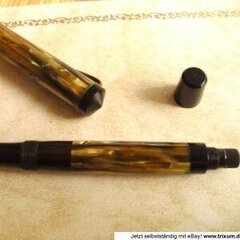
No idea how to fix this, despite endless googling (including FPN). 1960s French Watermans "Ligne 60" I think, nice nib: it's my Mum's. Presumably (?) the very thin filler tube needs a sac, or perhaps a sponge thingy, but no idea how to fit one or what to attach it to.  Alternatively: I found some CF cartridges, but they don't fit. No idea what the piece visible inside the section is: if nipple, inaccessible.


IMG_20250618_211639.jpg

IMG_20250618_211743.jpg

Link to comment
Share on other sites

  • Replies 1.8k
  • Created
  • Last Reply

Top Posters In This Topic

  • VacNut

    477

  • LoveBigPensAndCannotLie

    402

  • FarmBoy

    136

  • es9

    133

Top Posters In This Topic

Posted Images

Use a reducing flame. 

San Francisco International Pen Show - The next “Funnest Pen Show” is on schedule for August 23-24-25, 2024.  Watch the show website for registration details. 
 

My PM box is usually full. Just email me: my last name at the google mail address.

Link to comment
Share on other sites

10 hours ago, FarmBoy said:

Use a reducing flame. 


I think you're referring to the nib not the Watermans 🤣 But silliness aside, I didn't know that, and googling confirms you're right: most of my (limited) experience is with silver, and I always just automatically use blue oxidising not yellow reducing... thanks for the tip!

Link to comment
Share on other sites

I've been playing around with a project, and may have figured out the last couple obstacleslarge.20250619_125543.jpg.0810190ea738f983725732a8e31a61c1.jpg

Link to comment
Share on other sites

Oh dear, another post, sorry! Tried heat-setting for first time, fixed two Blackbirds. 


The first an older model, spoon feed, nib not working very nicely (I bought just body, then found nib): just standard bowl-of-hot-water heat-setting with nib-and-feed in section fixed it beautifully, writes lovely now. This one fine and springy, not much flex.


The second an early BB2, ladder feed, with radical dysfunction, nib-feed gap at least a mm: standard approach didn't work, so removed feed and heat-reshaped it... again this has fixed it very nicely, gap eliminated, writes lovely. This one medium with a lot of flex... bit too broad for my handwriting, but nice all the same. [Plus it has one of those lovely low-slung riveted clips.]


Happy!


[These are the Blackbirds with snapped feeds fixed using my improper metal-pins-and-cyanoacrylate approach described previously: both joins withstood all this re-setting work, phew.]


Link to comment
Share on other sites

14 minutes ago, gweimer1 said:

I've been playing around with a project, and may have figured out the last couple obstacleslarge.20250619_125543.jpg.0810190ea738f983725732a8e31a61c1.jpg


Apologies, didn't mean to bump you down from most-recent. Cryptic post!

Link to comment
Share on other sites

1 hour ago, gweimer1 said:

I've been playing around with a project, and may have figured out the last couple obstacleslarge.20250619_125543.jpg.0810190ea738f983725732a8e31a61c1.jpg

Is the entire filler new? 

Link to comment
Share on other sites

6 minutes ago, VacNut said:

Is the entire filler new? 


No, but I think I have figured out how to reproduce the plunger.   I have a pile of old vac pumps, but the one thing that seems to be the hardest to find is an intact plunger.

Link to comment
Share on other sites

23 hours ago, Nightjar said:

@VacNut "that’s another bitter, bitter story"... oh dear!


Soldered a nib today for first time (CS Dinky, so not a very important nib), to fix a break that ran about 3/4 of the way across the section end. Thermo-Gel, wow that's good stuff! Seems to have retained temper at business end, seems to have worked, not sure yet. (There is another crack from the breather hole. But then I noticed that the old regulator on my torch not fully gas-tight, so it's on hold while I order new torch/ tubing/ regulator... propane not to be messed with I think!)

How did you use the thermogel?  To protect parts of the nib you did not want heated? Sounds like a good way to protect the thinner part of the shank for a shank crack. I've been leaning a brass tube to touch this as a heat sink and has worked ok. Lately I've been trying to retip nibs by soldering a tip with iridium to the missing side, fun to try but difficult.

Regards, Glen

Link to comment
Share on other sites

Hi Glen! Yes, ThermoGel is a heat barrier, you daub it over what you want to protect. My main concern is messing with the temper of the tipped end, but maybe that's not a major concern, I'm just starting out, really don't understand this very well yet!


Blimey, re-tipping: I'm impressed! You mean attaching a new tipped tine (as opposed to new iridium to tine)? If new iridium, is that just gold solder temperature and the (iridium / ruthenium / platinum / whatever) alloy is unmelted? I need to look into that, but it sounds insanely difficult! [EDIT: Haha, looking at rather heated - no pun intended - previous posts, I see that actual re-tipping requires sophisticated electro-welding kit and highly specialised skills. Though ChatGPT plausibly indicates that in the old days they achieved sufficient temperature and precision with jewellers' torches.]

Link to comment
Share on other sites

There's an element of getting other people to do my homework for me, but can someone tell me all the bits I need to restore a Sheaffer Vac-Fil pen, and where I can buy them? I feel like it's gotten harder to source materials.


I know I need the following:

  • rubber washer for the front of the pen.
  • O-ring/washer combo for the back of the pen to seal it.
  • Proper size drill bit to drill out the old packing material.
  • Tool for getting the blind cap off.
  • Tool for pushing the plunger tube out (and put it back in later)

Did I miss anything?


I have been putting off trying to restore one of these for years, but I got a lot of a bunch of random pens as a gift recently and two of the pens are the open-nib vac fil ones. I figured I should at least give it a try. There's also a Triumph nib one but I will not be attempting that one without the right tool to take the nib off.

Link to comment
Share on other sites

Head gaskets?  I have them.  Others do as well, but this stuff is within a thousandth of an inch in thickness and is a high grade buna-N rubber.  I have yet to have any fail.  David Nishimura sells the packing 0-ring and retaining washers. (vintagepens.com)  


The drill bit is 1/4"  


Dale Beebe has the tools, including the one to keep the drill bit from damaging the threads, and the tool to set both the packing 0-ring and retaining washer in place.  There are two different spanners for the blind cap.  One is for the brass lock nut found on the earlier pens, one is for the aluminum lock nuts of the later pens with the cap that woggles around a bit.

spacer.png
Visit Main Street Pens
A full service pen shop providing professional, thoughtful vintage pen repair...

Please use email, not a PM for repair and pen purchase inquiries.

Link to comment
Share on other sites

Others may disagree, but I highly recommend using a reamer after drilling out the old packing materials. That will help make sure the packing unit is really clean so the new washer sits down correctly and you have a nice, strong bond between the white washer and the walls of the packing unit. (Because I use epoxy, I personally also sand the sides of the packing unit after with a long sanding swab, but that’s probably overkill.) 


EDIT: Non-Triumph versions of this pen often have a small plastic bushing in the section that needs to be removed to get the plunger out. They can be a pain and can break. The key is to hook behind it and pull it out from the back. But you don’t want to use something sharp as that can scratch the section. Here’s a photo of the business end of the tool sheaffer made for the task.
 

IMG_0878.thumb.jpeg.778a22f9add3977f08d942d316ebcc7e.jpeg


It probably wouldn’t be hard to make one from a nail. I’ve also had success using round, smooth dental tools. 

Link to comment
Share on other sites

I think I’ll stick to the vacs.
 

There is a high learning curve and a unique set of tools. Replacement parts don’t seem to be as commonly available as Parker pens.


They remind me of the Swan Visofils. Pretty straight forward restoration once you develop the technique and acquire the tools.

Link to comment
Share on other sites

5 hours ago, Nightjar said:

Hi Glen! Yes, ThermoGel is a heat barrier, you daub it over what you want to protect. My main concern is messing with the temper of the tipped end, but maybe that's not a major concern, I'm just starting out, really don't understand this very well yet!


Blimey, re-tipping: I'm impressed! You mean attaching a new tipped tine (as opposed to new iridium to tine)? If new iridium, is that just gold solder temperature and the (iridium / ruthenium / platinum / whatever) alloy is unmelted? I need to look into that, but it sounds insanely difficult! [EDIT: Haha, looking at rather heated - no pun intended - previous posts, I see that actual re-tipping requires sophisticated electro-welding kit and highly specialised skills. Though ChatGPT plausibly indicates that in the old days they achieved sufficient temperature and precision with jewellers' torches.]

I don't have the skills to just add iridium, (where does one get the stuff?) but with enough one tipped nibs around I have been able to retip a couple nibs by adding a new tine with good iridium over the existing one, with the original nib missing iridium tine thinned down at an angle very thin at the tip. The solder likes to wick between the gold layers surprisingly, but tricky to get the tips the same length. If a tip has alot of iridium to work down to match is easier.  I've run out of tips the moment though, hate to steal both off a nib!  It's time consuming for sure and the last one I did was too thin and I will have to redo it.  I've done 2 Wahl nibs and the last was a keyhole waterman, but I still can do that one again. I'm still learning and would not think adding tines to a nib missing both tips at all reasonable to try for me. Good for you to try fixing cracks it is fun when it works ok, I get some fails and still learning too.

Regards, Glen

Link to comment
Share on other sites

1 hour ago, GlenV said:

… (where does one get the stuff?)…

From a jar in the desk drawer. 
 

IMG_4491.thumb.jpeg.a16e87bf08945aef81555a98599aa49d.jpeg

San Francisco International Pen Show - The next “Funnest Pen Show” is on schedule for August 23-24-25, 2024.  Watch the show website for registration details. 
 

My PM box is usually full. Just email me: my last name at the google mail address.

Link to comment
Share on other sites

Heat it against the tip of the nib and it bonds, similar to soldering a copper pipe with flux? Then grind down?

Link to comment
Share on other sites

7 hours ago, FarmBoy said:

From a jar in the desk drawer. 
 

IMG_4491.thumb.jpeg.a16e87bf08945aef81555a98599aa49d.jpeg


Haha, if those are a vintage alloy (as opposed to steel), perhaps worth more than most pen collections? 🤣


@GlenV Love your inventive approach, noted, birders rock 👏🏽


@VacNut I guess so, though your one-liner is a bit along the lines of "just put the clay on a rotating platform then shape it" 🤣😉


If anyone can ever help with my much less arcane Waterman question, that'd be really appreciated. But I do realise that sometimes I just need to work stuff out myself. In general, thanks to all for super-generous knowledge-sharing!

Link to comment
Share on other sites

To be honest even wanted to ask for an advice here. I've this pen and I guess it might end up being a dip pen but am ready to attempt repairing it. It doesn't look as bad as it could be honestly, but as I worked only with metals am afraid of ruining the rubber/resin parts. The feed is stuck but I could unscrew the section without pliers or rubber sheet even. The filling mechanism is obviously stuck. The nib I took out easily (it is a replacement nib, the original nib had to be Edel nib, I'll choose a better one in the future, it is just how I got it). It is a WWII era pen, not post-war (I know because it has engravings I'll attempt to remove later, on the other side of the cap).


So, if anyone knows, what might be the material here? The section and the feed, they do not smell or look like ebonite honestly. The barrel is metal, probably stainless steel but I didn't check yet. If I'll use an ultrasonic cleaner, won't it ruin it? Or how do you guys clean such materials? Soaking in lukewarm distilled water didn't help much, obviously, but I didn't take the risk of putting it into the ultrasonic cleaner or using ammonia solution before posting here. This pen is too valuable, personally, to ruin it.

IMG_5917.thumb.jpeg.b655ed7f8ae7deae20cbf57b16d48cff.jpeg

IMG_5918.thumb.jpeg.d9a5cda38d7b2ed1d1289ae68631fd8c.jpeg

IMG_5920.thumb.jpeg.3aa8c0c1023e983443e400a5bf34ec52.jpeg

Many thanks in advance.


Link to comment
Share on other sites

That’s a great looking pen. It looks like the wrong type of ink was used. I use kohinoor Rapideze to remove ink. It is gentle on pens. It is getting more difficult to find.


The filler is odd at the end of the barrel. Could it be a retrofit or replacement? It’s uncommon to unscrew an end cap and then have the end of the barrel open. 


It may be black hard rubber BHR, which should not be immersed in water, as it may discolor. If you use the rapideze, you should use wet the q-tip to clean the pen interior.


Can you depress the spring?

Link to comment
Share on other sites

Create an account or sign in to comment

You need to be a member in order to leave a comment

Create an account

Sign up for a new account in our community. It's easy!

Register a new account

Sign in

Already have an account? Sign in here.

Sign In Now


×
×
  • Create New...