Jump to content

Glass Pen Inks


Plutosson

Recommended Posts

I would like to try out a glass pen but I'm unsure of the types and brands of inks to dip.


One reviewer advised staying away from regular fountain pen inks and sticking with watercolors.


Can anyone point me in the right direction with this?


Thanks in advance

Link to comment
Share on other sites

  • Replies 12
  • Created
  • Last Reply

Top Posters In This Topic

  • eharriett

    2

  • Bibliophage

    1

  • AAAndrew

    1

  • ENewton

    1

Top Posters In This Topic

Maybe I don't understand what you want to use the glass pen for, but the advice you cite seems odd to me. I've got a glass pen (which I got specifically for trying out ink samples, to make cleanup easy) and use it with any ink I please.

Link to comment
Share on other sites

Glass pen is actually probably one of the most user friendly as far as inks goes - so long the ink is not too thick as to not flow ; just about anything goes

Link to comment
Share on other sites

Glass pens are happy to use any and all fountain pen inks. Watercolor works too, but you'll have zero problems with any ink I can think of. As long as it flows, it works. You could even use heavily thinned acrylic or oil paints.

Selling a boatload of restored, fairly rare, vintage Japanese gold nib pens, click here to see (more added as I finish restoring them)

Link to comment
Share on other sites

I have never used my glass pen with anything other than fountain-pen inks. Some inks work better than others, but ironically the only ink I've found that really doesn't work with my J Herbin glass dip pen is J Herbin Eclat de Saphir.

Link to comment
Share on other sites

The main problem you run into with glass (or any dip) pens and fountain pen inks is the amount of ink a dip pen puts down. Most papers cannot handle that much ink, and some inks, especially "wet" ones, can easily overload even the best paper.


For dip pens in general, among fountain pen inks, the Pelikan 4001 inks are great, and many J. Herbin inks work well too. Some of the Noodlers are often used as well.


Again, it's not going to be the ink-pen combination that is a problem, but the ink-pen-paper equation.


If you're trying to use a glass pen to write letters, or a journal, then I would use one of the dryer fountain pen inks, or an ink made for dip pens. I really like using the walnut ink crystals. They're cheap, easy to make (just add water, shake, leave for 20 minutes and voila! Ink!) and works on a wider range of paper than many FP inks.


If you're wanting to draw, then diluted gouache (a type of watercolor with additives to make it more opaque) works quite well. It certainly comes in more colors, and you can mix your own. The problem with gouache is that the best way to load your pen is to use a brush and brush some of the color onto the pen rather than dipping.


Andrew


“When the historians of education do equal and exact justice to all who have contributed toward educational progress, they will devote several pages to those revolutionists who invented steel pens and blackboards.” V.T. Thayer, 1928


Check out my Steel Pen Blog. As well as The Esterbrook Project.

"No one is exempt from talking nonsense; the mistake is to do it solemnly."

-Montaigne

Link to comment
Share on other sites

OK, I know what you are asking. I have several glass nib pens including a dip I got from Papier Plume, a safety, and a lever filler.


I can tell you a regular fountain pen ink that is generally easy to use like a Waterman ink or a Pelikan 4001 ink is thin enough you'll get maybe half a word before needing to dip again. The majority of fountain pen inks will be close to this -- you won't get too much.


On the other hand, I have some non-fountain pen inks the Noodlers Safety Pen ink and J. Herbin's Lawyer's ink (trying to get a bottle of Pelikan Scribtol and it is proving impossible). You'll get a good sentence or two out of those inks, which is pretty good. They're thicker and the flutes in the glass nib will be able to catch more ink per dip. Your post is unclear about whether your glass pen is a dip or a self filler, so I'll just say if it is a dip, go for an ink that specifically says on the bottle "not for fountain pens" and make it easy that way for yourself. But if it is going into a self filler -- my lever fillers get anything and everything including some India if I so choose. My Safety glass pen houses Diamine Registrar's -- which is a friendly iron gall ink. Just be aware if you are holding the ink in a self filler the ink will not last long. Not a problem for me, but might be for some people. I really came around on glass nib pens this last year. I like the fact I can put almost anything in them. Just be aware a regular FP ink in a dip pen is incredibly thin and you'll be dipping a lot.

Link to comment
Share on other sites

I don't know about -glass-, but I was using an Esterbrook nib with reconstituted Skrip ink from 30+ years ago, and I got about a sentence before having to dip again. No problem with standard notebook paper.

Link to comment
Share on other sites

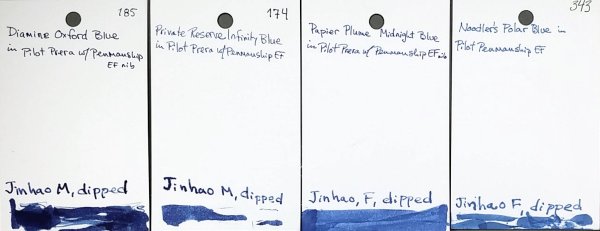
I do most of my ink testing with a glass dip nib. Hundreds of fountain pens inks, no problem.


Recently I came across a Moonman glass dip that is outstanding. First, it has a cap, so no worries about the delicate glass nib being damaged; also it can be pocketed and carried easily (although it has neither clip nor roll stop). It has a very comfortable grip. The pen also comes with a standard fude nib if you're into that.


It's one of the few glass nibs I've used that will give me close to a paragraph in one dip. That's with a heavy flow at the outset and light at the end before redipping. If you're going to use it for correspondence, I'd take more ink off at the start and redip before it got too light to maintain a consistent look.

Link to comment
Share on other sites

I do most of my ink testing with a glass dip nib. Hundreds of fountain pens inks, no problem.


Recently I came across a Moonman glass dip that is outstanding. First, it has a cap, so no worries about the delicate glass nib being damaged; also it can be pocketed and carried easily (although it has neither clip nor roll stop). It has a very comfortable grip. The pen also comes with a standard fude nib if you're into that.


It's one of the few glass nibs I've used that will give me close to a paragraph in one dip. That's with a heavy flow at the outset and light at the end before redipping. If you're going to use it for correspondence, I'd take more ink off at the start and redip before it got too light to maintain a consistent look.


OMG I DID NOT KNOW THAT WAS THING! I AM SO GETTING ONE!!!


:rolleyes:

Link to comment
Share on other sites

If you want ink you can also use in various arts and crafts, you can also try ecoline or dr. P.h. Martin liquid watercolour paint. As previously stated, anything that is liquid enough is usable.

Link to comment
Share on other sites

Glass pens are insanely robust. If you're having trouble getting one clean, you can use fine bronze wool (visit a paint store). Steel wool, and especially stainless steel wool, is hard enough to scratch, but bronze wool is quite a bit softer.

Also note that glass is non-reactive to almost any solvent, so you can also try various cleaners/solvents (methylated spirits, turpentine, etc.). Though you should check on whether the combination of any particular cleaner with an ink is potentially dangerous (producing toxic fumes etc.) before doing so.

Edited by loganrah
Link to comment
Share on other sites

Create an account or sign in to comment

You need to be a member in order to leave a comment

Create an account

Sign up for a new account in our community. It's easy!

Register a new account

Sign in

Already have an account? Sign in here.

Sign In Now


×
×
  • Create New...