Jump to content

3D Printed Prototypes


richardandtracy

Recommended Posts

Over the years I have watched fascinated as 3D printing has become progressively higher quality and more usable. First became aware of 3D printers in 2001, with the RepRap project. At the time they looked expensive, difficult and not really very good.


Roll on a number of years and up came the 'Shapeways' type printing companies. Even then their work didn't seem to have a very good finish. But they were definitely onto something. It was about 2015 that I mentally put aside a budget for a printer if a quality could be achieved. The mental budget was less than $500, the resolution being 0.05mm (about 2 thou in all directions). If that could be achieved, then I'd get a printer to try it for pen making. Reckoned my money was safe for years...


And it was...


Well, in December 2018 I became aware of a new type of printer, the LCD type. The resolution was right, the price was right & I had to put my money where my mouth was. So, I bought an 'Anycubic Photon', as shown below from an E-Bay sale:

$_10.JPG


So, what is an LCD 3D Printer?

Well, there are two main types of 3D printer available to the general public at an 'affordable' price. The first id the FDM machine, one that melts a plastic wire to draw something in the way a hot melt glue gun does. The second uses a liquid resin that is solidified by UV light.


The FDM process is currently not wildly good at precision stuff. You can usually see the layers, and feel them too, with minimum layer thicknesses being 0.1mm typically.


So, resin printers are more precise generally. These can operate in one of 3 ways, all of them solidify a layer of UV reactive resin through the clear bottom of a resin tank. The work is then slowly lifted from the resin as it's built up. The main difference between the types is the method used to solidify the resin. The first method invented is the SLA printer, which draws lines from a UV laser through the bottom of a resin tank, using a single precision mirror moving about under the tank. The second method is the 'DLP' method, where many tiny moving mirrors are used to point the UV light over the whole bottom of the tank, one layer at a time, rather than as a single moving spot. Then there is the most recent, and cheapest, method, the LCD type. The printer uses a tiny, high resolution, LCD screen to sit between the resin and the UV light source, and a mask is flashed up on the LCD to allow some areas to solidify and others not to. Each layer has a different mask image. The Photon is one of the last type, using a 2560 x 1440 pixel screen that its only 120mm x 65mm, giving a resolution of 0.047mm per pixel, and a layer thickness resolution of 0.01mm is achievable, though I have only ever used 0.05mm.


What can it do?

I have been testing and refining the output since I got the printer after Christmas 2018.


Yesterday, I got my first fountain pen out of it that needed no post work other than support removal.

The pen has 4 threads, M7.9 x 0.5 for the Bock #6 nib unit, M9 x 1, twin start thread for the section to barrel thread, M12.5 x 1.6 twin start ca-barrel thread and M10 x 1 single start cap to cap finial thread.


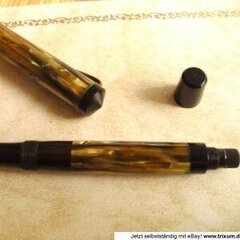
Can I re-iterate that. No work was needed on the threads. I greased them with silicone grease, but no work. The pen is as below:

fpn_1551360238__sdc15204a.jpg

fpn_1551360305__sdc15205a.jpg

fpn_1551360344__sdc15208a.jpg


Length Capped: 130mm

Length Uncapped: 125mm

Length Posted (insecure): 175mm

Barrel diameter: 13mm

Cap diameter: 15.75mm


The pen weighs about 22grams.


The cap has my attempt at a DNA engraving on it, and the barrel has a Barleycorn engraving. I have 12 other patterns I am going to try out as prototypes too. The clip is a mockup. The cured resin is a bit brittle, rather like Polyester resin.


I am amazed at the printer's consistency. The solidified resin always cures 0.075mm horizontally beyond the nominal surface of the part, so with care that can be accounted for, but leads to a lot of tweaking on the threads to get the correct size - I ended up doing 27 trials before getting it right. The consistency for circles is good too, I measured one diameter as being between 13.62 and 13.70mm, all of which variation could be accounted for by pixel positioning relative to the circle.

The resin is fairly hard, but I have not tried to polish it yet. I am unsure as to the durability of the resin. It has UV absorbers built in, so I suspect it may be damaged by sunlight more than most plastics, as it is actively designed to absorb the maximum amount of UV.


I am going to use it for a while to see how durable the pen is.


Hope this is of interest to anyone trying to make printed pens and have been a bit disappointed with pens from FDM printers. The Photon appears to be a viable alternative. The post work of washing the work in IPA & then a post cure in UV light is a faff, but it's not difficult. The Photon, and all other LCD type printers, will do 10 pen barrels in the same time as it does one, so it can work out much quicker than a SLA printer for multiple pen parts, and it's 1/6th the price of a Form2 SLA printer.


I shall keep experimenting and seeing what is possible.


Regards,


Richard.

Link to comment
Share on other sites

  • Replies 21
  • Created
  • Last Reply

Top Posters In This Topic

  • richardandtracy

    7

  • SpecTP

    3

  • Inspector

    2

  • fgarbrecht

    1

Amazing how far that technology has come. How long do you think it will be before they come up with a greater variety of colours? Is there a black for your machine or any transparent / translucent plastics?


Pete

Edited by Inspector
Link to comment
Share on other sites

The Anycubic resins are the only ones I have tried so far. The opaque colours are white, skin, light blue, maroon, grey and black. Transparent green, yellow, orange, clear and turquoise are available too. The machine came with transparent green, the results were much worse than with the grey, and seeing through to engraving on the other side is simply confusing. Furthermore, the green was smelly, sharp and acrid. Had to print with windows open else the whole house became unbearable.


Other resins that can be used include Wanhao, Monocure and a few others. One Monocure resin gives a rubbery material. The biggest limitation is that the resin must be designed for a low power LCD printer. SLA printers use a much more powerful laser spot in terms of W/mm^2, so can get away with much less in terms of UV absorbers within the resin.


The colour range is currently fairly limited, and at the moment the colours are pretty unattractive. One reason for this is, I'm sure, is that most output from this type of printer will be highly detailed Dungeons and Dragons figures, which will be painted anyway.

My eldest daughter is in the process of printing whole armies for her Warhammer games...


Regards,


Richard.

Link to comment
Share on other sites

Do you think the material and the threading could function as an eyedropper filler?

"Anyone who lives within their means suffers from a lack of imagination."

Oscar Wilde

Link to comment
Share on other sites

With a bit of silicone grease on the threads, and maybe an O-ring, almost certainly.

But, I am not sure about the plastic's longevity, and at the moment would be cautious about having a wet barrel in case it suddenly gives up and either cracks or collapses.


Regards,


Richard.

Link to comment
Share on other sites

Very cool! I think some pen makers are already using 3D deposition printers. But that method is likely beyond the price of us local 3D hobbyists.

Link to comment
Share on other sites

That's a big step, what is the approximate cost per pen? Will the durability of that type of plastic be for many at least?

It would be interesting a faceted type model, maybe it is very difficult? I would love to put urushi on one of these and see the result.

Link to comment
Share on other sites

I thought it was worthwhile showing the quality that is available from a home printer. The one I have is really usable at home, and costs about the same as a moderate spec laptop, or half the price of an iPhone (I think - I don't have any type of mobile phone, which appears to cause a certain degree of consternation with other people). Sorry, rambling. The printer is within reach of most people who may wish to use one. The chances are that anyone with enough interest to look at this forum will have the persistence to be able to use it, too.


Right. After a few tests this afternoon I have shown a few things:

1) The clip is as fragile as I expected, breaking this afternoon.

2) A polishing mop with fine and ultra fine plastic polishing sticks does polish the resin, but is not really aggressive enough.

3) Sticking the pen (one piece at a time) in the lathe and using 4000 grade to 12000 grade micromesh does not give a great finish, as it doesn't take off the matt texture properly.

4) Polishing on the lathe, starting with 1200 grade wet & dry (silicon carbide paper) then 4000 to 12000 grade micromesh does polish with a glorious depth of lustre, as if polishing acrylic or polyester. The resin polishes much better than any polyurethane resin.


Regards,


Richard.

Link to comment
Share on other sites

instead of polishing it, you can use car gloss paint

Edited by SpecTP
Link to comment
Share on other sites

Nice... my FDM printer would not make very good pens and it cost a lot more them your SLA printer. It's materials are much cheeper though, not that it helps in pen making.


I saw a youtube video where someone replaced the Z track with higher quality parts and got a big improvement with the Anycubic Photon, but he machined the mounts so it's not something most people could do.


At this point the material for SLA printers isn't cheep. I had no idea though that some SLA printers can use materials others can't.


Good luck in your prints! You've done some nice work so far.

Edited by Driften

Laguna Niguel, California.

Link to comment
Share on other sites

The resin cost for a pen is £0.63p, that's assuming a resin price of £38.60p per litre, which is what I paid in January. Washing the surplus off, the cost of IPA and ancillary costs probably takes it to £0.70p, so pessimistically assume £1.00, or US$1.25 including anything else I have forgotten. The printer cannot print the filler or nib unit - not within the capability of a home printer - so a total pen cost of £16 is possible, say under US$20.


The Photon seems to have a bit of variability in its manufacturing. I do not think my printer needs a different Z axis. There is no evidence of any wobble caused at any stage. That being said, some people have had problems, and are exceptionally vocal about it, giving (I suspect) a disproportionate view of its reliability. The online reviews I have seen -Youtube, All3D, amongst others - rarely mention problems that cannot be sorted by process changes or are picnic errors. Anycubic have tried to answer the valid concerns and have produced the more expensive Photon S, which is currently available through AliExpress, that doubles up on the Z axis track and has other improvements. I do not think I'd see any change to the work on my one, and have no plans to upgrade.


I do not wish to use paint if I can avoid it. Paint + threads is never really a happy combination. Otherwise car manufacturers would paint rather than plate their screws. I also have acid skin, and it seems to be a fairly effective paint stripper. Not nice for a pen to be shedding bits over your hands.


Regards,


Richard.

Link to comment
Share on other sites

  • 3 weeks later...

I love this! I really want to see your daughter's creations too. :) . Thank you for sharing.

Fountain pens are my preferred COLOR DELIVERY SYSTEM (in part because crayons melt in Las Vegas).

Create a Ghostly Avatar and I'll send you a letter. Check out some Ink comparisons: The Great PPS Comparison 

Don't know where to start?  Look at the Inky Topics O'day.  Then, see inks sorted by color: Blue Purple Brown Red Green Dark Green Orange Black Pinks Yellows Blue-Blacks Grey/Gray UVInks Turquoise/Teal MURKY


Link to comment
Share on other sites

  • 2 weeks later...

No, I have not.


Furthermore I have had to stop using the Anycubic resins, as it appears that I am allergic to one of the constituent materials. On of the ones whose nature is unchanged by the curing process. My wife and eldest daughter are both entirely unaffected. I on the other hand, feel a stinging sensation when I touch the cured resin, and feel a burning sensation when sanding dust touches my skin. The stinging sensation lasts 24 hrs, the burning sensation lasts 48 hrs. Bit of a problem.


I have changed to the 'Monocure Rapid' resin, which uses the same settings. I am mostly free of allergy symptoms now, and I think what little I now feel is down to residue dust left from the Anycubic resin. The amounts I seem to react to are very small. I collected sanding dust on a metal plate, then washed it with water and washing up liquid. The residue left on the plate made my skin sting when I took my gloves off, despite the plate having no visible contamination. I imagine my workshop will be slightly contaminated for years.


Regards


Richard.

Link to comment
Share on other sites

Oh! That’s terrible. I hope the residue leaves quickly

To hold a pen is to be at war. - Voltaire
Link to comment
Share on other sites

Create an account or sign in to comment

You need to be a member in order to leave a comment

Create an account

Sign up for a new account in our community. It's easy!

Register a new account

Sign in

Already have an account? Sign in here.

Sign In Now


×
×
  • Create New...