Jump to content

Penkala And Penkala-Moster


4lex

Recommended Posts

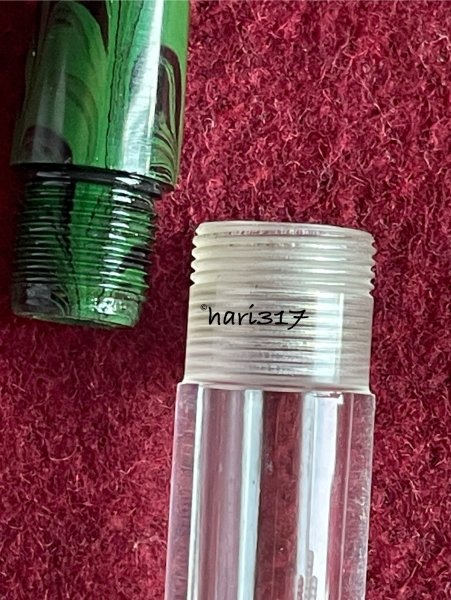
Answering my own question: right-hand thread on the piston mechanism, and on closer inspection, I'm pretty certain the nib and feed are friction-fit. Since I got the filler out, I won't risk knocking out the nib and feed unless it proves necessary. The piston seal is plastic, similar in style to the black plastic ones on postwar Pelikan 100Ns -- a cap that fits over the end of the piston shaft with two ridges around the circumference serving as gaskets -- but the OD of the seal is only 7mm at its widest point in this case, so I'm not sure what one would do if this had to be replaced. Luckily, this piston still produces a good seal, so I don't have to solve that problem (yet!).

Link to comment
Share on other sites

  • 4 weeks later...
  • Replies 21
  • Created
  • Last Reply

Top Posters In This Topic

  • corgicoupe

    4

  • WaskiSquirrel

    3

  • 4lex

    3

  • Bikerchick

    3

Top Posters In This Topic

Posted Images

I'm new to the forum but I am from Croatia and I thought of mentioning few things about Penkala (although I don't know much about them). I think that the production was closed a while ago, although I remember I could see some new fountain pens being sold maybe some 15 years ago in the local stores (probably new old stock). I never held one in my hands. Somehow their website is still alive and the year on the website is 2025 so I guess there may be some production going on. They even have some models on the offer here https://www.toz-penkala.hr/proizvodi-garniture

In addition to that, some of the more seasoned collectors may be interested in old Penkala's (or other old fountain pens). You can try out the website where people sell used stuff, most popular in Croatia. This is the link https://www.njuskalo.hr

Croatian word for a fountain pen is nalivpero (singular) or nalivpera (plural) and a quick search even returns some old ones made by TOZ (Tvornica olovaka Zagreb - Pencil Factory Zagreb) which was Penkala factory to begin with. 


Search for "nalivpero" https://www.njuskalo.hr/search/?keywords=nalivpero

TOZ fountain pen vintage https://www.njuskalo.hr/antikviteti/toz-nalivpero-14k-oglas-44261139


It is possible to register and send a private message to the seller. I used the website many times and albeit generally people are honest, it is known to have few scammers here and there. Old ink pens are usually sold by private collectors or sometimes by a type of shop which is called "antikvarijat" which sells all sorts of old stuff, something like pawn shops in the USA I guess. I don't know if the sellers would send internationally but I am just putting this out there so people are aware. There is another website called aukcije.hr which is similar but works on the basis of auction type of competition where you have to bid and win. I am not affiliated with  either and can't be responsible if something goes wrong.


Another thing which made me curious was the claim (you can find it here and there) about Slavoljub Penkala inventing "solid-ink fountain pen". Google did not return anything for this, but, I did managed to find patent number and an entry in fountainpen.it with the actual patent filled in 1907 in Germany (back then it was some old Germany). Of course in German language. Google did return an old topic where the author was questioning the same thing, back in 2015. So here it is for those who are interested. Patent is as well downloadable from the German patent office website. 


Patent https://www.fountainpen.it/File:Patent-DE-193717.pdf


Full text of the patent:

Subject of the Invention

The subject of the invention is a fountain pen which, compared with known ones, has the great advantage that it is not filled with liquid ink, but instead with pure water. This water, flowing from the reservoir, comes into contact only in the nib itself with the solid ink inserted there, the so-called ink stone.

The existing fountain pens, all of which are filled with liquid ink, have the great disadvantage of becoming extremely easily soiled, which is entirely avoided with the present pen.

A further very practical advantage of this fountain pen is that one can instantly write with a different ink color, simply by removing the ink stone currently in the nib and replacing it with another of a different color.

Description of the Drawings

In the drawing, the fountain pen is shown in one example of its design:
Fig. 1 shows a vertical longitudinal section, and
Fig. 2 shows a part of the same.

The holder (1), which forms a cylindrical sleeve open at the top, has at its lower end a mouthpiece (2) designed to hold a longitudinal bore, into which are inserted the pump (3) together with the nib (4).

The pump consists of a cylindrical rod made of springy material, which is split from below almost up to its other end.

The rod parts (5, 6) that project into the mouthpiece (2) clamp the nib firmly, being shaped accordingly. The shorter rod part (5) lies on the back of the nib, while the longer rod part (6) fits with its free end against the inner side of the nib.

The rod part (6) has at its tip an opening (7) for holding a small piece of ink stone, and near the top, close to the mouth of the mouthpiece (2), a projection or spur (8), whose purpose is described below.

At the upper end of the holder (1) there is a reservoir (9) for holding ink stones, closed off by a cap (11). The cap is a one-sided closed protective cover that can be fitted on either end of the holder.

Operation

The spur (8) is shaped so that it protrudes beyond the circumference of the holder.

When writing, pure water from the water reservoir (12) passes through the gaps in the pump (3) to the nib, where it comes into contact with the ink stone inserted into the opening (7). The ink stone dissolves accordingly, and writing with liquid ink becomes possible.

If the pen is not to be used further, the protective cap (11) is removed from the top and placed on the lower end (see Fig. 2). The inner wall of the cap presses on the protruding spur (8), which acts as a lever on the springy rod part (6), lifting its lower end away from the nib (as shown in Fig. 2).

This also lifts the ink stone out of the opening (7), preventing it from drying out or sticking and thereby clogging the gaps while the pen is not in use.

Filling the Fountain Pen

Filling the pen is simple:
The mouthpiece (2) is unscrewed, water is poured into the reservoir (12), and then it is closed again.
Next, a piece of ink stone is taken from the container (9) and inserted into the opening (7).
The fountain pen is now ready for use.

Patent Claims

  1. Fountain pen for solid ink, characterized by a split, springy rod extending into a water reservoir, which clamps the nib at its lower end and, on the rod part lying against the inner side of the nib, has an opening for holding an exchangeable ink stone, to which the water from the reservoir flows during writing through the rod.

  2. Fountain pen according to claim 1, characterized in that the rod part carrying the ink stone has a projection or spur protruding beyond the circumference of the holder (1), which, when the protective cap is placed on, acts as a lever on the lower rod part and lifts its end—and thereby the ink stone—away from the nib.


Screenshot 2025-10-09 at 23.58.36.png

Link to comment
Share on other sites

Create an account or sign in to comment

You need to be a member in order to leave a comment

Create an account

Sign up for a new account in our community. It's easy!

Register a new account

Sign in

Already have an account? Sign in here.

Sign In Now


×
×
  • Create New...