Jump to content

Dragonfly Wing Pattern


Drawing61

Recommended Posts

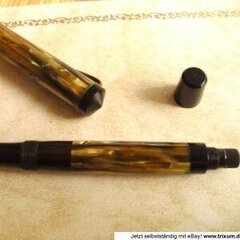
Hi, can someone tell me a little more about this technique: seirei-nuri-maki-e? Known as dragonfly wing pattern invented in Shizuoka in the Taisho era which I guess explains its Art Deco look. This is the extent of my scanty research. Any information much appreciated.

post-107375-0-75965000-1495409219_thumb.jpg

post-107375-0-08900800-1495409245_thumb.jpg

Love all, trust a few, do harm to none. Shakespeare

Link to comment
Share on other sites

  • Replies 6
  • Created
  • Last Reply

Top Posters In This Topic

  • Drawing61

    3

  • Algester

    2

  • stan

    1

  • Bounce792

    1

Top Posters In This Topic

Posted Images

even my google-fu has been lacking well let's just say Taishou-era (1912-1926 WW1-Sino-Japanese conflict technically WW2) togidashi technique

as it is a togidashi technique the lines are formed by having been "pre-coated" with Urushi which is then sprinkled with gold powder and I think this type of technique is only seen on pens or small cylindrical containers but beg to correct me as I'm no Urushi and Maki-e expert

https://www.youtube.com/watch?v=RuQMkn65wR8

the video above teaches about the Hira Makie steps

as for the Pilot pen in question

FK-5MP-SR(ペン種)

研出平蒔絵 蜻蛉(蜻蛉塗)

Edited by Algester
Link to comment
Share on other sites

Thank you very much for the information.

Love all, trust a few, do harm to none. Shakespeare

Link to comment
Share on other sites

even my google-fu has been lacking well let's just say Taishou-era (1912-1926 WW1-Sino-Japanese conflict technically WW2) togidashi technique


Even by the most generous start date of the 2nd Sino-Japanese War (1931 and the Mukden Incident), the Taisho Emperor and his reign were never involved with it. The Second World War started in 1939, well past the death of the Taisho Emperor and well into the reign of his son, the Showa Emperor.


I know little about the maki-e and urushi processes. However, the Taisho period was the most liberal period of the Japanese Empire with a general tolerance of many creative experiments. This is, of course, within the context of a generally conservative society but it was the only period in which democratic rule was a brief reality. So, there was a promotion of the arts which would not be seen until after the American Occupation ended. I would say, historically speaking, that specific technique would be one of those cultivated during the Taisho period but which lost popularity afterwards.

round-letter-exc.png

Link to comment
Share on other sites

Even by the most generous start date of the 2nd Sino-Japanese War (1931 and the Mukden Incident), the Taisho Emperor and his reign were never involved with it. The Second World War started in 1939, well past the death of the Taisho Emperor and well into the reign of his son, the Showa Emperor.


I know little about the maki-e and urushi processes. However, the Taisho period was the most liberal period of the Japanese Empire with a general tolerance of many creative experiments. This is, of course, within the context of a generally conservative society but it was the only period in which democratic rule was a brief reality. So, there was a promotion of the arts which would not be seen until after the American Occupation ended. I would say, historically speaking, that specific technique would be one of those cultivated during the Taisho period but which lost popularity afterwards.

hmm interesting but Taishou era would still be covered in WW1... hmm my datings could be very off...
Link to comment
Share on other sites

Thanks very much. I assume from the videos that the pattern is achieved by floating urishi on water. Am I wrong? Also is this a currently used technique?

Love all, trust a few, do harm to none. Shakespeare

Link to comment
Share on other sites

Create an account or sign in to comment

You need to be a member in order to leave a comment

Create an account

Sign up for a new account in our community. It's easy!

Register a new account

Sign in

Already have an account? Sign in here.

Sign In Now


  • Most Contributions

    1. amberleadavis
      amberleadavis
      43972
    2. PAKMAN
      PAKMAN
      35517
    3. inkstainedruth
      inkstainedruth
      31116
    4. Ghost Plane
      Ghost Plane
      28220
    5. Bo Bo Olson
      Bo Bo Olson
      27746
  • Upcoming Events

    No upcoming events found
  • Blog Comments

    • stylographile
      Awesome! I'm in the process of preparing my bag for our pen meet this weekend and I literally have none of the items you mention!! I'll see if I can find one or two!
    • inkstainedruth
      @asota -- Yeah, I think I have a few rolls in my fridge that are probably 20-30 years old at this point (don't remember now if they are B&W or color film) and don't even really know where to get the film processed, once the drive through kiosks went away....  I just did a quick Google search and (in theory) there was a place the next town over from me -- but got a 404 error message when I tried to click on the link....  Ruth Morrisson aka inkstainedruth 
    • alkman
      There is still chemistry for processing regular chrome (positive) films like Kodak Ektachrome and Fuji Velvia, but Kodachrome was a completely different and multistep beast. 
    • Ceilidh
      Ah, but how to get it processed - that is the question. I believe that the last machine able to run K-14 (Kodachrome processing) ceased to operate some 15 or so years ago. Perhaps the film will be worth something as a curiosity in my estate sale when I die. 😺
    • Mercian
      Take a lot of photos!   If the film has deteriorated or 'gone off' in any way, you can use that as a 'feature' to take 'arty' pictures - whether of landmarks, or people, or whatever.
  • Chatbox

    You don't have permission to chat.
    Load More
  • Files


×
×
  • Create New...