Jump to content

Hairline Crack In Plastic Section


sandy101

Recommended Posts

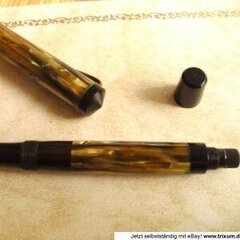
I have a vintage pen with a hairline crack in the section, which is causing ink to seep out.


It's an old Caran d'ache Madison, and being second hand I don't have a guarantee.


The nib is quite lovely - so I'd like to ge thte pen into a conditin so that I don't get inky fingers everytime I use it.


I can't find a replacement section. So, what would anyone suggest?


I've noticed the part on repairing cracksin MBs, but this is hard plastic, not celloid.

Link to comment
Share on other sites

  • Replies 30
  • Created
  • Last Reply

Top Posters In This Topic

  • LizEF

    7

  • sandy101

    6

  • praxim

    5

  • PaulS

    3

Top Posters In This Topic

I've heard of metal weld being used in some areas of pen repair, but not plastic weld, but assume a similar product to Loctite perhaps.

With a hairline completely through a section, are you going to be able to get the adhesive into the entire crack......... can you open up the crack sufficiently to achieve that?

There might be a problem with this venture, similar to gluing splits in caps and barrels, as in ... when a situation is subject to internal stress/pressure because, for example, you shove a section into a barrel or a feed into a section, it's apparently difficult to guarantee the problem won't recur. You might need one of those dental circular screw grips to provide all round pressure whilst curing.

Shouldn't be pessimistic - best of luck and let us know if your fingers regain their original colour :)

Link to comment
Share on other sites

The crack is thin, but streteches 1/2 cm from the nib and up the grip. This means ink is getting through resulting in inky fingers, and ink leaking into the cap. I went to town and found various glues including a silicon one. There is one with emk in it, a modelling one which might be the most suitable. Its about plugging the crack, to stop the seepage and not ending up with ugly marks that you'd get with modelling glue.

Link to comment
Share on other sites

I have successfully used thin CA glue (it comes in different thicknesses at hobby shops) to seal a crack in the section of a Waterman Laureat ca1993. It has held well. The thin CA glue is pretty much like water, and will seep into the crack. Wipe off excess. It is guaranteed you will get it on your fingers, so be prepared for that. ;)

Link to comment
Share on other sites

could you not wear rubber gloves Liz?? - however, it does sound to be the answer for such repairs as this. :)


Certainly. And then, when you think you're done, you could take them off, and then, when you pick up the section to examine it, some could get all over your fingers because there was more there than you thought. Or something like that... ;)

Link to comment
Share on other sites

PS: I'll be trying this again on the cracked section of a Cross pen my aunt owns. I'm hoping to do a better job this time at not making a mess. (The last job was good as far as the section is concerned, I just wasn't as organized and careful as I could have been.)

Link to comment
Share on other sites

I have successfully used thin CA glue (it comes in different thicknesses at hobby shops) to seal a crack in the section of a Waterman Laureat ca1993. It has held well. The thin CA glue is pretty much like water, and will seep into the crack. Wipe off excess. It is guaranteed you will get it on your fingers, so be prepared for that. ;)


I too have done this with current success. One difference was that after seeping glue into the thoroughly cleaned and dried crack (warmth and patience) I clamped it immediately ( soft rubber gripping surfaces) and left it alone completely for a week; time is not what one normally considers with CA glues. Since then, I have an invisible mend with flawless operation to date.


I am aware that water (i.e. ink) can soften and eat CA glues. I remain fairly confident of a decent lifetime. This has also been done with hard rubber. It has been hard to find anything unequivocally recommended for that.

X

Link to comment
Share on other sites

@LizEF Idle question: "If your taste changes do you become LizOB?"


I reckon I would. :lol: Hasn't happened yet (though I do like the 0.6mm stub on my Nemosine Singularity).

Link to comment
Share on other sites

thanks - I hadn't realized that CF required such a long curing time - perhaps the warmer the weather the shorter the time.

quote from LIzEF ..... "(it comes in different thicknesses at hobby shops" ... assume this refers to viscosity, perhaps?

EF or OB ............. much more polite than saying you're a broad :blush:

Link to comment
Share on other sites

I've cleaned the pen out, and I'm sure the crack has expanded since. I've e-mailed Caran d'Ache to ask about the likelihood, and cost of a repair.

Coming to think of it, in this day & age do any FP manufacturers offer a recycling scheme. Think of all these gold nibs sitting around going to waste because they are sitting in cracked plastic sections or whatever. It can't be beyond the wit and wisdom to come up with some kind of recycling scheme. Gold takes a lot of energy to get out of the ground, and I'm sure these nibs can be reused whether they are melted down or plugged into a new pen.

Link to comment
Share on other sites

thanks - I hadn't realized that CF required such a long curing time - perhaps the warmer the weather the shorter the time.

quote from LIzEF ..... "(it comes in different thicknesses at hobby shops" ... assume this refers to viscosity, perhaps?

EF or OB ............. much more polite than saying you're a broad :blush:


To my knowledge, CA glue doesn't take that long to cure, but my knowledge is limited, and waiting longer certainly can't hurt.


Yes, I was referring to viscosity.


Speaking about certain nib widths certainly can be tricky without context. :)

Link to comment
Share on other sites

Regarding CA, MEK or shellac curing, for most common uses it does not matter beyond the "set" or "strength" point but for maximum strength with any glue then keep it clamped, stable, and at a nice temperature for at least as long as the maximum time you can find anywhere in the literature.


Editing to add: Henkel advises full strength for CA in 24 hours. It is noted also that thicker layers take longer. Call me obsessive. :)


I think the week may have been only for the hard rubber... MEK I left two weeks.

Edited by praxim

X

Link to comment
Share on other sites

I have a dark red MB Generations style pen with cracks above the nib. Some may throw up their hands in horror but I used a little bees wax to seal the cracks since I didn't want to spend more on repairs than the pen was worth. It has a beautiful OB nib and works perfectly.


When their bodies were severely damaged, I recycled 2 of my favorite nibs (from another MB Generations and a S.T. Dupont) by having Shawn Newton make new bodies for each of them. After several years, they are still used almost everyday.


Thank you, Shawn

Link to comment
Share on other sites

I have a vintage pen with a hairline crack in the section, which is causing ink to seep out.


It's an old Caran d'ache Madison, and being second hand I don't have a guarantee.


The nib is quite lovely - so I'd like to ge thte pen into a conditin so that I don't get inky fingers everytime I use it.


I can't find a replacement section. So, what would anyone suggest?


I've noticed the part on repairing cracksin MBs, but this is hard plastic, not celloid.


Have successfully repaired low-cost, cracked, modern pens with black nail polish. Just a thought.

My latest ebook.   And not just for Halloween!
 

My other pen is a Montblanc.


Link to comment
Share on other sites

You could try JB weld or if the barrel is straight then a brass tube might make a more permanent repair..

Also you could try modelers glue or they have plastic instant glue too ..Sorry I forget the name for the instant plastic glue but it came with a glass needle applicator..

Link to comment
Share on other sites

On checking, the e-bay shop I purchased the pen from had a 14 day return policy, and they have accepted the return on the pen. It is entirely possible that the problem developed in transit - as the pen had been sent airmail with a convertor full of ink. Anyway the pen's on its way back to where it came from, so hopefully there will be a happy ending. I'd washed the pen out and the crack was just getting bigger every time I looked at it.


I think I'll save my pennies and look out for a deal at a pen show, rather than buy any more vintage pens online.

Link to comment
Share on other sites

Create an account or sign in to comment

You need to be a member in order to leave a comment

Create an account

Sign up for a new account in our community. It's easy!

Register a new account

Sign in

Already have an account? Sign in here.

Sign In Now


×
×
  • Create New...