Jump to content

Shellac Vs. Rubber Cement?


chud

Recommended Posts

Pros and cons of rubber cement as an alternative to shellac in pen repair?


I spoke with someone here who advocates rubber cement instead, largely I think because it's easier to disassemble again in the future, but I wanted to get some more opinions before I jump in with that...


Thanks!

A handwritten blog (mostly)


http://img525.imageshack.us/img525/606/letterji9.png

Link to comment
Share on other sites

  • Replies 9
  • Created
  • Last Reply

Top Posters In This Topic

  • kirchh

    2

  • chud

    2

  • PAKMAN

    1

  • Freddy

    1

Top Posters In This Topic

All the pro restorers that I know of use shellac. I wouldn't use rubber cement. 140 degrees F is all that is needed to release shellac.

PAKMAN

minibanner.gif                                    

        My Favorite Pen Restorer                                            


Link to comment
Share on other sites

All the pro restorers that I know of use shellac. I wouldn't use rubber cement. 140 degrees F is all that is needed to release shellac.

Agree.


Fred

Link to comment
Share on other sites

Section Sealant.


Next?


EDIT; I myself won't use shellac for a 51 hood. Given the choice, I wouldn't use RC either.


Butttt, if you told me I Had to seal the hood with One if those two, I'd use the RC.


Now I wouldn't use it to seal a Raspberry Vac hood, but I honestly don't think anything in even modern RC is going to hurt 51 Lucite.


Bruce in Ocala, Fl

Edited by OcalaFlGuy
Link to comment
Share on other sites

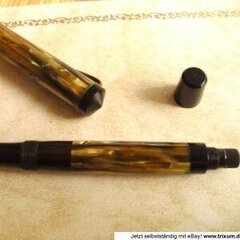
I would use anything. If you need to seal is because something damaged the thread (perhaps shellac solidified crystals?)in this case I just put a Teflon band of just one millimeter in only one thread (to see photo). If you need to put a sac I use a tight sac and fix it with cotton thread with a pair of knots.


About shellac:


-Shellac has power amber dyeing.

-Shellac contains alcohol and alcohol can to damage celluloid.
-The shellac is insoluble in water.
-140 F inside needs a rather high temperature of the outer surface
-140 F not diluted shellac crystals. If the heat is dry on contrary, even further solidifies shellac.
-Shellac crystals can damage the threads of the thread when you need to unscrew.
-Parker abandoned the use of shellac 70 years ago in favor of other cements.


Edited by Lazard 20
Link to comment
Share on other sites

About shellac:


-Shellac has power amber dyeing.


I wouldn't apply it directly to a very porous surface, like raw wood or fabric, unless you wish to change the color somewhat. But it's fine for pen parts such as sac nipples. It won't dye things it's not applied to. If it would, shellaced furniture would dye other items in the same room, which of course doesn't happen.


-Shellac contains alcohol and alcohol can to damage celluloid.


Alcohol is a mild solvent for celluloid; try to avoid spilling shellac on your celluloid pen. But it's fine for a sac nipple, for example.


-The shellac is insoluble in water.


Definitely one of its most important attributes in pen repair. Makes a nice, ink-tight seal.


-140 F inside needs a rather high temperature of the outer surface


Not true. Just some time for the temperature to equalize. Patience is important when warming shellaced areas.


-140 F not diluted shellac crystals. If the heat is dry on contrary, even further solidifies shellac.


I don't know what this means. Shellac softens when warmed. That's a wonderful attribute.


-Shellac crystals can damage the threads of the thread when you need to unscrew.


Debatable, but as shellac softens when warmed, this is a non-issue.


-Parker abandoned the use of shellac 70 years ago in favor of other cements.


False. Parker continued to recommend the use of shellac inside celluloid pens at least until about 1960, and they stopped issuing repair instructions for celluloid pens after that, as far as I have seen.


- "Hey, hey, I´m a pro, so you should not correcting me because I've been doing this for many years! claimed one.

- "Well, you has been doing it wrong "many years", replied another.


You really need to become familiar with common logical fallacies so you don't continue to make the same mistakes over and over.


--Daniel

Edited by kirchh

"The greatest mental derangement is to believe things because we want them to be true, not because we observe that they are in effect." --Jacques-Bénigne Bossuet

Daniel Kirchheimer
Specialty Pen Restoration
Authorized Sheaffer/Parker/Waterman Vintage Repair Center
Purveyor of the iCroScope digital loupe

Link to comment
Share on other sites

Daniel-

Thanks


-Todd

San Francisco International Pen Show - The next “Funnest Pen Show” is on schedule for August 23-24-25, 2024.  Watch the show website for registration details. 
 

My PM box is usually full. Just email me: my last name at the google mail address.

Link to comment
Share on other sites

Daniel-

Thanks


-Todd


You got it.


--Daniel

"The greatest mental derangement is to believe things because we want them to be true, not because we observe that they are in effect." --Jacques-Bénigne Bossuet

Daniel Kirchheimer
Specialty Pen Restoration
Authorized Sheaffer/Parker/Waterman Vintage Repair Center
Purveyor of the iCroScope digital loupe

Link to comment
Share on other sites

I don't use rubber cement at all, and I cannot think of any pen repair application where it would be the optimal choice.


For sealing of threads, rosin and wax-based sealants are far superior in all respects.

For attachment of sacs, shellac has been the adhesive of choice for over 100 years (silicone sacs excepted -- silicone needs silicone adhesive).


Rubber cement contains some pretty nasty solvents, which I don't want to breathe myself, and which I don't want near most pen plastics. I also don't quite understand the reasoning behind using an adhesive that releases easily for this application. When a sac pen is in use, you want to have its sac held in place very securely indeed. When it comes time to change sacs, it's really no big deal at all getting the old sac off the nipple if it's held with shellac -- rubber cement is, in this respect, a misguided "solution" to a nonexistent problem.

Link to comment
Share on other sites

Thanks all - that confirms my suspicion, and I don't know why the guy I was talking to likes rubber cement beyond it being easier to remove (this was in the context of a Parker 51 hood, not a sac replacement, to be fair, though he did say that he doesn't use shellac for anything...)


I will continue to have faith in the wisdom of other's experience and do it the traditional way. :-)

A handwritten blog (mostly)


http://img525.imageshack.us/img525/606/letterji9.png

Link to comment
Share on other sites

Create an account or sign in to comment

You need to be a member in order to leave a comment

Create an account

Sign up for a new account in our community. It's easy!

Register a new account

Sign in

Already have an account? Sign in here.

Sign In Now


×
×
  • Create New...