Jump to content

Sheaffer Balance Nib/feed/collar Assembly Making Me Scream


DavyJones

Recommended Posts

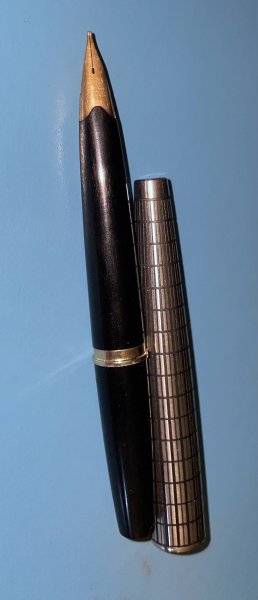
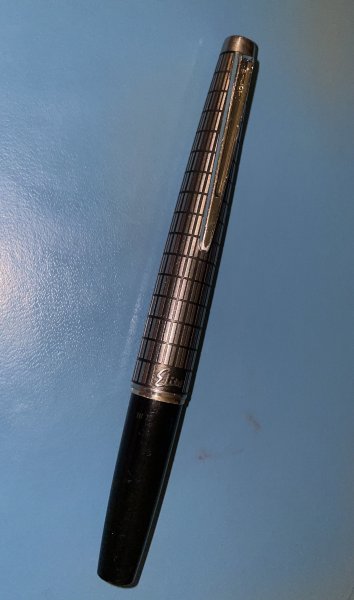
I've been struggling putting this Sheaffer Balance lever filler back together for a few weeks now. This nib/collar thing is absolutely driving me crazy. This is a normal-sized Sheaffer Balance lever filler, which was incredibly gunked up when I got it. I knocked out the nib, feed, and silly collar thing to give a really good cleaning, and have been having problems ever since. First, after reassembling the three pieces, the nib would wiggle back and forth in the collar assembly. I tried shimming it with a small piece of brass sheet, no luck. I tried some heat, no go. The collar appears to be some sort of plastic and not ebonite like the feed is. So then I tried building up the inside diameter of the collar with shellac, allowing it to dry for quite some time, and then inserting the nib and feed. The nib no longer wiggles from side to side, but, will not hold tight against the feed. Even the slightest bit of pressure with lift the nib off the feed, which I am positive is not correct. I'm also concerned that the shellac I used to build up the internal diameter of the collar will eventually fail and cause some sort of feed clogging. I thought at first that the collar was not down far enough on the assembly, but after comparing to pictures it looks to be placed correctly. Can anybody offer assistance? This thing is giving me a major headache. My last guess is that I will have to try and fabricate a new, tighter collar, but I am not that mechanically inclined and would not have any idea what material to use.

"We are in a sense the Universe trying to understand itself. By Observing it we are observing what we are." - Phillip Plait

Link to comment
Share on other sites

  • Replies 11
  • Created
  • Last Reply

Top Posters In This Topic

  • DavyJones

    5

  • Ron Z

    2

  • pen lady

    2

  • mhosea

    2

Top Posters In This Topic

You weren't far off in what you tried to get it to fit. Heating the feed to raise the impression of the nib might help. But you're right in thinking that the shellac will eventually break down. Trying shim stock was a good idea too. But the best thing to do do is to replace the collar. The reason it's loose is that the material of either the section or collar has changed dimension, and the hard rubber of the feed has cold flowed.


The collar is usually celluloid, as is the section. You need a lathe to make a new one because you need to both bore out the ID of the rod stock for a snug fit for the nib and feed, and to turn down the OD to the right diameter for a snug fit in the section. When I do it, I tend to use hard rubber because it machines easily and even though "hard" rubber, does have some elasticity to it... more than acrylic.

spacer.png
Visit Main Street Pens
A full service pen shop providing professional, thoughtful vintage pen repair...

Please use email, not a PM for repair and pen purchase inquiries.

Link to comment
Share on other sites

I don't know if anybody will actually read this now, but I always like to respond in case somebody searching sometime in the future finds this and wants additional information.


After seeing Ron's response, I thought I would try a few more things. I do not own a lathe, and do not have anywhere near the funding to buy one at this point, so I sat down and tried to be creative. First thing I did was go an get some digital calipers to measure with some degree of accuracy the sizes we were talking about. Although I'm in the US, I find metric to way easier to work with. The first thing I discovered was that the collar, while appearing circular, was severely warped out of circle on a very small scale. Depending on where you took the measurement of the outside diameter you got readings from 6.25-6.45mm, as was a similar case for the ID.


So, I went online and searched for thin ebonite rod stock and found a supplier who will sell small pieces in 5mm+ diameters. I am planning (key word here) on using some 7mm rod stock and first centering a hole and drilling an appropriate sized hole for the nib and feed using a Dremel as a drill press, and finishing with a needle file until I reach the exact ID I'm looking for. Then I will find some way to affix the piece to my Dremel, and will spin the piece against some sand paper until I get the OD I am looking for (We are only talking about removing .5-.75mm here). My only concern is that the wall thickness will get too thin and the piece might break while I'm machining it. Look for future updates.... Maybe if I do enough of these I can sell enough replacement collars to buy a lathe in 1000 years or so ;-)

"We are in a sense the Universe trying to understand itself. By Observing it we are observing what we are." - Phillip Plait

Link to comment
Share on other sites

Your Dremel is variable speed, I hope. I convered a Ranga Ebonite pen to blow filler using a similar technique to turn a sac nipple, but mine isn't variable, just 2 speed. Eventually it got out of balance, and then I had to search the room for the grip section with only the sound it made hitting things to go by. Ron is cringing because amateurs are insane. :)

I know my id is "mhosea", but you can call me Mike. It's an old Unix thing.

Link to comment
Share on other sites

Your Dremel is variable speed, I hope.


Yes it is, but that is definitely something to note. I really hope that it wears evenly enough to stay balanced, and I'm only sanding off a very small amount.


As I mentioned, I would love to do this on a lathe, but for such small production it's not worth the expenditure at this point in time. What I need to do is find something reliable and cost effective with the tools I have available, that's why I started searching for ebonite rod stock that was close to the dimensions I required.


I'm also viewing the the OD as having more wiggle room than the ID. I can always shellac the new collar inside the section, the same cannot be said for the nib and feed inside the collar. But I figure since I will be carefully and slowly sanding my way down I should be able to find the perfect fit.

"We are in a sense the Universe trying to understand itself. By Observing it we are observing what we are." - Phillip Plait

Link to comment
Share on other sites

And I don't feel as insane because I'm making replacement parts from new materials. I don't know if I would try such a stunt with actual vintage parts. I simply can't send out every pen that comes across my table for custom repair work.

"We are in a sense the Universe trying to understand itself. By Observing it we are observing what we are." - Phillip Plait

Link to comment
Share on other sites

Speaking as another Rube Goldberg amateur, wouldn't it be easier to re-form the collar to it's original round shape. If it's ebonite, it will soften in hot water, why not try that and then put a correct diameter rod through it until it's cooled. I'm at a bit of an advantage for an assortment of rods, I knit, and knitting needles come in all sorts of sizes. Just a thought. Actually, last night when I was cleaning up a Junior Balance that my sweetie bought (red veined grey pearl) was the first time I'd come across a collar inside a section. I've ruined FAR to many pens, so I just put the whole thing in my US cleaner and left it at that. Good luck.

Link to comment
Share on other sites


Maybe if I do enough of these I can sell enough replacement collars to buy a lathe in 1000 years or so ;


The problem is that the degree of shrinkage will very from pen to pen. When the pen was made the nib/feed/collar were a very snug fit in the section. The properties of the celluloid varied a bit from batch to batch, and the environmental conditions to which the pen has been exposed will be different for each pen. That's why some shrink, and others are just as snug as the day that they were made. The collar has to be made to fit the individual pen/section.


Wall thickness is an issue, which is why it's tough to do without a lathe. Been there, done that. In my early days of pen repair I used to chuck the work piece in a slow speed drill clamped in a vise. Risky, but it worked. Sort of.

spacer.png
Visit Main Street Pens
A full service pen shop providing professional, thoughtful vintage pen repair...

Please use email, not a PM for repair and pen purchase inquiries.

Link to comment
Share on other sites

And I don't feel as insane because I'm making replacement parts from new materials. I don't know if I would try such a stunt with actual vintage parts. I simply can't send out every pen that comes across my table for custom repair work.


It was meant in the spirit of self-deprecation only. Carry on. :)

I know my id is "mhosea", but you can call me Mike. It's an old Unix thing.

Link to comment
Share on other sites

Speaking as another Rube Goldberg amateur, wouldn't it be easier to re-form the collar to it's original round shape. If it's ebonite, it will soften in hot water, why not try that and then put a correct diameter rod through it until it's cooled. I'm at a bit of an advantage for an assortment of rods, I knit, and knitting needles come in all sorts of sizes. Just a thought. Actually, last night when I was cleaning up a Junior Balance that my sweetie bought (red veined grey pearl) was the first time I'd come across a collar inside a section. I've ruined FAR to many pens, so I just put the whole thing in my US cleaner and left it at that. Good luck.


Unfortunately the collar is made of celluloid, otherwise it would have probably been easy to heat set it tight enough. I've been fooling with this piece for hours and hours, and am very convinced that replacement is the only viable option. But, going forward I will not separate these assemblies unless I can find a reliable way to reproduce custom collars. For now it seems like a good soak in a ultrasonic is the better and more conservative approach.

"We are in a sense the Universe trying to understand itself. By Observing it we are observing what we are." - Phillip Plait

Link to comment
Share on other sites

Oh darn! And I thought my suggestion might help. Ah well, but maybe your sorry tale will be instructive! There used to be a great pen repairer in S. Ontario who would get me out of various jams, but, alas, he's out of the business now, so I have to be rather more cautious. Most times ;)

Link to comment
Share on other sites

Your Dremel is variable speed, I hope. I convered a Ranga Ebonite pen to blow filler using a similar technique to turn a sac nipple, but mine isn't variable, just 2 speed. Eventually it got out of balance, and then I had to search the room for the grip section with only the sound it made hitting things to go by. Ron is cringing because amateurs are insane. :)


That's beautiful. :notworthy1:


I'll bet a coffee that Ron didn't cringe until after he was done chuckling.


Bruce in Ocala, Fl

Link to comment
Share on other sites

Create an account or sign in to comment

You need to be a member in order to leave a comment

Create an account

Sign up for a new account in our community. It's easy!

Register a new account

Sign in

Already have an account? Sign in here.

Sign In Now


×
×
  • Create New...