Jump to content

Something I Discovered About Early Pen Production


thompenshop

Recommended Posts

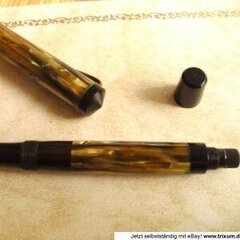
When I first began to turn pens in 1997 I discovered something about the Parker Senior Duofold that surprised me. I needed a set of taps and dies with which to make replica pens, after which I would add original vintage medal parts (nibs, filler button, pocket clip, and pressure bar) for a complete pen. I took three or four vintage Parker Sr. Duofolds to a Machine Gauge Shop so that I could obtain the exact size the new set of taps and dies should be. To my surprise the shop owner informed me that only two of the pens were alike in thread dimensions. When I ask , "how could that be", he set me down and explained the process of part duplication. He farther explained that two of the four pens would not have passed the "go or no go" test in a modern machine shop. They were too far out of size restraints for modern part run production. His question to me was, "which pen do you want me to use as a gauge for your new set of taps and dies?" Needless to say, I was dumb founded! With his counsel the decision was made to make my set of taps and dies the size of the two pens that were alike. Over the years I discovered that decision to be my first $1,000.00 mistake. All though my set of T&D's were very usable, the parts I turned such as the cap inner cap were too loose to be perfect for replacement on most vintage pen caps and the sections that I turned were too tight to be used for replacement of most vintage sections. Either of the parts could be "chased" and made to work but they were not perfect.


Early on I came to an educated conclusion. Parker pen company probably had at least three different production lines turning parts for the Parker Sr. Duofold during the height of their production of this specific pen. Here is why I have come to that conclusion. It was common practice long ago for machinist to make their own tooling. Because they did not have the advantage of Computer Numeric Controls (CNC) they very easily could have varied just the slightest bit in the tooling that they made. Thus the slight variations in the size of parts they produced. Were this the case each production line would have produced pens that varied a few thousands from those produced over in the other line. If my guess were to be correct, the reason why the four pens I took to the gauge shop varied in size, makes since. Another explanation might be that the different production lines used separate gauges to determine when it was time to change used tools.


This subject may not be of interest to most, but it is just a little insight into what happens in the machine shop when one is faced with turning parts that must or should be exactly alike every time. Ole machine shops were very good at setting their machines up with correct stops but it would be near impossible to be 100 per cent correct every time. The modern CNC shop has made many improvement over the years. However, anytime one introduces humans into the scenario perfection goes out the door.


Now that I have had the experience of turning several thousand pens using a conventional lathe, I have come to the conclusion that the learning curve is a long one.


Thank God that mankind built servo motors! I just wish I could afford three computer assisted machines: A lathe, a mill, and a laser engraver. I could really get into the pen business.


Chris Thompson

Thompson Pens


Link to comment
Share on other sites

  • Replies 32
  • Created
  • Last Reply

Top Posters In This Topic

  • thompenshop

    10

  • Vintagepens

    4

  • Chthulhu

    3

  • SteveE

    2

I'm going to suggest that the pens' threads were possibly cut by chasing, rather than with taps and dies. You can see what I mean starting at about 1:25 in this video:


Basically, a cap was made first, then the pen was made to fit that cap. There is no concerted effort to make parts interchangeable from one pen to another.

Mike Hungerford

Model Zips - Google Drive

Link to comment
Share on other sites

I am very well acquainted with turning threads by the chasing method. However I have seen the specific sets of taps and dies that Parker used in the factory for the Parker Sr. Duofold series of pens.

Link to comment
Share on other sites

Wow, this is really interesting. Was this the same issue when Parker was making its famous 51 series of pens? My experiences been that the pen parts in the 51 series do seem to be interchangeable.


Bobby

Why carry one pen when four will do!


Member of the Calgary Pen Club: <A href="http://www.calgarypenclub.com/" target=_blank>http: //www.calgarypenclub.com/

Link to comment
Share on other sites

I am very well acquainted with turning threads by the chasing method. However I have seen the specific sets of taps and dies that Parker used in the factory for the Parker Sr. Duofold series of pens.

I shall withdraw the suggestion, then. I have nothing better to offer in the way of explanation.

Mike Hungerford

Model Zips - Google Drive

Link to comment
Share on other sites

I shall withdraw the suggestion, then. I have nothing better to offer in the way of explanation.

Thanks for your input. You may very well be correct. All though triple and quad lead (start) threading is difficult to do, the practice became industry standard very early. When I have had the opportunity to make that quip to friends in the business, they frequently respond, "a walk in the park".
Link to comment
Share on other sites

Let me be very clear hear (I sound just like our president). I am not a trained machinist. I spent all of my professional career in two jobs: College professor and behind a pulpit. I did happen to obtain an Ed. D. with an emphasis in The Administration of Vocational/Technical Education. Pen turning has never risen any higher on my list of things to do than a hobby. My wife would probably have somewhat of a different opinion but then she tends to be opinionated. She doesn't know my pass word so I think I am safe with posting this statement.

Link to comment
Share on other sites

Wow, this is really interesting. Was this the same issue when Parker was making its famous 51 series of pens? My experiences been that the pen parts in the 51 series do seem to be interchangeable.


Bobby

Bobby, I have repaired many 51's. Because the threads are so fine by guess would be that taps and dies were used. I may be very wrong about this issue however.

Link to comment
Share on other sites

Bearing in mind that Parker had a manufacturing plant in Canada, which I believe concentrated on the European market, also Parker acquired facilities in the UK. That might be a clue with regard to the measurement differences. At one time Parker brought parts in from another plant for assembling in one center.


Bearing in mind that manufacturing plants sometimes run short on materials, and will import finished goods from another to make up deficiencies. Might that also be a clue as to the differences in measurement?.

They came as a boon, and a blessing to men,
The Pickwick, the Owl and the Waverley pen

Sincerely yours,

Pickwick

Link to comment
Share on other sites

Bearing in mind that Parker had a manufacturing plant in Canada, which I believe concentrated on the European market, also Parker acquired facilities in the UK. That might be a clue with regard to the measurement differences. At one time Parker brought parts in from another plant for assembling in one center.


Bearing in mind that manufacturing plants sometimes run short on materials, and will import finished goods from another to make up deficiencies. Might that also be a clue as to the differences in measurement?.

You add important factors to the discussion

Link to comment
Share on other sites

Thanks for your input. You may very well be correct. All though triple and quad lead (start) threading is difficult to do, the practice became industry standard very early. When I have had the opportunity to make that quip to friends in the business, they frequently respond, "a walk in the park".

I would say "tedious" rather than "difficult," at least when single-pointing. :-)

Mike Hungerford

Model Zips - Google Drive

Link to comment
Share on other sites

Were the parts from which you took your original gauging celluloid or hard rubber, per chance? Could the dimensional stability of those materials over time have been a contributing factor in the differences?

Also, the point about non-US production seems interesting. Would plants in France and parts of Canada perhaps been using metric equivalents, rather than actual English gauges, at that date?

ron

Link to comment
Share on other sites

Were the parts from which you took your original gauging celluloid or hard rubber, per chance? Could the dimensional stability of those materials over time have been a contributing factor in the differences?

Also, the point about non-US production seems interesting. Would plants in France and parts of Canada perhaps been using metric equivalents, rather than actual English gauges, at that date?

ron

They were early plastic, the green, red ,and black. With regard to your other questions concerning parts done outside the US, my guess is that other shops would have required drawings just as is the practice in the machining industry here is the USA. I suppose that Parker could have just sent parts for duplication. I guess it would be nice to go back in time and see how things were done. We will probably never know for sure.

Link to comment
Share on other sites

Now that I have had the experience of turning several thousand pens using a conventional lathe, I have come to the conclusion that the learning curve is a long one.


Thank God that mankind built servo motors! I just wish I could afford three computer assisted machines: A lathe, a mill, and a laser engraver. I could really get into the pen business.


Chris Thompson

Thompson Pens


keep an eye out for a company called tech shop. its a workspace that is membership based where they have all sorts of cool gizmos that you can use once you take a class certifying that you can use them. they definitely have a full range of cnc equipment including a cnc lathe as well as other neat gizmos like laser and plasma cutters and injection molding equipment. they are mostly on the west coast at the moment but from what i gathered they are expanding rapidly.

Link to comment
Share on other sites

I cannot add anything of technical interest to this fascinating topic, but I can say a heartfelt Hello to Chris! Long time, no see - I think the last time was either 2004 or 2005 at the Chicago show. It is good to see you again.

Link to comment
Share on other sites


keep an eye out for a company called tech shop. its a workspace that is membership based where they have all sorts of cool gizmos that you can use once you take a class certifying that you can use them. they definitely have a full range of cnc equipment including a cnc lathe as well as other neat gizmos like laser and plasma cutters and injection molding equipment. they are mostly on the west coast at the moment but from what i gathered they are expanding rapidly.

I'll look for them. Perhaps a reader here will have a web address.

Link to comment
Share on other sites

I cannot add anything of technical interest to this fascinating topic, but I can say a heartfelt Hello to Chris! Long time, no see - I think the last time was either 2004 or 2005 at the Chicago show. It is good to see you again.

Steve, help me recall who you are. Thanks! I'll look forward to renewed friendship.

Link to comment
Share on other sites

Were the parts from which you took your original gauging celluloid or hard rubber, per chance? Could the dimensional stability of those materials over time have been a contributing factor in the differences?

Also, the point about non-US production seems interesting. Would plants in France and parts of Canada perhaps been using metric equivalents, rather than actual English gauges, at that date?

ron


Celluloid shrinkage over time could easily account for dimensional variation of a few thousandths of an inch -- and more, if the material was at any time exposed to heat.


Duofold Seniors were not made in France. Canadian production (Toronto) was surely Imperial in specs. The issue of metric vs Imperial measurements is an interesting one, but not really applicable here (note that 36 tpi and 0.7 mm threads are functionally indistinguishable over the short distances and loose fits found on pen components).

Edited by Vintagepens
Link to comment
Share on other sites

Wow, this is really interesting. Was this the same issue when Parker was making its famous 51 series of pens? My experiences been that the pen parts in the 51 series do seem to be interchangeable.


Bobby


51 components were turned on automatic screw machines. Parts were held to unprecedentedly tight tolerances -- for the pen industry, that is -- and the plastic components were acrylic rather than celluloid, and thus far more dimensionally stable over time.


Note that such tight tolerances simply aren't required in a pen such as the classic Duofold button-filler. Joints don't have to be air-tight, after all. Tighter tolerances raise production costs.

Link to comment
Share on other sites

David thanks for chiming in on the subject. One of my good friends owns a Screw Machine Shop. They are very interesting machines in that they can turn more than one part at a time. Besides they are very complex. What great minds invented them. I watch my friend take them apart and put them back together again. It seems that he has a thousand parts at one time on his work bench.

Link to comment
Share on other sites

Create an account or sign in to comment

You need to be a member in order to leave a comment

Create an account

Sign up for a new account in our community. It's easy!

Register a new account

Sign in

Already have an account? Sign in here.

Sign In Now


  • Most Contributions

    1. amberleadavis
      amberleadavis
      43972
    2. PAKMAN
      PAKMAN
      35599
    3. inkstainedruth
      inkstainedruth
      31483
    4. Ghost Plane
      Ghost Plane
      28220
    5. Bo Bo Olson
      Bo Bo Olson
      27747
  • Upcoming Events

  • Blog Comments

    • Misfit
      Oh to have that translucent pink Prera! @migo984 has the Oeste series named after birds. There is a pink one, so I’m assuming Este is the same pen as Oeste.    Excellent haul. I have some Uniball One P pens. Do you like to use them? I like them enough, but don’t use them too much yet.    Do you or your wife use Travelers Notebooks? Seeing you were at Kyoto, I thought of them as there is a store there. 
    • A Smug Dill
      It's not nearly so thick that I feel it comprises my fine-grained control, the way I feel about the Cross Peerless 125 or some of the high-end TACCIA Urushi pens with cigar-shaped bodies and 18K gold nibs. Why would you expect me or anyone else to make explicit mention of it, if it isn't a travesty or such a disappointment that an owner of the pen would want to bring it to the attention of his/her peers so that they could “learn from his/her mistake” without paying the price?
    • szlovak
      Why nobody says that the section of Tuzu besides triangular shape is quite thick. Honestly it’s the thickest one among my many pens, other thick I own is Noodler’s Ahab. Because of that fat section I feel more control and my handwriting has improved. I can’t say it’s comfortable or uncomfortable, but needs a moment to accommodate. It’s funny because my school years are long over. Besides this pen had horrible F nib. Tines were perfectly aligned but it was so scratchy on left stroke that collecte
    • stylographile
      Awesome! I'm in the process of preparing my bag for our pen meet this weekend and I literally have none of the items you mention!! I'll see if I can find one or two!
    • inkstainedruth
      @asota -- Yeah, I think I have a few rolls in my fridge that are probably 20-30 years old at this point (don't remember now if they are B&W or color film) and don't even really know where to get the film processed, once the drive through kiosks went away....  I just did a quick Google search and (in theory) there was a place the next town over from me -- but got a 404 error message when I tried to click on the link....  Ruth Morrisson aka inkstainedruth 
  • Chatbox

    You don't have permission to chat.
    Load More
  • Files


×
×
  • Create New...