Jump to content

Copperplate Handwriting & English Roundhand


Columba Livia

Recommended Posts

Just squish them together and you will have the perfect nib.

I suspect that the ideal nib was a goose feather,

not too soft and not too stiff with several well aligned vents and

with a highly polished ceramic nano-finished coating.

Edited by WestLothian
Link to comment
Share on other sites

  • Replies 67
  • Created
  • Last Reply

Top Posters In This Topic

  • caliken

    22

  • smk

    16

  • WestLothian

    10

  • Mickey

    8

Top Posters In This Topic

Posted Images

Ken, your reasoning seems perfectly logical to me.


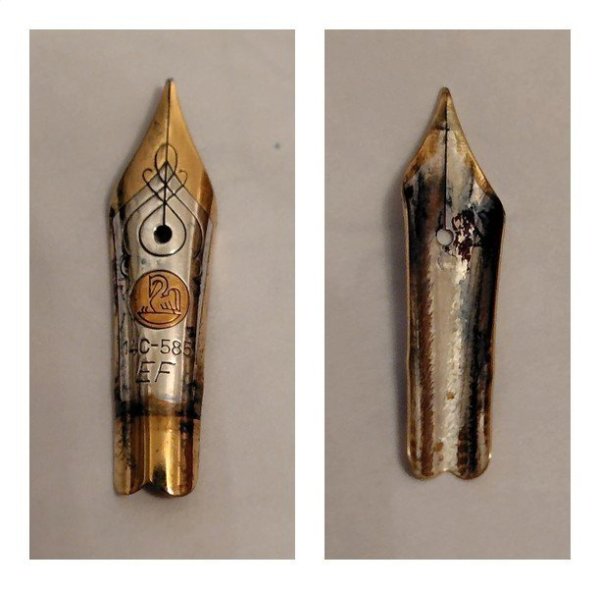
Does the scroll nib have any flex to it? If not, how about figuring out a way to fill up the gap between the tines rather than bending them. The bending seems to be tricky as the inside tines look quite delicate while the outside ones are fairly solid.


Salman

Link to comment
Share on other sites

Does the scroll nib have any flex to it? If not, how about figuring out a way to fill up the gap between the tines rather than bending them. The bending seems to be tricky as the inside tines look quite delicate while the outside ones are fairly solid.

I was just thinking that myself! It's not intended as a flexible nib (I'm sure that the separate tines are just to assist the ink flow) and is fairly stiff. I'm thinking of filling the gap with a tiny amount of car body filler. It's easy to apply as a very fine paste and grinds very well when dry. I'll have to give it some thought.


Thanks for your comments.


Ken

Edited by caliken
Link to comment
Share on other sites

If you push a piece of paper (or thin plastic sheet that grocery bags are made of) in the two slits it should keep the slits free of debris and you can use an epoxy resin that hardens to something non absorbent without fear of gluing the slits shut.


The next question would be whether the two slits on each end would provide sufficient flow for the whole width of the nib.


S.

Link to comment
Share on other sites

If you push a piece of paper (or thin plastic sheet that grocery bags are made of) in the two slits it should keep the slits free of debris and you can use an epoxy resin that hardens to something non absorbent without fear of gluing the slits shut.


The next question would be whether the two slits on each end would provide sufficient flow for the whole width of the nib.


S.

Good advice...I'll probably do as you suggest. As to the ink flow, I won't know until I try it!


Thanks


Ken

Link to comment
Share on other sites

After some further experiments I have decided that feeding the fountain pen left corner for this technique is more important than reducing the width of the right tine as Alais advises.


Here is a close up of today's project based on an extra fine factory nib. It shows no sign of drying out on the upstrokes.


http://farm9.staticflickr.com/8348/8249963889_08b77ffda2_o.jpg

Link to comment
Share on other sites

I am in the process of 'developing' a brass nib using the principle of an automatic pen. The design allows for unlimited hairlines - or at least until the ink runs out - and are fairly smooth to allow for the tricky transition at the top of the compound curve.


Here are my efforts so far:


fpn_1355063183__brass-nib-600-1.jpg


fpn_1355063379__brass-nib-600-2.jpg


The hairlines are fairly thick right now but the principle is sound. I will develop this further as and when I find time over the next few days and report here.


Salman

Link to comment
Share on other sites

I am in the process of 'developing' a brass nib using the principle of an automatic pen. The design allows for unlimited hairlines - or at least until the ink runs out - and are fairly smooth to allow for the tricky transition at the top of the compound curve.

The hairlines are fairly thick right now but the principle is sound. I will develop this further as and when I find time over the next few days and report here.

That's looking good, Salman. I think that you may have solved the problem. I thought of trying something similar with some old, double-bladed "Automatic" pens I have, but I haven't figured out how to do it, as yet.


I'm rather cautious on how to proceed, as I ruined two Mitchell's scroll nibs in my experimenting (as described earlier in this thread). I think that it may have worked, but they were far too small to adapt without damaging the tiny tines.


Please keep us posted!


Ken

Link to comment
Share on other sites

Create an account or sign in to comment

You need to be a member in order to leave a comment

Create an account

Sign up for a new account in our community. It's easy!

Register a new account

Sign in

Already have an account? Sign in here.

Sign In Now


  • Most Contributions

    1. amberleadavis
      amberleadavis
      43972
    2. PAKMAN
      PAKMAN
      35569
    3. inkstainedruth
      inkstainedruth
      31298
    4. Ghost Plane
      Ghost Plane
      28220
    5. Bo Bo Olson
      Bo Bo Olson
      27747
  • Upcoming Events

    No upcoming events found
  • Blog Comments

    • stylographile
      Awesome! I'm in the process of preparing my bag for our pen meet this weekend and I literally have none of the items you mention!! I'll see if I can find one or two!
    • inkstainedruth
      @asota -- Yeah, I think I have a few rolls in my fridge that are probably 20-30 years old at this point (don't remember now if they are B&W or color film) and don't even really know where to get the film processed, once the drive through kiosks went away....  I just did a quick Google search and (in theory) there was a place the next town over from me -- but got a 404 error message when I tried to click on the link....  Ruth Morrisson aka inkstainedruth 
    • alkman
      There is still chemistry for processing regular chrome (positive) films like Kodak Ektachrome and Fuji Velvia, but Kodachrome was a completely different and multistep beast. 
    • Ceilidh
      Ah, but how to get it processed - that is the question. I believe that the last machine able to run K-14 (Kodachrome processing) ceased to operate some 15 or so years ago. Perhaps the film will be worth something as a curiosity in my estate sale when I die. 😺
    • Mercian
      Take a lot of photos!   If the film has deteriorated or 'gone off' in any way, you can use that as a 'feature' to take 'arty' pictures - whether of landmarks, or people, or whatever.
  • Chatbox

    You don't have permission to chat.
    Load More
  • Files


×
×
  • Create New...