Jump to content

Advice For Starting Calligraphy


DrHaire

Recommended Posts

Ok so I have decided that for Christmas I want to get started into FP's and Calligraphy. The pen I have decided to start with is a TWSBI Diamond 540 Smoke with a fine nib tip. This pen is for school mostly and getting introduced into FP's.


However I am also very interested in learning Calligraphy as I have been looking around this forum and seeing the threads regarding this beautiful type of writing. I am most interested in learning Gothic Batarde #35, Uncial #6, and English Roundhand (Copperplate) #2 that is discussed in Caliken's 'Despository of Handwiting And Calligraphy Styles And Discussion'. I have different interests for each one and the one I would probably use most is the copperplate, however I found a style somewhere (I think it was here but I can't find it) that looked like the copperplate #2 but was termed with an "under-linked" emphasis. I thought that style looked great and it really sparked my interest and is my favorite.


I can accept, however, that a newbie needs to put in plenty of practice hours and time to develop these skills and would like to get started. I have been looking around the forums for a good place to start and I am not really finding anything concrete, I have found threads about the absolute beginning and then more advance "group learning" threads. My question is this:


"Where is the best starting place for someone who does not have great handwriting and would like to begin learning calligraphy (could also use tips for general handwriting)? What is the best tool to use for Calligraphy writing (FP, dip pen, penholder+nib combo, or others if there are any)? What is the advised form of calligraphy to begin learning?"


To break down each of these questions I will start with the first and move to second and third, that way you guys can better understand what I am asking.


First, when I ask where is the best place to start I am referring to books, videos, web-sites etc.... From what I have gathered the book Write Now is a good starting place and IAMPETH.com has tutorials for various calligraphy forms. Would these places be good starting places? Also how much time should one expect to spend before begin getting satisfied results or pieces of writing (I am planning to spend an average of about 5-7 hours a week practicing, I would like to spend more but don't think I will be able to between school and life)?


Second, I have been reading around on these forums and have come to know that there are various ways to can acquire a pen suitable for calligraphy. I have found that you can buy different sized nibs for fountain pens, and the 540 has a variety that is fairly easy to change. I have read about dip pens and how many people prefer them for calligraphy. Additionally, I have heard about getting a penholder+nib, but whenever you search google for explanations on them it brings up a plethora of physical "pen" holders. I am curious as to how to use this penholder+nib combo, what they are referred to as by businesses, and how they work. These combos seemed cheap and also very neat and customizable. So what would you guys advise is a good investment to begin this process of learning. In addition, I am curious as to what paper is most effective with calligraphy and what to avoid when picking paper for calligraphy (as I watch videos I can understand how feathering and bleed could be a potential nightmare (correct me if I am wrong). Also what kind of writing surface should I practicing, specifically angle of surface.


Third, is the question I have been unable to locate an answer for and consider it an important question. I think this because I would rather not try and learn a very advanced form of calligraphy and get burnout or discouraged by not being to develop the adequate skill. So my favorite form is the Roundhand copperplate style with the "under-linked letters" because I feel it is a more practical form of calligraphy, but I would also like to learn the Gothic Batarde followed by the Uncial to use for presents and special occasions. After sharing these preferences and thoughts, with what form or style of calligraphy would you recommend me starting with?


Thank you all in advance for the help and I have until Christmas before I will get any of these pens, tools, or books. Once I get my utensils I will post my current handwriting so you all know my starting point regarding style and print.


Thanks again and I look forward to the responses,

Tim

Link to comment
Share on other sites

  • Replies 26
  • Created
  • Last Reply

Top Posters In This Topic

  • DrHaire

    7

  • Mickey

    5

  • notbob

    5

  • caliken

    3

Top Posters In This Topic

Whoah, you're very wordy when you ask for something aren't you? it's all good I quite like it!


So if I understand you right you're asking where to learn the various styles of calligraphy and you're asking what equipment you need. Your post is a little confusing because (while you've done the research) you're both asking what you should get and then saying you've decided on certain things that contradict your questions.


Also, can we see your handwriting first? You don't need a fancy tool to improve that, any old pencil will do (or ballpoint pen, or what not).


As to answer the questions how I can I would recommend picking up a copy of "The Universal Penman" and trying to find "The Calligrapher's Bible" as those, combined, will probably have all the styles you ever desire. Then simply try to copy the letters in there as best as you can until it's second nature.


The type of copperplate you seem to want to learn is called copperplate, not Engrosser/engraver's script as the others are. Basically copperplate is WRITTEN while engraver's is DRAWN. The quick and dirty differences between those are that writing can be done in copperplate in a rather timely manner, in fact, it can become your normal handwriting. However Engraver's script, when done properly, takes forever as there's (on average) 2-3 pen-lifts for each LETTER, never mind the elaborate (but beautiful0 capitals.


Caliken has an awesome book on using copperplate for handwriting, you might want to check that out; it's in his signature.


Writing surface for baroque scripts (spencerian/copperplate) is best done on a flat surface. For the other scripts it can be done on anything from 45º to flat. I prefer flat because that's how I've learned all of them and that's how I work, but others have different preferences. The more important thing is what to write on and with.


I would discourage you from spending money on cheap alternatives, if you are to spend money on calligraphy it should (in my opinion) be either the absolute minimum or enough to cover all your needs for the foreseeable future with quality tools. I would suggest taking a gander at john neal's bookstore, it has several items in there. You can get all the nibs you need for copperplate, gothic, and unical for rather cheap. I highly recommend getting a fancy schmancy adjustable oblique pen holder. They're about $25 instead of $3 but sooo worth it. They fit everything from crow quills to the fattest longest nibs on the market. And since you can adjust it you can make it fit you. Apparently my nib needs to be really flat compared to most other people since I tend to write with a different angle than most people (my wrists are hyper-flexible is the best guess I have as to why) and the adjustable thing allows me to.


I hope that helps some, sorry for the awful formatting of my answer.

Edited by thang1thang2
Link to comment
Share on other sites

Whoah, you're very wordy when you ask for something aren't you? it's all good I quite like it!


So if I understand you right you're asking where to learn the various styles of calligraphy and you're asking what equipment you need. Your post is a little confusing because (while you've done the research) you're both asking what you should get and then saying you've decided on certain things that contradict your questions.


Also, can we see your handwriting first? You don't need a fancy tool to improve that, any old pencil will do (or ballpoint pen, or what not).


As to answer the questions how I can I would recommend picking up a copy of "The Universal Penman" and trying to find "The Calligrapher's Bible" as those, combined, will probably have all the styles you ever desire. Then simply try to copy the letters in there as best as you can until it's second nature.


The type of copperplate you seem to want to learn is called copperplate, not Engrosser/engraver's script as the others are. Basically copperplate is WRITTEN while engraver's is DRAWN. The quick and dirty differences between those are that writing can be done in copperplate in a rather timely manner, in fact, it can become your normal handwriting. However Engraver's script, when done properly, takes forever as there's (on average) 2-3 pen-lifts for each LETTER, never mind the elaborate (but beautiful0 capitals.


Caliken has an awesome book on using copperplate for handwriting, you might want to check that out; it's in his signature.


Writing surface for baroque scripts (spencerian/copperplate) is best done on a flat surface. For the other scripts it can be done on anything from 45º to flat. I prefer flat because that's how I've learned all of them and that's how I work, but others have different preferences. The more important thing is what to write on and with.


I would discourage you from spending money on cheap alternatives, if you are to spend money on calligraphy it should (in my opinion) be either the absolute minimum or enough to cover all your needs for the foreseeable future with quality tools. I would suggest taking a gander at john neal's bookstore, it has several items in there. You can get all the nibs you need for copperplate, gothic, and unical for rather cheap. I highly recommend getting a fancy schmancy adjustable oblique pen holder. They're about $25 instead of $3 but sooo worth it. They fit everything from crow quills to the fattest longest nibs on the market. And since you can adjust it you can make it fit you. Apparently my nib needs to be really flat compared to most other people since I tend to write with a different angle than most people (my wrists are hyper-flexible is the best guess I have as to why) and the adjustable thing allows me to.


I hope that helps some, sorry for the awful formatting of my answer.


Yes this is great information and answers most if not all my questions. I am sorry for the confusion and I was just trying to inform the reader of the gifts my family and fiance are getting me for Christmas that way I don't buy an unnecessary tool. However I would like to start collecting FP's, dip pens, etc... so I should say here that their is probably no unnecessary tool. I have been looking at John Neal's bookstore and the pen holders I would purchase would be around 25 dollars.


Another question however is how to use the oblique pen holders and how are they different from straight pen holders?? They look confusing as far as handwriting but very simple as far as using and changing nibs.

Link to comment
Share on other sites

There are as many opinions as people on how to start with calligraphy. Usually, italic is easiest to learn and can be adapted to stylize your cursive writing. Copperplate is difficult and takes practice to learn. It is almost impossible to do without the proper oblique holder and nibs. Most FP sets for calligraphy have a square cut nib that makes normal writing difficult.

However, since you seem serious to try this, you will be better off using a nib holder and dip nibs. Once you learn the basics, there are many styles of nibs to try for different uses. Your local art store should stock sets such as Speedball makes for a reasonable price. Also, using dip nibs allows you to use FP ink and India ink or even paint based inks - just remember to clean after each use.

There are programs listed here to print out your own practice sheets although any quality 6mm or 8mm lined paper will do to start. Keep in mind most calligraphy uses movements from L to R and top to bottom. The pens do not work so well R to L and bottom to top.

Try posting a scan of your initial efforts and you will get lots of helpful suggestions.

Good luck.

Link to comment
Share on other sites

Ok so I have decided that for Christmas I want to get started into FP's and Calligraphy.


Me! Me! Me! Call me! (waving raised hand frantically)


heh heh...... no, really. I think I can help cuz I jes started from where you are now, about 6-8 wks ago. Didn't know zip, and am now totally gonzo crazy eyebrow deep into it. Calligraphy, pens, nibs, holders, markers, paper, inks, books, forums, sellers.....well, let's jes say it's too late for me. ;)


I'll try and put it to you as succinctly and simply as I can. Here's how I got started and I don't think it's bad route to take. Watch this video. Coolest beginning video I've seen yet:


OK, which style to start with. ITALIC!! Nineteen out of twenty people here on FPN will say the same. You can do italic with everthing from a pencil to a 5mm wide calligraphy pen. You can do it as straight print or as connected cursive. It's easy, it's fun, it's practical, it's pretty, it's exotic, it's classy. Just do it!


You have a good pen. Keep it full of ink. Get all the nibs for the 540. The 1.1 and 1.5mm nibs are great for italic. If you want to go cheaper, you can buy a Hero 5028 calligraphy pen from ISellPens with 3 nibs (same sizes as 540) INCLUDED for a mere $10. I think it has better nibs and feeds better than the 540, but it's a smallish pen, 5-11/16ths untopped, and bizarrely, it can't be topped. Only pen I've run across that can't. Weird.


Get a couple books. Check out your library. I recommend Getting Started with Calligraphy by Nancy Baron. It's fer kids, but it's excellent. Nothing but the basics for italic, chancery (a fancy version of italic), both print and cursive, and black letter. Black letter is that ornate calligraphy everyone calls gothic or old English. Regardless, those three or four strokes you hear Mark telling you to practice over and over in the video ....learn those horizontal and vertical strokes and connect them and that's black letter. The basics are brain dead simple. Perfection requires only practice. One other book, Written Letters by Jacquiine Svaren. It has 33 exemplars (example alphabets) plus ductus (how to make each letter stoke) and tips for EACH LETTER!. No kidding. Even tells which brand/size nib to use. Both these books are out of print, but both can be bought online for less than $15 ea. I've seen about a dozen calligraphy books and these two are now my beginner bibles for broad nib calligraphy.


Copperplate and Spencerian. Still calligraphy, but a whole different ballgame. This is pointed pen calligraphy. That other stuff like black letter and uncial is broad edged nib calligraphy. Both require different pens, nibs, and approach. Plenty of info on the web. Google for it. You know about IAMPETH, already. They are the keepers of all things pointy.


Markers. Like that beginner video, get a marker. Very cheap. I started with a Sharpie Calligraphic 2.5mm marker and a legal pad. $3 total!! Later, try Pilot Parallel Pens. At first I resisted buying a PPP cuz of the hype. Then I bought one. Now I have four and a box of different colors. These things seem cheaply made and fragile, but they hang in there and write like butter. Big fun!! I've already created an original font with my 6mm PPP.


Paper. Start with a Walmart legal pad. Scarf some printer paper. Look for some old college rule 3 hole paper, which was originally for fountain pens. HP1124 is BETTER printer paper. Finally, go big and buy some Rhodia or Clairefontaine. It's worth it, believe me. You'll need CF or Rhodia if you get those PPPs. They lay down some serious ink and CF can handle it.


Inks. No mas!! You can lose your ever lovin' mind over inks. Start small. Buy samples. Then get a bottle of one you really like. The 2-3ml samples will not fill that big ol' 540 and you will have feed problems, so get a full bottle of ink you like and fill that pen up FULL! Goulet Pens has the coolest ink color comparison thingie on the web. You'll camp out overnight.


I'll put in a plug, here. All this stuff, including all those Copperplate and Spencerian books, nibs, pens, paper, books, etc, can be found on the John Neal Bookseller website. This vendor rocks. I sleep with their glossy color catalog and a yellow highlighter, for when I wake in the middle of the night. He's not the biggest, but for calligraphy he's the most concentrated. His catalog is more than a jes a catalog, it's an education. Seriously.


Watch videos and surf. Youtube has dozens, some very good. FPN has great videos, specially by Caliken. Look in the Penmanship forum for links, videos, and calligraphy information. FPN, itself, is a gold mine. Many of the FPN regulars are pen professionals who make their living from FPs. Many of the folks you will buy from, sell to, and deal with, are regulars on FPN, so pay close attention. I read it at least a couple hours every day and never fail to learn something new, usually several things. Never be afraid to ask questions. I've haunted the internet for about 15 yrs and have never met a more helpful and friendly group of people.


I could go for days, but I promised "succinct", so I'll stop here. If you would like even more info or great links from a full throttle "noob" or merely clarification on info I have provided, jes personal message (PM) me. I'm old and retired and have nothing but time. Heck, I'll even help look for any info you might need. ;)

nulla dies sine linea

Link to comment
Share on other sites

I recommend that you begin with only one hand, preferably italic or perhaps humanist, either of which can be executed with inexpensive fountain pens. Become competent in this first hand before tackling another.


When you do get around to Copperplate, an oblique holder is highly recommended. You might consult the learning Copperplate thread for the nib choices, but don't start off your studies with the most flexible nibs, e.g., Leonardt Principal, Brause 76, Gillott 303, Hunt 101, etc.; sexy yes, but difficult to control. Instead, begin with nibs like the Hunt 56, Gillott 404, and Nikko G, which are much easier for the beginner to handle. In fact, starting with a pencil is not the worst way to start the study of any new hand, Learn the letter forms first.

The liberty of the press is indeed essential to the nature of a free state; but this consists in laying no previous restraints upon publications, and not in freedom from censure for criminal matter when published. Every freeman has an undoubted right to lay what sentiments he pleases before the public; to forbid this, is to destroy the freedom of the press; but if he publishes what is improper, mischievous or illegal, he must take the consequence of his own temerity. (4 Bl. Com. 151, 152.) Blackstone's Commentaries

Link to comment
Share on other sites

I recommend that you begin with only one hand, preferably italic or perhaps humanist, either of which can be executed with inexpensive fountain pens. Become competent in this first hand before tackling another.


When you do get around to Copperplate, an oblique holder is highly recommended. You might consult the learning Copperplate thread for the nib choices, but don't start off your studies with the most flexible nibs, e.g., Leonardt Principal, Brause 76, Gillott 303, Hunt 101, etc.; sexy yes, but difficult to control. Instead, begin with nibs like the Hunt 56, Gillott 404, and Nikko G, which are much easier for the beginner to handle. In fact, starting with a pencil is not the worst way to start the study of any new hand, Learn the letter forms first.


I was the opposite. I first started with copperplate and quickly realized that I was out of my depth, and then I did some of the exercises and went back to learning business script to familiarize my hand with delicate writing. For some reason I seem to be able to draw letters rather well for the amount of practice (probably due to learning how to draw earlier in life, but then forgetting some of it) so slow drawing of the letters looked fine for me but the slant and size would always be off. Downgrading from the 303 to the 404 and making the size smaller helped a lot but I was able to jump straight into either spencerian or copperplate and improve in it. I do love humanistic hands, though, and italic so I want to learn those (especially italic since I have to write a notebook in a manuscript hand for part of a competition)


It's not necessary to become competent in one hand before starting a complicated one, but it makes your journey MUCH easier. The greatest advice I was ever given was to write out each letter in pencil first before learning it.


"One should write out, in pencil, a perfect form of each letter they are attempting to learn. Strive for the absolute perfection of it, every delicate stroke and line should be copied even if the erasure has to be used copiously. Once you have a perfect letter cemented into your mind you will be able to write it much easier and you will learn much faster"


I've found that advice the most help out of anything I've ever read about learning calligraphy.

Link to comment
Share on other sites

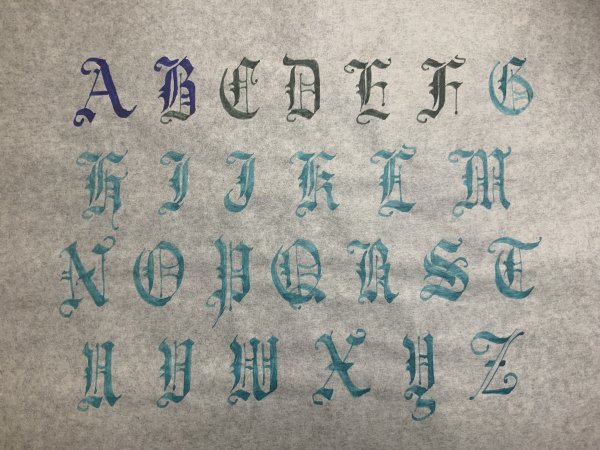
I realize this is only tangentially relevant, but your mention of "gothic batarde" got me digging. Lotta variations out there, which is to be expected, but I ran across this example and got a good laugh out of it. I love a hearty guffaw in the am and thought, amidst all this stringent advice, you folks might appreciate a good morning chuckle, also. So here is a calligraphic case of old meets new:


dier party girl

nulla dies sine linea

Link to comment
Share on other sites

I recommend that you begin with only one hand, preferably italic or perhaps humanist, either of which can be executed with inexpensive fountain pens. Become competent in this first hand before tackling another.


When you do get around to Copperplate, an oblique holder is highly recommended. You might consult the learning Copperplate thread for the nib choices, but don't start off your studies with the most flexible nibs, e.g., Leonardt Principal, Brause 76, Gillott 303, Hunt 101, etc.; sexy yes, but difficult to control. Instead, begin with nibs like the Hunt 56, Gillott 404, and Nikko G, which are much easier for the beginner to handle. In fact, starting with a pencil is not the worst way to start the study of any new hand, Learn the letter forms first.


I was the opposite.


Hardly the opposite. If anything, your post reiterates most of my points. Learn one set of letter forms first, use a nib which isn't beyond your control, and consider starting with a pencil.


The only way in which we differ is my suggestion to begin with edged pen rather than pointed pen and I stand by that recommendation. Edged pens, I believe, are easier for beginners to use than flexible pointed pens, and, if used in a formal study, inculcate proper technique more quickly. Also, the student avoids the portability barrier of pointed pens and can practice nearly anywhere. I also believe that making a clean break from one's old scrawl is beneficial and that the cursive writing most people learned is more likely based on pointed pen hands, ergo, begin formal study with an edged pen hand.

The liberty of the press is indeed essential to the nature of a free state; but this consists in laying no previous restraints upon publications, and not in freedom from censure for criminal matter when published. Every freeman has an undoubted right to lay what sentiments he pleases before the public; to forbid this, is to destroy the freedom of the press; but if he publishes what is improper, mischievous or illegal, he must take the consequence of his own temerity. (4 Bl. Com. 151, 152.) Blackstone's Commentaries

Link to comment
Share on other sites

I recommend that you begin with only one hand, preferably italic or perhaps humanist, either of which can be executed with inexpensive fountain pens. Become competent in this first hand before tackling another.


It's not necessary to become competent in one hand before starting a complicated one, but it makes your journey MUCH easier. The greatest advice I was ever given was to write out each letter in pencil first before learning it.


"One should write out, in pencil, a perfect form of each letter they are attempting to learn. Strive for the absolute perfection of it, every delicate stroke and line should be copied even if the erasure has to be used copiously. Once you have a perfect letter cemented into your mind you will be able to write it much easier and you will learn much faster"


I've found that advice the most help out of anything I've ever read about learning calligraphy.


I consider this fantastic advice and between notbobs post and these I think I am going to head over to a michaels or hobby lobby and purchase a marker and get started this weekend. I don't want to wait for Christmas haha.


Also is there a particular form of italic or is it just italic. I haven't been able to do much research on this yet but I will today during classes haha, and get started tonight. I appreciate all the help guys and will scan and post my efforts tonight and tomorrow. I will link the post to the thread here so that you all can refer to it if you don't mind.


Thanks,

Tim


P.S. I will pm my finds, some research, and progress notbob.

Link to comment
Share on other sites

I realize this is only tangentially relevant, but your mention of "gothic batarde" got me digging. Lotta variations out there, which is to be expected, but I ran across this example and got a good laugh out of it. I love a hearty guffaw in the am and thought, amidst all this stringent advice, you folks might appreciate a good morning chuckle, also. So here is a calligraphic case of old meets new:


dier party girl


Great funny, I appreciate the morning laughs. May write a calligraphic letter to God myself one day, regarding forgiveness for my poor calligraphy in letter and if he can mail me a sample of His.


Hardly the opposite. If anything, your post reiterates most of my points. Learn one set of letter forms first, use a nib which isn't beyond your control, and consider starting with a pencil.


The only way in which we differ is my suggestion to begin with edged pen rather than pointed pen and I stand by that recommendation. Edged pens, I believe, are easier for beginners to use than flexible pointed pens, and, if used in a formal study, inculcate proper technique more quickly. Also, the student avoids the portability barrier of pointed pens and can practice nearly anywhere. I also believe that making a clean break from one's old scrawl is beneficial and that the cursive writing most people learned is more likely based on pointed pen hands, ergo, begin formal study with an edged pen hand.


I agree with you in that both your posts compliment each other. I have a question though however and it is regarding markers. Would you suggest starting with a pencil before a calligraphic marker? I'm thinking of getting one like the one used in Mark Wilson's video (its linked in notbobs first post). Disregard this purchase as definite I would rather have your answer first.


Thanks,

Tim

Link to comment
Share on other sites


I agree with you in that both your posts compliment each other. I have a question though however and it is regarding markers. Would you suggest starting with a pencil before a calligraphic marker?


Yes. The idea of working with a pencil is to learn the path the point (or edge) must trace without regard to the varying line width, i.e., concentrate on the core of the letter.

The liberty of the press is indeed essential to the nature of a free state; but this consists in laying no previous restraints upon publications, and not in freedom from censure for criminal matter when published. Every freeman has an undoubted right to lay what sentiments he pleases before the public; to forbid this, is to destroy the freedom of the press; but if he publishes what is improper, mischievous or illegal, he must take the consequence of his own temerity. (4 Bl. Com. 151, 152.) Blackstone's Commentaries

Link to comment
Share on other sites

Also is there a particular form of italic or is it just italic?

If you look at post #4 in "Depository of Handwriting and Calligraphy Styles" at the top of this forum, you'll find an example of basic, formal Italic.


Ken

Link to comment
Share on other sites

So how many hours of slow, tedious, and lapidary exercise will it honestly take to note real progress.

If you find it tedious, you're in trouble. It should be pleasurable, if you're to make progress. :P

Link to comment
Share on other sites

Edged pens, I believe, are easier for beginners to use than flexible pointed pens, and, if used in a formal study, inculcate proper technique more quickly. Also, the student avoids the portability barrier of pointed pens and can practice nearly anywhere. I also believe that making a clean break from one's old scrawl is beneficial and that the cursive writing most people learned is more likely based on pointed pen hands, ergo, begin formal study with an edged pen hand.


Great advice IMO :thumbup:


Ken

Link to comment
Share on other sites

So how many hours of slow, tedious, and lapidary exercise will it honestly take to note real progress.

If you find it tedious, you're in trouble. It should be pleasurable, if you're to make progress. :P


Absolutely. I find practice meditative, calming, and when I need to find a little peace in the middle of my personal chaos, I retreat to my desk.

The liberty of the press is indeed essential to the nature of a free state; but this consists in laying no previous restraints upon publications, and not in freedom from censure for criminal matter when published. Every freeman has an undoubted right to lay what sentiments he pleases before the public; to forbid this, is to destroy the freedom of the press; but if he publishes what is improper, mischievous or illegal, he must take the consequence of his own temerity. (4 Bl. Com. 151, 152.) Blackstone's Commentaries

Link to comment
Share on other sites

Ok guys so I am thinking of using a flare pen instead of a pencil, reasoning is because the flare pen (basically a pointed marker that doesn't bleed as bad) wouldn't require as much pressure to do the writing but would also prevent worry of contrast between thick/thin lines. This is something I have come up with on my own however and would be willing to alter my purchase if you guys instruct otherwise.


Now referring to the edged pen over the pointed pen, I think I understand why that is a wiser choice and have a question about getting around purchasing an edged dip pen just yet. If I understand you correctly the benefit of an edged pen is that you would not have to worry about the point flexing, but instead just focus on your point's angle in order to produce the line's thickness. I also would like to believe that this understanding and emphasis would produce more effective and satisfying results in the learning process. If I am correct in my beliefs and understanding let me know, if not please correct me.


As far as the question I am wondering if the calligraphy marker would work for the edged pen? I am asking this because I am under the impression that the point doesn't flex and requires an angling of the point to produce the line's thickness.


Thank you guys all the advice is tremendously helpful,

Tim


P.S. Thank you for the form of italic Caliken I will refer to it. Also I will upload my handwriting for note-taking and a more relaxed style tonight.

Link to comment
Share on other sites

I am starting a thread in chatter that refers to what music you like to listen to, I find that this can be helpful when practicing anything that requires patience and prevention of excess frustration. Please check out the thread and post your preferences.

Link to comment
Share on other sites

lobby and purchase a marker and get started this weekend. I don't want to wait for Christmas haha.


Also is there a particular form of italic or is it just italic.


P.S. I will pm my finds, some research, and progress notbob.


Do it!! Get a marker. Here's why: Half the fun of calligraphy is creating/seeing the difference between the narrow and the wide portion of a stroke. That's what it's all about. This can be done with a flat broad nib held at various angles or with a nib that flexes to different widths as greater pressure is applied to it. This is the heart of both broad edge nibs (angle) and pointy flex nibs (pressure), You can achieve neither with a pencil. Oh, you can make a pencil look great:

But, I think that is drawing, not writing. A marker is a joyful entry into the world of broad edge calligraphy. It's simple and it's cheap, but most of all it's FUN. That's the one thing Mark keeps hammering on in his video, keep it fun. This should not be drudge work. A marker say's, "Ta' heck with it! Let's get crazy."
That's not to say we can't be serious, too. Just take yer legal pad and cheapo marker and copy that M like Mark does it. It's easy. It's fun. It looks fabulous! Yer a calligrapher.


Ahhh.... back to Italic. Such a great letter style. Not only is it classy, it's really rather easy. And, like all letter styles, there are all kinds of variations. I've evolved my own italic that lends itself naturally to my unshakeable tendency to sharply corner round loops, thus making it look kinda dark and eeee-ville. It looks all Halloweenish and spooky, but I didn't have it ready for prime time before this year's big night. Next year.


Italic, at it's simplest, is those boring block print lower case letters (minuscules) you learned in grade school. But, wait! Add a little serif, that little abbreviated 45 degree flick line at the top left or bottom right of a vertical stroke, and give the ovals a more triangular shape, create narrow and wides in your strokes and ....voilà.... you have Italic. One of FPN's own, Ann Finley, gets up close and personal with chancery italic: Ann's italic tutorial link Chancery is a style variation of italic that's a bit more elegant, but the basics are the same. Notice how in her written comments, Ann connects the letters. Whoa! Cursive, or connected, italic. Start with the printed style italic, paying close attention to bottom right serifs. When you master those, just extend the ending serif to the next letter. The beauty of italic is, the letters are basically the same whether printed or cursive. This unlike contemporary K-12 cursive which has some letters totally unlike one another, like a printed b and s and a cursive b and s. None of that nonsense with italic. Well, maybe a little. Notice Ann's s's look like a K-12 cursive s. A personal preference variation.


Notice to all experts: Feel free to pounce mercilessly about my head and shoulders should I make any erroneous statements while shamelessly dispensing only recently acquired facts as kindly advice. Jes trying to help. ;)


Yes, PM me, Doc. I got some great links for ya'. If you have a printer, I have a link to a website that will generate a template to print most of the guide lines you might need to practice your writing. Found a partial ductus for French bartarde, too. Still looking.


Remember, keep it fun!

nulla dies sine linea

Link to comment
Share on other sites

Create an account or sign in to comment

You need to be a member in order to leave a comment

Create an account

Sign up for a new account in our community. It's easy!

Register a new account

Sign in

Already have an account? Sign in here.

Sign In Now


×
×
  • Create New...