Jump to content

Why German Penmakers Don't Use Celluloid?


kauloltran

Recommended Posts

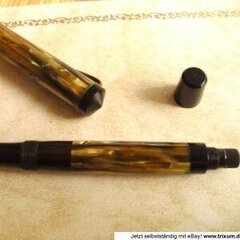
I'm wondering why the offering of celluloid pens is mostly restricted to Italian brands, since they all (with the possible exception of Aurora) produce some variety of celluloid pens in their current production runs. How come the big German penmakers like Montblanc and Pelikan don't offer celluloid in their modern ranges, not even the limited editions?

Edited by kauloltran
Link to comment
Share on other sites

  • Replies 61
  • Created
  • Last Reply

Top Posters In This Topic

  • eric47

    8

  • jar

    4

  • raging.dragon

    4

  • mirosc

    4

Cost.

Need to age celluloid for some three years; and warehouse space is some $75 a day per square yard for a book keeper. Need to work it differently. Too much hand work.

The Reality Show is a riveting result of 23% being illiterate, and 60% reading at a 6th grade or lower level.

      Banker's bonuses caused all the inch problems, Metric cures.

Once a bartender, always a bartender.

The cheapest lessons are from those who learned expensive lessons. Ignorance is best for learning expensive lessons.


Link to comment
Share on other sites

Why should they?

The pens are selling well enough without, so there's no need to start another production line with machines, processing sequence, storage,... That's just too much cost for something that almost no one is demanding.

Greetings,

Michael

Link to comment
Share on other sites

The above two replies, by Bo Bo Olsen and mirosc, are profoundly and even ludicrously unresponsive to the question Kaulotran asked. As I think both respondents will have understood, the time it takes to age celluloid would be the same for German as for Italian manufacturers. If it costs extra money to use celluloid in Germany, and require extra machines, the same thing would be true in Italy. Nevertheless, in the face of similar considerations of cost and human effort and sales possibilities, Italian manufacturers choose to do it and (it is asserted) German manufacturers don't.


Does anybody have an answer based on specific historic knowledge rather than hand-waving?


The reason may be nothing more complicated than inertia: it may be that for Italian manufacturers making celluloid pens is continuing to do what has been done in the past, no problem, and for German manufacturers omitting to make celluloid pens is also, precisely, doing what has been done in the past. (But surely I've read about celluloid pens made in Germany?)


If it isn't just inertia, it could be interesting for FPN readers to know what it is.

Link to comment
Share on other sites

I'm wondering why the offering of celluloid pens is mostly restricted to Italian brands, since they all (with the possible exception of Aurora) produce some variety of celluloid pens in their current production runs. How come the big German penmakers like Montblanc and Pelikan don't offer celluloid in their modern ranges, not even the limited editions?

Maybe because they coated the Hindenburg with a mixture of celluloid and thermite. It didn't work out well.

Can a calculator understand a cash register?

Link to comment
Share on other sites

Because you can't injection mold celluloid.

Anyone becomes mannered if you think too much about what other people think. (Kim Gordon)


Avatar photography by Kate

Link to comment
Share on other sites

The above two replies, by Bo Bo Olsen and mirosc, are profoundly and even ludicrously unresponsive to the question Kaulotran asked. As I think both respondents will have understood, the time it takes to age celluloid would be the same for German as for Italian manufacturers. If it costs extra money to use celluloid in Germany, and require extra machines, the same thing would be true in Italy. Nevertheless, in the face of similar considerations of cost and human effort and sales possibilities, Italian manufacturers choose to do it and (it is asserted) German manufacturers don't.


Does anybody have an answer based on specific historic knowledge rather than hand-waving?


The reason may be nothing more complicated than inertia: it may be that for Italian manufacturers making celluloid pens is continuing to do what has been done in the past, no problem, and for German manufacturers omitting to make celluloid pens is also, precisely, doing what has been done in the past. (But surely I've read about celluloid pens made in Germany?)


If it isn't just inertia, it could be interesting for FPN readers to know what it is.


Congratulations for having found long and complicated sounding words for telling the almost same thing as we did. But contrary to your statement German manufacturers in fact were making celluloid pens in the past, but hardly anymore. They just don't start it again (like I have written) due to cost factors; it's just not profitable enough to start with it, just like it's no more profitable for Pelikan anymore to produce OB, OBB... nibs


If you are looking for historical answers (which I don't see asked in the opening post, just contemporary - he is asking about "current"), that's quite easy.

Celluloid is flammable, almost explosive and thus should have been prohibited (initial production and certain endproducts like film) since April 1, 1940. But the second world war made this regulation impossible, because the replacement products were needed for war efforts, and so celluloid was made and used until the 1950s. Then, during the "Wirtschaftswunder" the use of celluloid was officially restricted very much - in an attempt to ban it (and also other materials were more fashionable in Germany), Montblanc switched to other materials and also the other pen manufacturers, but if I remember correctly Montblanc was first. Today celluloid isn't banned anymore (at least not in Germany - we still produce tabletennisballs, for example), but it's just not cost effective to start with it again. Just read again what I have written above: machinery, processing sequence, storage (think of the safety regulations!),...

Edited by mirosc

Greetings,

Michael

Link to comment
Share on other sites

Correct me if I am wrong but aren't the bodies of the Souveran line made of celluloid and the caps acrylic. If not they sure have the look and feel.

Link to comment
Share on other sites

Correct me if I am wrong but aren't the bodies of the Souveran line made of celluloid and the caps acrylic. If not they sure have the look and feel.


IIRC the Silver Screen special edition has a band of celluloid, but not the others.

But what is "celluloid"? The real celluloid (as we understand it here in Germany) is "Zellulosenitrat" (not sure about the correct English term), but the modern version is "Zelluloseacetat" which is used by Pelikan for the striped version.

Edited by mirosc

Greetings,

Michael

Link to comment
Share on other sites

Right after the war, Lamy bought plastic exclusion machines from Artus, who still makes those types of machines.


The US as far as I can tell followed the plastic excluded P-51 also, in it was cheaper, to exclude fresh plastic than store and age celluloid and then drill it out by hand. Less machining ... less hand work, which costs more per unit.


It's the same reason that excluded plastic feeds replaced the better hand cut hard rubber feeds, cost.


Some Italian pens, not all, kept doing it the traditional way* so they still have celluloid pens.

There was an old Italian company, that stayed old fashioned. It got bought up over a decade ago, and I think the new owners went modern. The Granddaughter I believe after a few years left to form her own company; to make pens like Gramps made; with celluloid.


Perhaps the Italian market NOW wanted a flashier more colorful pen, and got it.


I am not up on Italian pens, but my 1950 celluloid Columbus is one of my top 5 for pretty pens.


Some new firms like Delta went back to a material with more color. The new firm Visconti also.

Italian design has it's own flare, a brighter more 'sunny' sparkle.


The Italian Aurora, a very old company makes plastic exclusion pens; the 88...I don't know if they still make celluloid pens.

The Reality Show is a riveting result of 23% being illiterate, and 60% reading at a 6th grade or lower level.

      Banker's bonuses caused all the inch problems, Metric cures.

Once a bartender, always a bartender.

The cheapest lessons are from those who learned expensive lessons. Ignorance is best for learning expensive lessons.


Link to comment
Share on other sites

I have been told by Rick Propas (someone with actual knowledge) that colored pens did not sell as well as black pens in Germany. That being said, Sonnoecken (spelling may be wrong) had some beautiful celluloid pens.

President, Big Apple Pen Club

Follow us on Instagram @big_apple_pen_club


"Let other pens dwell on guilt and misery."


J.J. Lax Pen Co.

www.jjlaxpenco.comOn Instagram: @jjlaxpenco

Link to comment
Share on other sites

From what I have observed, the German firms like MB and Pelikan tend to stick with a good design and a proven material once it is perfected. Celluloid as a material has some dimensional stability and age related deterioration issues. MB and Pelikan know about these problems too well having made pens from these when no other material was available. Once they mastered the art of injection molded PMMA to make really well finished pens(at least MB, IMO) I think they are loathe to go back.

In case you wish to write to me, pls use ONLY email by clicking here. I do not check PMs. Thank you.

Link to comment
Share on other sites

Edited to withdraw what little I had to say; since I made my earlier post, various members have addressed the matter from both the Italian (yes to celluloid) and German (no to celluloid) positions, in the ways I was hoping for. The original question was really about both Italian and German manufacturers.

Edited by Jerome Tarshis
Link to comment
Share on other sites

Let's look at a real simple and uncomplicated answer...


THEY DON'T WANT TO... THE REASON IS MOST LIKELY DUE TO MARKETING STUDIES...

Why over complicate the answer...

Link to comment
Share on other sites

It is hard to find colored German pens on German Ebay, they cost 1/3 more than the common black and gold.

Many German companies exported colorful pens.


Esterbrook in the US stopped making pretty celluloid pens in 1960.

Yep, all I had as a kid, was the ugly pastel excluded plastic ones, with a metal top. :headsmack:

The Reality Show is a riveting result of 23% being illiterate, and 60% reading at a 6th grade or lower level.

      Banker's bonuses caused all the inch problems, Metric cures.

Once a bartender, always a bartender.

The cheapest lessons are from those who learned expensive lessons. Ignorance is best for learning expensive lessons.


Link to comment
Share on other sites

Celluloid is very hard to work with in high volumes under today's health and safety rules and in mass automation as opposed to manual turning and labor today is cost prohibitive and expertise (training, intern and apprentice programs) virtually nonexistence.


Link to comment
Share on other sites

IIRC the Silver Screen special edition has a band of celluloid, but not the others.

But what is "celluloid"? The real celluloid (as we understand it here in Germany) is "Zellulosenitrat" (not sure about the correct English term), but the modern version is "Zelluloseacetat" which is used by Pelikan for the striped version.

You're most likely looking for the difference between celluloid nitrate and celluloid acetate. I can "see" it in German. "Celluloid" generically used can refer to either one. Indeed, modern Pelikan use celluloid acetate.


Some Italian pens, not all, kept doing it the traditional way* so they still have celluloid pens.

There was an old Italian company, that stayed old fashioned. It got bought up over a decade ago, and I think the new owners went modern. The Granddaughter I believe after a few years left to form her own company; to make pens like Gramps made; with celluloid.


The Italian Aurora, a very old company makes plastic exclusion pens; the 88...I don't know if they still make celluloid pens.

From that extremely vague description of the old Italian company, it might be Omas. Omas never switched to injection molding or extrusion (it's extrusion not exclusion) at least on their flagship pens until 2004-5. They made celluloid pens at least until the 1960s, turning them. When cellluloid stop being readily availabe, Omas continued to turn them using resin as they did with modern "Arte Italiana" series of the 1980s. Later once modern celluloid nitrate was available again in the early 1990s, they started turning celluloid pens along with the resin ones.


Omas still has celluloid nitrate stock, so still makes celluloid pens today, turning them. They have other resin models too, I have no idea how those are made.


I believe the last Italian manufacturer of celluloid nitrate no longer produces it in Italy -- EU regulations make the production of celluloid rather difficult from what I heard.


The granddaughter of the founder of Omas, Armando Simoni, sold the company around 2000, to LVMH. She and her son after a brief hiatus, founded the company Atelier Simoni. But they did *not* and have *not* made any celluloid pens as far as I know. The original pens were Titanium and demonstrators.


Aurora, based on the "How its made" video, use injection molding on some (if not all of their) apens. In plastic production, injection molding is different from extrusion by the way -- they different processes. Aurora do not have currently any celluloid pens, resin and PMMA are the materials they use. There were some pens they made with celluloid acetate, the very first marbled Optimas; but the material shrank badly and Aurora switched materials.


----

I'm not sure why this celluloid discussion has to do with colors. I have vintage black celluloid pens, along with other more colorful celluloids.

Edited by eric47

Anyone becomes mannered if you think too much about what other people think. (Kim Gordon)


Avatar photography by Kate

Link to comment
Share on other sites

Very informative thread. I now know about 100% more about celluloid than I did before today!

Kind regards

Timothy

Link to comment
Share on other sites

I agree with humsin that it may be nothing more than aesthetics. German manufacturers tend to favor simple and understated (outrageous LE pens notwithstanding), while the Italian manufacturers like color and intricacy in their pens (for the most part). I like both, so sometimes I buy German-made pens and sometimes I buy Italian-made pens. There's room for everyone that way :)

Tamara

Link to comment
Share on other sites

Create an account or sign in to comment

You need to be a member in order to leave a comment

Create an account

Sign up for a new account in our community. It's easy!

Register a new account

Sign in

Already have an account? Sign in here.

Sign In Now


  • Most Contributions

    1. amberleadavis
      amberleadavis
      43972
    2. PAKMAN
      PAKMAN
      35684
    3. inkstainedruth
      inkstainedruth
      31756
    4. Ghost Plane
      Ghost Plane
      28220
    5. Bo Bo Olson
      Bo Bo Olson
      27748
  • Upcoming Events

  • Blog Comments

    • Misfit
      Oh to have that translucent pink Prera! @migo984 has the Oeste series named after birds. There is a pink one, so I’m assuming Este is the same pen as Oeste.    Excellent haul. I have some Uniball One P pens. Do you like to use them? I like them enough, but don’t use them too much yet.    Do you or your wife use Travelers Notebooks? Seeing you were at Kyoto, I thought of them as there is a store there. 
    • A Smug Dill
      It's not nearly so thick that I feel it comprises my fine-grained control, the way I feel about the Cross Peerless 125 or some of the high-end TACCIA Urushi pens with cigar-shaped bodies and 18K gold nibs. Why would you expect me or anyone else to make explicit mention of it, if it isn't a travesty or such a disappointment that an owner of the pen would want to bring it to the attention of his/her peers so that they could “learn from his/her mistake” without paying the price?
    • szlovak
      Why nobody says that the section of Tuzu besides triangular shape is quite thick. Honestly it’s the thickest one among my many pens, other thick I own is Noodler’s Ahab. Because of that fat section I feel more control and my handwriting has improved. I can’t say it’s comfortable or uncomfortable, but needs a moment to accommodate. It’s funny because my school years are long over. Besides this pen had horrible F nib. Tines were perfectly aligned but it was so scratchy on left stroke that collecte
    • stylographile
      Awesome! I'm in the process of preparing my bag for our pen meet this weekend and I literally have none of the items you mention!! I'll see if I can find one or two!
    • inkstainedruth
      @asota -- Yeah, I think I have a few rolls in my fridge that are probably 20-30 years old at this point (don't remember now if they are B&W or color film) and don't even really know where to get the film processed, once the drive through kiosks went away....  I just did a quick Google search and (in theory) there was a place the next town over from me -- but got a 404 error message when I tried to click on the link....  Ruth Morrisson aka inkstainedruth 
  • Chatbox

    You don't have permission to chat.
    Load More
  • Files


×
×
  • Create New...