Jump to content

Fountain Pens Seen As Cultural Symbols


rochester21

Recommended Posts

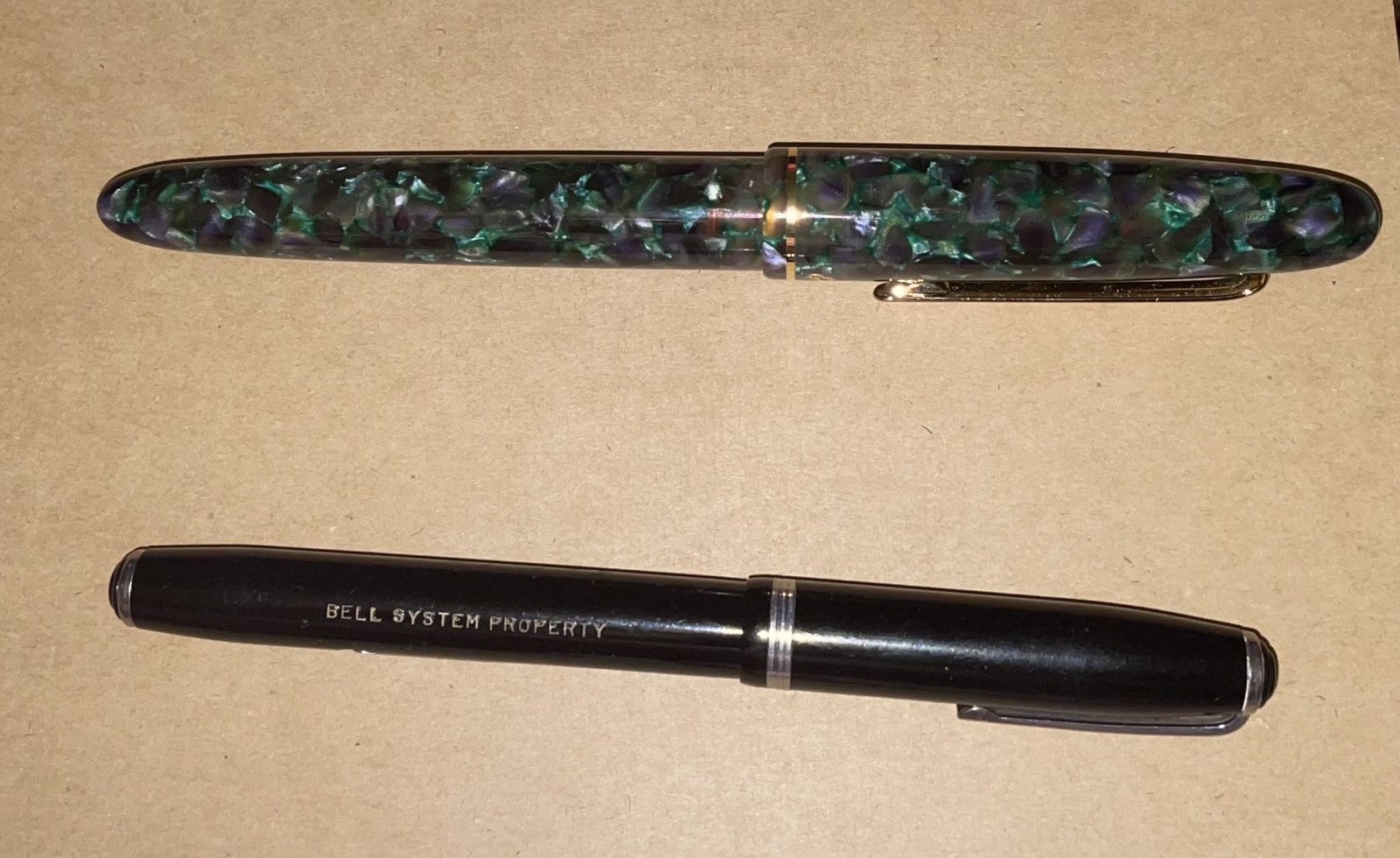
By now, i figure that most of the members of this forum have noticed that fountain pens from different countries have their own...let`s say character. For instance, japanese pens in general are manufactured with great precision, german pens are practical, whilst american pens have an original design. Italian pens have interesting patterns/colours.

Some might say that all fountain pens share some common features, and all need to be made with a certain degree of precision. More than that, there are a lot of designs that have been "migrated" from their country of origin to others. Still, i consider that every fountain pen model is somewhat representative for the period and the place where it was manufactured- in the same way that coins are. This is one of the reasons i like fountain pens- they tell a story about who we are. The fact that today fountain pens are much rarer because people use ballpoints instead is just another cultural sign that states that writing instruments change along with society. In this sense, it can be said that fountain pens are a symbol of the past and of the times people weren`t in such a rush and things weren`t made to be used once and then thrown away.

So, for me, fountains pens are interesting and valuable because they are genuine cultural objects- and maybe we tend not to notice that when buying a new pen. Contrary to what some people think, a pen is not just a pen, it`s a cumulus of things- and they all represent us, and who we are. Consider my post an invitation to (maybe) seeing these humble objects not just as merely writing instruments.

Link to comment
Share on other sites

  • Replies 11
  • Created
  • Last Reply

Top Posters In This Topic

  • terminal

    2

  • escribo

    1

  • rwilsonedn

    1

  • rochester21

    1

Top Posters In This Topic

Lately I've been feverishly trying to collect the flexible-nib pens of the late 19th/ early 20th century. What I have are a couple of old Watermans -- a 52 and a 52 1/2 V, but will likely collect others. These represent to me the end of an era of beautiful handwriting, when a person's penmanship really mattered and it said a lot about that person. Not that my handwriting with these is any good, but I am slowly learning.

I may not have been much help, but I DID bump your thread up to the top.

Link to comment
Share on other sites

I'm not sure this is so true anymore. The fountain pen market is so international and fountain pen use is on such a decline that I think it's become a self-selected identity and not cultural anymore.

"One always looking for flaws leaves too little time for construction" ...

Link to comment
Share on other sites

I'm not sure this is so true anymore. The fountain pen market is so international and fountain pen use is on such a decline that I think it's become a self-selected identity and not cultural anymore.

I think this is an excellent observation. And in a way, the fact that we are choosing to self-select an identity is also a statement about who we are. Many of us (here I'm generalizing about affluent, middle-aged people in the USA and perhaps the UK/Western-Europe) have become sufficiently separated from our cultural heritage that we prefer to assemble a ready-to-wear identity from the global market rather than to identify with our present surroundings. Nothing around me suggests that I should prefer to write with vintage fountain pens, listen to European classical music, or read translations of Chinese poetry. I've picked and chosen from across a range of cultures rather than conformed to my local culture. In fact, my local culture hardly exists beyond the sum of all the people around me who are also picking and choosing. Norms have been replaced by tentative limits.

That is an indication of just how privileged even the middle class has become in the West. But perhaps it is also an indication of just how disenfranchised--maybe the word is disestablished--we have become.

ron

Link to comment
Share on other sites

I think this is an excellent observation. And in a way, the fact that we are choosing to self-select an identity is also a statement about who we are. Many of us (here I'm generalizing about affluent, middle-aged people in the USA and perhaps the UK/Western-Europe) have become sufficiently separated from our cultural heritage that we prefer to assemble a ready-to-wear identity from the global market rather than to identify with our present surroundings. Nothing around me suggests that I should prefer to write with vintage fountain pens, listen to European classical music, or read translations of Chinese poetry. I've picked and chosen from across a range of cultures rather than conformed to my local culture. In fact, my local culture hardly exists beyond the sum of all the people around me who are also picking and choosing. Norms have been replaced by tentative limits.

That is an indication of just how privileged even the middle class has become in the West. But perhaps it is also an indication of just how disenfranchised--maybe the word is disestablished--we have become.

ron


The number of interesting ideas in this reply is amazing. Are you an author? If so, there's a book here, and I'd gladly buy it if you wrote it.

Link to comment
Share on other sites

I'm not sure this is so true anymore. The fountain pen market is so international and fountain pen use is on such a decline that I think it's become a self-selected identity and not cultural anymore.

I think this is an excellent observation. And in a way, the fact that we are choosing to self-select an identity is also a statement about who we are. Many of us (here I'm generalizing about affluent, middle-aged people in the USA and perhaps the UK/Western-Europe) have become sufficiently separated from our cultural heritage that we prefer to assemble a ready-to-wear identity from the global market rather than to identify with our present surroundings. Nothing around me suggests that I should prefer to write with vintage fountain pens, listen to European classical music, or read translations of Chinese poetry. I've picked and chosen from across a range of cultures rather than conformed to my local culture. In fact, my local culture hardly exists beyond the sum of all the people around me who are also picking and choosing. Norms have been replaced by tentative limits.


That is an indication of just how privileged even the middle class has become in the West. But perhaps it is also an indication of just how disenfranchised--maybe the word is disestablished--we have become.

ron


OhMyGosh exactly right.


The point about local culture is a bit more tricky I think. By bringing in these artifacts from "other cultures" (quotes because they to have divested themselves of these artifacts) you are self identifying BUT the capacity to identify locally still exists. In other words, if you and I live next door in western europe and we both buy Korean Hanboks because we think they are cool and identify with their history, then we have identified to each other. Now I understand you're saying "conform" but I'm not sure the tentative limits follows.


The last sentence -- that's tricky. Is it an issue of privilege? Could it be argued that selecting a Noodler's Konrad Rollerball for $20, and the cheapest possible ink is more affordable in the long run? I would argue that perhaps there needs to be a new term coined for this... perhaps "informationally privileged". Maybe being disenfranchised means not having access to the information rather than actually self identifying by buying expensive artifacts? Expensive being beside the point.

"One always looking for flaws leaves too little time for construction" ...

Link to comment
Share on other sites

I agree to some extent with the OP about cultural and period reflections in pen design. In a recent thread ("Battle of the full-sizers") there were also some specific remarks touching on this.


I'm not sure what the FP user demographics really are, but I definitely don't consider myself affluent, and have been an avid FP user at various points from elementary school on. There is a cultural continuity in the sense that my first pens were gifts from older relatives who had them and grew up using them, but, being Canadian, the ethno-cultural identity is quite diffuse (not true for all Canadians certainly, but true for many) and also, as terminal put it, self-selected.


It would be great to see an extended post with photos essaying cultural/historic aspects of pen design.

Link to comment
Share on other sites

Rochester21, congratulations on a very thought-provoking post. This type of thing is one of the reasons I enjoy the forum so much.


Ron, you certainly raise some very valid points in your discussion. At the time that my current favorite pens were manufactured (early 1940's through early 1960's), an individual's choice of culture, at least here in the US, would seem to be quite limited in comparison to today. That homogeneity had both some benefits and some significant drawbacks, which are probably out of the boundaries of the current discussion. Besides, there's no way to ensure that we are all holding our favorite beverage during the discussion, which seems a necessity for this sort of thing.


I've been learning over the past few months that my favored writing instruments tend to be US-manufactured pens from the golden age. They are before my time, chronologically speaking, so I've been picking them up on Ebay, in antique stores, and in vintage shops. While I still love my "modern" pens, the Sheaffer's and Parkers have so much more gravitas that I tend to pick them up first.


Also, as an engineer involved in a manufacturing industry, I feel some pride in holding and using these 50+ year old artifacts that are still performing their tasks admirably and efficiently so many years later. They are a testament to the men and women who designed, built, serviced, and used them. So at least, in that context, I think that Rochester21 has clearly identified an important thread that motivates many collectors - a sense of connection to our past, touching our daily lives in the form of a simple tool.

Link to comment
Share on other sites

I'm not sure this is so true anymore. The fountain pen market is so international and fountain pen use is on such a decline that I think it's become a self-selected identity and not cultural anymore.


And I see alot of pens from European (especially Italian) makers that are obviously designed to appeal to the Asian and/or Middle Eastern markets. So those pens reflect, not the culture of the country of manufacture but instead the culture of the intended target market. Then again, one could see this as fountain pens reflecting the globalization of culture.

Link to comment
Share on other sites

A fountain pen is never just a Fountain pen. That is my motto and I belive it to be true even if we talk about a $0.99 cts Fountain Pen: It is a material artifact, against the virtual artifacts the rollers of today are.

A pen is a cultural artifact indeed, and the virtual culture of today (like all of us here right now, in a inmaterial forum, a virtual reality) have come with it's own cultural products through the 'adoption/replacement' method. Hence, this or that Bic is of no consecuence. Like using this or that keyboard to type on this forum: A 'ready-to-wear' identity (or a 'ready-to-use' artifact) is the sign of globalization -no loose if discarted, there is always another one near by.

Now... despite globalization, the local identity still exists and will never be erased. Although that is precisely the plan of certain factions, to recognize the attibutes of material arttifacts through the incorporation of such items in our lifes, that is ultimately to expand the limits of material culture. It is the virtual culture the one with the tentative to limit a material culture(s).

Yet, how many cultures are strong enough as to be able to produce a locally designed fountain pen portraying the characteristics of its weather, its idea of functionality, its historical heritage, its identity, and to be recognized as such? Not many. It is not a priviledge. I'd call it an achievement of that culture. How many 'nib-mesters' or 'urushi-masters' are there? Those subjects have been able to survive in an ambient that recognizes them. Binder is not reparing pens anymore, because of an excess of work! -or thats what i heard. How many can do that? Not a nib-meaister from Peru, let me tell you.

I do not think that a German Fountain Pen would not write in Japan (although a scottish lighter never worked in Mexico, despite it perfectly functioning in Scotland). Polar Blue functions perfectly fine in the south of Spain. Is not the mixture of localities, nor the propietary design of/from any given latitude what is important. The key is the use of artifacts designed for a world that considered a person to be more than an idiot. That is a strong message to all those arround us (and to the world in general): I am an individual, not a clone.

A Fountain Pen is never just a Fountain Pen.

Link to comment
Share on other sites

I'm not sure this is so true anymore. The fountain pen market is so international and fountain pen use is on such a decline that I think it's become a self-selected identity and not cultural anymore.


Fountain pen use is far less than it was 50 years ago, but is it still on the decline? My impression, perhaps incorrect, is that there is a resurgence in fountain pen use driven by the Internet.


Fountain pens might have reflected cultural preferences in times past. With globalization and the Internet, a pen manufactured in one country might well reflect the preferences of a land far distant.


If German pens are "practical" does that characterize all of Germany? As one of my high school teachers once put it: "The Prussians are stern and disciplined, while the Bavarians are fat and happy and drinking beer". Countries considered homogeneous can actually have marked regional variations in culture. Is this also manifested in their pens?

Link to comment
Share on other sites

I can buy a calligraphy brush at just about any bookstore or stationery store where I live. I don't really like using them, and I certainly don't use them for day to day writing. They reflect the whole "slow down" subculture in a way that fountain pens can't compete with. Chisels would also be a nice nostalgic technology to use, but no thanks. Dip pens are tolerable, though not nearly as convenient as fountain pens for longer writing.


Fountain pens seem attractive in that they are the oldest writing instruments that can keep up with everyday life. I guess I can look at my Sailor and Pilot pens and see the fascinating combinations of ethnocentrism and xenocentrism in their designs, but I don't do that any more than I look for signs of misogyny in fountain pen marketing.

Robert.

Link to comment
Share on other sites

Create an account or sign in to comment

You need to be a member in order to leave a comment

Create an account

Sign up for a new account in our community. It's easy!

Register a new account

Sign in

Already have an account? Sign in here.

Sign In Now


×
×
  • Create New...