Jump to content

Ink Dyes, Traditional Or Synthetic?


antigrence

Recommended Posts

How much of the ink content of today's major brands offerings is actually made from what the color’s name is historically associated with vs. artificial components?


For example, Ultramarine blue was made as early as the 6th century and used to include powder from the semi-precious stone lapis lazuli. It was for a long time the most expensive pigment, and in the 19th century it was deemed so out of reach that chemists developed a synthetic version. Or Cobalt blue, which derives its name from cobalt salt. Do I still get lapis lazuli or cobalt salt from any manufacturer if I buy these colors today?


You would think the manufacturers would have lengthy explanations about how traditional their methods are, insisting on all the precious and semi-precious metals or stones that go in the production of their inks, but they don’t. And most reviews out there talk about color, shading, feathering, dry time, but not the actual components of the ink.


I notice that most manufacturers charge the same amount for whatever color they sell, where you would think if the content came at least partially from precious metals or stones the price for each ink would vary greatly depending on the component.


Are some manufacturers, perhaps more obscure ones (just as you have Ferraris and Chryslers), famous for using the same techniques and components that were used one or two centuries ago? Or is everything synthetic nowadays?


If it is the latter, you would think that looking at the success of upscale inks like Edelstein or Pilot Iroshizuku some brands would look into marketing inks based on the traditional formulations?

Link to comment
Share on other sites

  • Replies 14
  • Created
  • Last Reply

Top Posters In This Topic

  • Uncle Red

    4

  • The Good Captain

    3

  • FPFan

    2

  • pharmacist

    2

Top Posters In This Topic

Fountain pen inks are by and large made with aniline dyes. There are several Iron Gall inks, the special pigmented inks from Platinum and Sailor (using special pigments, no lapis involved), Pelikan has an India Ink that works in FP's and there's the true Sepia from Japan but those are the only exceptions I know about.

Remember, fountain pens are a 19th century technology.

Link to comment
Share on other sites

Probably a relief to all those from that particular area, that Prussian Blue is a synthetic pigment, then.

The Good Captain

"Meddler's 'Salamander' - almost as good as the real thing!"

Link to comment
Share on other sites

Why, is real Prussian Blue toxic?

No and neither is it, or ever has been, made from real concentrated Prussians. Meddler's 'Bismarck Brown' is another matter...

The Good Captain

"Meddler's 'Salamander' - almost as good as the real thing!"

Link to comment
Share on other sites

One moment: please the TS talks about PIGMENTS: coloured particles that do not dissolve but are suspended in a medium and will give a milky "solution". Almost all fountain pen inks are based on DYES: molecules that are truely dissolved and these solutions are completely transparant.

Link to comment
Share on other sites

First, wouln't an ink made of lapis lazuli be cost prohibitive at this time and second what amount of pulverization would be required to allow the particles of ROCK flow through a modern day ink feed?

Edited by FPFan

Fair winds and following seas.

Link to comment
Share on other sites

First, wouln't an ink made of lapis lazuli be cost prohibitive at this time and second what amount of pulverization would be required to allow the particles of ROCK flow through a modern day ink feed?


impossible. These suspensions (NOT true solutions) need alot of gum arabic and similar substances to keep the particles evenly distributed and will become very thick....It will ruin your feeding system in seconds. Even dip pens will have difficulty to use these suspensions. Good with brushes and goose quill pens.


Actually these creations can only be regarded as paint, not as ink. In german there is a distinction between inks with suspended particles (pigments) called "Tusche" and true inks (true solutions of dye) as "Tinte".

Link to comment
Share on other sites

Why, is real Prussian Blue toxic?
No and neither is it, or ever has been, made from real concentrated Prussians. Meddler's 'Bismarck Brown' is another matter...

Yeah, and Girl Scout Cookies aren't made from Girl Scouts.


Nelson, we know that FP inks are made with dyes.

Link to comment
Share on other sites

Why, is real Prussian Blue toxic?
No and neither is it, or ever has been, made from real concentrated Prussians. Meddler's 'Bismarck Brown' is another matter...

Yeah, and Girl Scout Cookies aren't made from Girl Scouts.


Nelson, we know that FP inks are made with dyes.

Who the hell is Nelson? I'll have to keep my eye out for him.

The Good Captain

"Meddler's 'Salamander' - almost as good as the real thing!"

Link to comment
Share on other sites

Hi,


It's quite an interesting topic we have here as it stands. Most inks are made from dye as mentioned earlier. We have a few odd ones that are pigmented. One thing I have seen with a lot of pigmented inks is a large amount of chemicals to keep the pigment suspended in the ink. With these inks, one must be sure to use their pen often to keep everything flowing because the pigment can collect and become impacted in the feed if the pen is not used. The advantages of the pigment is that the colors are deeper and have an odd depth to them. They also don't fade much if at all. If you like that and you are someone who writes a lot, those are certainly something to look for.


My personal long-term experience with pigmented ink is with the Platinum Carbon ink. I say that it is well behaved and it looks great on the page. The lines are a lot crisper, and very much like its cousin India ink, but without the chemicals that make India ink water proof. Despite this lack, the ink is quite waterproof. The best way to clean it out I found was with an ultrasonic cleaner and Rapidoeze. I certainly don't think I can recommend using it in a super-fine nib. My Nakaya pens have an extra fine nib and an extra super fine nib. These nibs don't seem to create enough flow, and one must clean their pens a lot more often. It probably was worse since my nibs are tuned to be fairly dry which is the way I like them. You may be much happier with a medium nib with a wetter flow.


These pigmented inks are more like the traditional inks of which I think you may be referring to.


I think that it is certainly of note that many dyes used in food coloring and commercial fountain pen ink are extracted from natural sources. It's something to make note of. For example, some reds are from coal tar, and other dyes are from plants. If one has common dye standards, it is possible to determine roughly what dyes are used in fountain pen inks with TLC and a good solvent to resolve the plates.


Dillon

Stolen: Aurora Optima Demonstrator Red ends Medium nib. Serial number 1216 and Aurora 98 Cartridge/Converter Black bark finish (Archivi Storici) with gold cap. Reward if found. Please contact me if you have seen these pens.

Please send vial orders and other messages to fpninkvials funny-round-mark-thing gmail strange-mark-thing com. My shop is open once again if you need help with your pen.

Link to comment
Share on other sites

Who the hell is Nelson? I'll have to keep my eye out for him.

Pharmacist is Nelson. I have nothing to contribute to the thread, so I'll just be sitting over here...

Robert.

Link to comment
Share on other sites

Thanks for the answers to my questions. I feel better now. I had this image of ancient egyptian artifact from Lapis Lazuli being crushed up to make ink and was a little petrified! :crybaby:

Fair winds and following seas.

Link to comment
Share on other sites

Hi,


I just popped in to add my tuppence worth about use of the 'particle' inks:


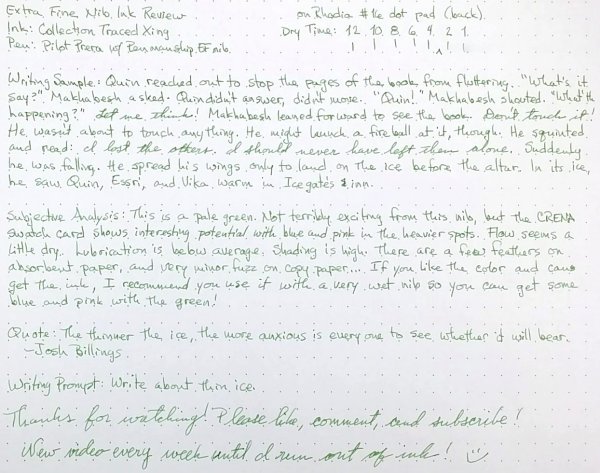
For very fine lines, I have taken to using the Platinum Carbon Pen, which apparently has a feed+nib designed for such inks. Very nice indeed. One can see written samples when paired with a dye-based ink in this Ink Review: LINK

Also, the Noodler's pens that allow one to modify the feed and feed+nib set-up seem prime candidates for experimenting playing around with particle FP inks.


In addition, we have the acrylic polymer suspension 'Magic Color' inks. After encouraging Reviews by Member 'fibredrunk', I have taken those for a whirl in expendable c/c pens, and am much impressed - a niche ink which sees use on coated stock or when I want high water resistance. Certainly not to be left to linger in an unused pen; and I use the MC Cleaning Fluid after use.


Bye,

S1

Edited by Sandy1

The only time you have too much fuel is when you're on fire.


Link to comment
Share on other sites

Thanks for the answers to my questions. I feel better now. I had this image of ancient egyptian artifact from Lapis Lazuli being crushed up to make ink and was a little petrified! :crybaby:

That pun rocks.

Link to comment
Share on other sites

Create an account or sign in to comment

You need to be a member in order to leave a comment

Create an account

Sign up for a new account in our community. It's easy!

Register a new account

Sign in

Already have an account? Sign in here.

Sign In Now


×
×
  • Create New...