Jump to content

Fusing cracks in celluloid


Sam Lee

Recommended Posts

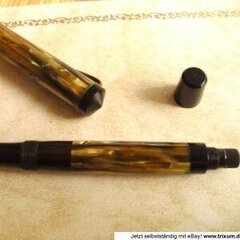
well i've successfully played with acetone and fused some barrel cracks and cap hairlines on some junker pens, but I'm wondering what is the best delivery system for precisely placing the acetone on the crack?


I was thinking syringe, but the the aceone will disolve plastic syinges won't it? I find that if i use toothpicks/metal picks, etc., the acetone evaporates too quickly.

Link to comment
Share on other sites

  • Replies 18
  • Created
  • Last Reply

Top Posters In This Topic

  • Gerry

    4

  • Keith with a capital K

    2

  • einv

    2

  • Sam Lee

    2

i always have used a paintbrush, it gives the best control. syringe requires more attention to the hand holding it to operate, and this causes imprecise control. i too tried it first but quickly settled on paintbrush.

Link to comment
Share on other sites

When fusing Lexan and similar plastic material, commercial shops have a plastic squeeze bottle with a metal tube for applying the solvent to the pieces to be joined. The solvent wicks in by capillary action and creates a very nice looking joint. I suspect that this bottle would be resistant to acetone as well. Try asking at a local fabricator of plastic products.


If not available or suitable, try converting a small metal container by soldering a fine tube to the cap and using that as a sort of syringe.


Gerry

Link to comment
Share on other sites

thanks viv for the info.


i read an archive of allan tischler's thought on the subject. it seems that he doesn't believe that acetone is an acceptable solvent for crack repair.


does Allan do repair work?

Link to comment
Share on other sites

gerry's suggestions are also well taken, i have such squeeze bottles and may try using them.


as for acetone in celluloid repair, there are purists who object because it can dissolve material and cause 'slumps' even where cracks get welded. that is, the welding is actually by erosion. a truly professional repair would be to dissolve similar material from a parts pen in acetone, and apply the mixture by using gerry's idea to fuse the cracks.

Link to comment
Share on other sites

If it's possible to source out matching celluloid then mending a crack with this is possible and preferable.


In many cases, finding a parts pen to source material can be a difficult or a nearly impossible proposition.


I have also had good success mending cracks in many celluloid and plastic pens using Ambroid Pro Weld although found that Esterbrooks do not respond to this at all. The Pro weld is also ideal for pens made of lucite such as the Parker 51.


Esterbrooks do respond to cyanoacrylate.

Please visit http://members.shaw.ca/feynn/

Please direct repair inquiries to capitalpen@shaw.ca

Link to comment
Share on other sites

What about the plastic of a 1950s Sheaffer lever filler? the cap on this thing is bowed out (i'm guessing time and heat?) and has too cracks. They don't seem to go quite all the way through such that they allow air in there and they are not immediately noticeable on the black cap. But what's the best filler method for these. Or should they be filled. It isn't my pen so I want to take the least offensive approach should the owner decide to sell it.


And my apologies if this has been discussed before. :(

KCat
Save animal lives - support your local animal shelter

My personal blog https://kcdockalscribbling.com

My nature blog https://kcbeachscribbles.com
Venerable are letters, infinitely brave, forlorn, and lost. V. Woolf, Jacob's Room

Link to comment
Share on other sites

If it were mine, I'd fill the crack with CA - either the normal type - or the thicker Gel type. Depends entirely on the thickness of the crack. Use several applications if necessary, then sand the resulting bump carefully down to the level of the rest of the pen body. From there you polish the added material 'till it blends into the finish of the rest of the pen.


I'm assuming that the owner wants a fixed up 'user', and that we're not talking about a purist type collector here. :)


Gerry

Link to comment
Share on other sites

Dennis Lively did an amazing job on an old Champion fountain pen that was smashed to bits...He has photos of the pen here: https://www.fountainpennetwork.com/forum/in...p?showtopic=201

(you have to click on the words "Champion" and "champion 2" in his first post on that page to see the pictures). I think he used acetone to dissolve the "donor celluloid" to repair it, IIRC...

Edited by Maja
Link to comment
Share on other sites

That's a really nice repair job Dennis did Maja.


The reason I recommended CA in this instance was because the repair appeared to be a need for filling rather than a structural repair like joining broken parts of a barrel together. KC mentioned that the cracks didn't seem to go through the whole barrel, and it still was airtight. That said, the filling is simpler (especially on an outside surface) if done with CA. It doesn't dissolve the barrel material, and therefore the surface finishing work is limited to just removing the excess CA applied. With the acetone, you have to find matching donor plastic material and mix a solution of acetone and donor material to create the filler.


Someone else posted a bit on the deterioration that can be brought on by the acetone since it is a solvent. Of course, that's not to say it can't be used - just that you need a fair bit of experience using it.


Regards,


Gerry

Link to comment
Share on other sites

at the risk of sounding even more stupid than usual.


where does one get CA? Is this something I can just pick up at the local hardware store?

KCat
Save animal lives - support your local animal shelter

My personal blog https://kcdockalscribbling.com

My nature blog https://kcbeachscribbles.com
Venerable are letters, infinitely brave, forlorn, and lost. V. Woolf, Jacob's Room

Link to comment
Share on other sites

Cyanoacrylate - It's very handy stuff and an essential thing to have if one is repairing pens.


Like everything, you have to exercise caution when using it as although some of us can get very attached to our pens, you don't want to become permanently attached.


Acetone and chemicals welders are considered hazardoous materials and should be used with caution as the fumes can be harmful and you don't want to expose your skin to these materials.

Please visit http://members.shaw.ca/feynn/

Please direct repair inquiries to capitalpen@shaw.ca

Link to comment
Share on other sites

  • 1 year later...

just a thought here but my daytime job is doing stone chips on windshields and the repair material that we use curs in the sunlight and is hard as hell. I made a pen one time out of plastic and nicked it with the chisel and repaired it with the repair material and then polished it up with no problem.


Just an idea


Chris Hughes

Appleman Pens

Orangeville, Ontario, Canada


Photo's Of Past Pens

My Blog


Phone 912-376-7165

Link to comment
Share on other sites

  • 3 weeks later...

One thing to keep in mind--when the celluloid for the pens was first manufactured, solvents were used to fuse the various colors, patterns and to shape them to some extent. Hence, solvents can be used once again to re-bond cracked celluloid. The choice of solvent can be debated--I've used stuff like methyl ethyl ketone with some success. I would guess that stuff which contains toluene or zylene can also be used, but I'd stay away from acetone if possible. Multiple applications are needed to properly fuse the material, spaced at intervals which don't cause the pen to change its shape, but enough to get a good fused bond. Mixing of scrap material into solvent to fill the crack has been mentioned and can be done with pretty decent results.


In NO way would I recommend liquid cyanoacrylate (crazy glues) as a primary bonding agent for cracks. It doesn't fuse the material properly like a real solvent can, and eventually it leaves a brittle "bond" that will crack once again.


Frank Dubiel (da Book) has said that cyanoacrylate in GEL form can be used to help fill depressions or gouges in celluloid, and that does seem to be a reasonable way to go, based on my experience. You have to build up the material properly, let it cure for a decent interval so that it doesn't shrink, and then carefully grind down the repair so that it blends in with the contour of the original celluloid.

Link to comment
Share on other sites

I have two Parker "51" barrels (1944 and 1945 vacs) with cracks all the way through at the plunger end, so I've read this thread and others like it with interest.


But I still have questions.


I have sealed one other P51 barrel with CA glue before reading about its potential problems. I used thin CA to join the cracked sides, then a fine layer of gel CA.


Problems mentioned with CA for cracks are: (1) absorbs liquids, therefore it may fail from contact with ink; (2) it will become brittle with time (Bill above).


Regarding #1: From what I've read about CA glues is that it cures through absorbing water, but then it becomes waterproof. See:


http://en.wikipedia.org/wiki/Cyanoacrylate


When I was doing model airplanes, I recall that the general purpose CA glues one finds in tubes at the hardware or grocery stores were not regarded very highly by modellers in contrast to the more expensive CAs sold to modellers which were better formulas. Maybe these better quality CA glues would make a difference and answer Bill's concern that the CA gets brittle over time? I don't know....


Just some musings, because I would really like CA to work on these barrels. I have lots of experience with it from the model days and it does work really well in some applications if you use it properly.


I have tried Tryphon's dental resin on parts pens with mixed results.


I recently chipped a tooth grinding my teeth at night over this problem :rolleyes: and the dentist smoothed some resin into the broken area and hardened it with blue light. Now THAT stuff has GOT to be waterproof! Maybe we ought to get ahold of that and try it out. B)


Steve

Link to comment
Share on other sites

Steve,


You mentioned good results with CA on Parker 51 barrels. 51s are not made from celluloid, but acrylic (poly methyl methacrylate, or PMMA). Lucite was the trade name.


I have no problem with using CA on acrylics--they're much more compatible, and in fact are chemically related. So no worries.

Link to comment
Share on other sites

Create an account or sign in to comment

You need to be a member in order to leave a comment

Create an account

Sign up for a new account in our community. It's easy!

Register a new account

Sign in

Already have an account? Sign in here.

Sign In Now


×
×
  • Create New...