Jump to content

removing stamped letters


manolo

Recommended Posts

Hi all,


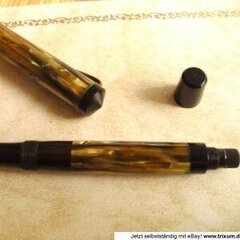
I have a Waterman Preface with stamped golden letters on the cap. If you touch with the finger it seems these letters are deposited someway on the original cap. I would like to remove them, any hint about which product could I use without damaging the cap enamel? maybe alcohol? acetone?


Will the finish of the cap once the letters removed be comparable with the rest of it?


and I would like to know also your opinion. I have heard different opinions about whether an engraving adds o substract value form a pen. What do you think?


Thanks


(I cannot attach the photos I have..don't know why...brrrr)

Link to comment
Share on other sites

  • Replies 9
  • Created
  • Last Reply

Top Posters In This Topic

  • OldGriz

    2

  • manolo

    2

  • The Pensmith

    2

  • ZeissIkon

    1

Top Posters In This Topic

It is a personal choice....

I have had one or two very collectible pens with personal engraving that I got for a great price..

I sent them to Ron Zorn to remove the engraving... you can't tell it was ever there..

Ron is a master at this kind of work

Link to comment
Share on other sites

maybe alcohol? acetone?


Can't really help you on getting the lettering off (I suspect it gets polished off when the experts do it, and polishing a pen that aggressively without lots of experience is a fine way to leave a wavy surface or even melt the pen). However: do not ever put alcohol or acetone on any part of your pen that isn't metal (and then only if that part has been disassembled from the rest of the pen). Those two solvents will, between them, damage virtually every plastic ever used to make pens, from polystyrene to acrylic to celluloid to "precious resin". Bakelite is the only pen plastic I know that will stand up to both, and it's been seldom used because it has serious drawbacks compared to other plastics.


Edit to add missed emphasis.

Edited by ZeissIkon

Does not always write loving messages.

Does not always foot up columns correctly.

Does not always sign big checks.

Link to comment
Share on other sites

I suspect that anything that you do will damage the finish of the pen. It is possible to remove a name from a plastic barrel or cap, or from a brushed stainless steel pen. But you need to know what you're doing.


But if you try to remove the name from any enamel or lacquer finish, you will damage the finish. It is very easy to remove too much material, and even if you could match the color, you'd never be able to blend it in well.

spacer.png
Visit Main Street Pens
A full service pen shop providing professional, thoughtful vintage pen repair...

Please use email, not a PM for repair and pen purchase inquiries.

Link to comment
Share on other sites

Trying to chemically remove the intials is not the anwser. There is a good technique in Marshall & Oldfields "Repair Book". Basically involves removing the initials with abrasives, rebuilding the site on the cap with Super Glue GEL and polishing back to the resin finish. Depending on colour, a lttle dye may be needed to colour the Super Glue Gel. Don't use orfinary Super Glue - doesn't work. My preference is Loctite Super Glue Gel (made in Ireland) in a blue tube. Hope this of some help.

Link to comment
Share on other sites

Trying to chemically remove the intials is not the anwser. There is a good technique in Marshall & Oldfields "Repair Book". Basically involves removing the initials with abrasives, rebuilding the site on the cap with Super Glue GEL and polishing back to the resin finish. Depending on colour, a lttle dye may be needed to colour the Super Glue Gel. Don't use orfinary Super Glue - doesn't work. My preference is Loctite Super Glue Gel (made in Ireland) in a blue tube. Hope this of some help.


Hello Pensmith,


I looked at your web-page and you are obviously a good and successful professional but it seems to me that removing a name using the 'Loctite Gel Method 'is the kind of 'restoration' that a careful amateur might try on a not too expensive pen leaving the good stuff to guys like you to do!


Can I ask a question? When you use an abrasive technique to get rid of the name do you take off the whole name in one swoop leaving a fairly long 'trough' to fill with the glue or do you take out individual letters leaving a series of 'ridges and tiny troughs' to fill in with the glue.


I have an old pen with a name on it and I would like to have a go just to see if I could do this. I was thinking of using a simple set of needle files to do the abrading as any kind of power tool might just burn the barrel up.


I'd be grateful for your comments.


PH

Link to comment
Share on other sites

Trying to chemically remove the intials is not the anwser. There is a good technique in Marshall & Oldfields "Repair Book". Basically involves removing the initials with abrasives, rebuilding the site on the cap with Super Glue GEL and polishing back to the resin finish. Depending on colour, a lttle dye may be needed to colour the Super Glue Gel. Don't use orfinary Super Glue - doesn't work. My preference is Loctite Super Glue Gel (made in Ireland) in a blue tube. Hope this of some help.


I am sorry, but this is one technique in the book that I just do not agree with....

I have had extensive discussions with Ron Zorn and Sean Gosse about this and neither one recommend doing what the "Repair Book" states...

Ron Zorn has become a master at removing and/or hiding engravings on pens... he has done a few for me. And NONE of them involved grinding off the old engraving and filling it with CA Gel and then reshaping the area to match....


Link to comment
Share on other sites

Firstly, I don't always remove engraving. Some engraving has a use - particularly engraving with dates. If there are dates in engraving, I leave the entire engraving alone. The scrawly "script type" engraving which is without a date, is the type of engraving I often consider, has no place on a pen.


If I do remove engraving, I remove the "whole slice" - not a "letter by letter" approach. The letter by letter approach is too difficult to bring back to a perfect barrel or cap. The letter by letter approach without removing material (which I think is what the last post was about), is simply "filling" which, without careful resin and colour matching, can produce some very average results. I've seen many "filled pens" where i can still see the original engraving.


The trick with the SG Gel method is to apply small layers and cut them back. Sometimes, this needs to be done two or three days apart to allow enough time for the Gel to harden to be capable of further work.


Nothing wrong with needle files but I use a few other methods including the full range of MicroMesh pads or, the new type of silicone wheels available from jewellers' supply houses. The silicone wheels are superb so long as speed is kept to a minimum. I've seen a number of people attempt the use of silicon wheels with a Dremel which only works at too faster a speed for most resins, celluloids and plastics - simply melts them. I use a variable speed jewellers' flexible drive with the silicon wheels.


Like anything else, it is patience and a little bit at a time.


Link to comment
Share on other sites

Couple of points here to clarify:


The method used by Ron et. al. for removing engravings are usually applied to vintage pens, or modern pens with a solid plastic barrel. The pen in question is a modern pen, and I believe it has the typical brass barrel with laquer finish. That is a whole different animal.


There are a number of techniques that can be used to remove engravings from celluloid and other plastic pens which usually involve filling the engraving with the same material as the barrel (usually from a doner parts pen) dissolved in an appropriate solvent. There are also techniques with hard rubber that involve heating the barrel to make the impressed hard rubber "pop" and then sanding smooth (it is a disaster if you don't heat the letters out first - then you get raised letters down the road - and of course the whole process can destroy chasing etc.).


The Marshall-Oldenfield technique is obviously a workable technique, or else it would not have appeared in that book, or be used by one of the most experienced pen repair people in the UK. The fact that Ron Zorn, also an expert repair person, disapproves is also worth considering. The disagreement between pen repair experts is the subject of many a heated discussion over an evening pint during pen shows, and shows that there is no "one true way" in pen repair.


And +1 to the OP for careful consideration of the options in regards to this pen.


John

So if you have a lot of ink,

You should get a Yink, I think.


- Dr Suess


Always looking for pens by Baird-North, Charles Ingersoll, and nibs marked "CHI"

Link to comment
Share on other sites

Create an account or sign in to comment

You need to be a member in order to leave a comment

Create an account

Sign up for a new account in our community. It's easy!

Register a new account

Sign in

Already have an account? Sign in here.

Sign In Now


×
×
  • Create New...