Jump to content

Dip Pen as your primary writing instrument


jbb

Recommended Posts

... Southworth Fine Business Paper (404IC) which Staples.com carries at a discount...
Funny you mentioned them. I asked Southworth a question regarding a specific paper of theirs and fountain pens. I didn't ask for samples but rep. said she didn't know but "tomorrow morning" would mail me some different papers to try. I said "Thank you, but no rush."


Two months went by, no samples. I sent reminder. Not important but I *was* curious what paper types she had in mind because she originally said something about being familiar with what calligraphers use but not fountain pen users' needs. I was wondering what assortment she'd send for fountain pens users?


Warmly said that she would send them out the very next morning. "Thanks!", I say. Three more months, no samples. Didn't matter. I'd moved on with my fountain pens and my life. :ltcapd:


I'd forgotten about them and then, about 6 months after original inquiry, I receive envelope from Southworth "Enclosed are the samples you requested." Contents? Seven different colors of Southworth 24lb 0% Cotton Acid Free Parchment Paper. I think the rep. still had calligraphers on her mind since all were parchment.


Now I have some parchment to try my dip pens on. Not my original need but I'll just roll with it. :roflmho:


Link to comment
Share on other sites

  • Replies 54
  • Created
  • Last Reply

Top Posters In This Topic

  • jbb

    9

  • ShadowWriter

    6

  • pen2paper

    4

  • inkcoffee

    3

I also mainly use a dip pen for inking. I use fountain pens when I'm on the road and want to work. I also use the fountain pens for writing scripts on the road. But the dip pens get the majority of use. I find that they are much quicker to use, swap and maintain. But nothing beats the ease of the fountain pen on the road.

Link to comment
Share on other sites

Nice topic thread, Jbb! I had no idea there were so many dip pen users on FPN.


I'm not a true dip pen user, although I have a few nibs and holders, this thread inspires me and I may just pull some out and dust them off a bit.


JBB— Not to pressure you or anything, but if you are able to take a photo of one of your handmade feeds on the pen, it would be very instructional to see what it looks like/where it's attached. :)


Link to comment
Share on other sites

JBB— Not to pressure you or anything, but if you are able to take a photo of one of your handmade feeds on the pen, it would be very instructional to see what it looks like/where it's attached. :)

Here's a wax feed:

Link to comment
Share on other sites

  • 2 weeks later...

Does anyone know where Gillott #659 nibs can be purchased in Houston, TX? I used to get them at Texas Art Supply, but they no longer carry them. I kind of hate ordering them online/through the mail since there are usually quite a few in a gross that are defective, will never work or at the least that I have to work on with Super Glue, etc. to get use out of. I've gotten some that are so flexible to the touch that they just bend backwards all the way with a normal touch.


If nothing else I will have to give in since I can't do without. I just hate chunking out brand new nibs (I'm 'thrifty'). The older bronze colored ones were sturdier.

Link to comment
Share on other sites

  • 1 year later...

I've put aside my fountain pen as soon as I laid my hands on a dip pen. If you are looking for a DP friendly paper, try Enviro copy 100, made in Canada.Really cheap, about 60$ a box, 5000 sheets. For note bookd, well, I often come back with an expensive leader bonded note book (30+_) that looks creamy and all. My dip pen would bleed right through it. :mellow:

Edited by kifndir
Link to comment
Share on other sites

  • 2 years later...

I don't know about primary, but I have been using and very much enjoying using a dip pen for the past few days, much more than my fountain pens. It might even push my fountain pens out as my favorite pens. The ink line looks so nice, and it is surprisingly easy to create the different line widths. And I can change the look by just swapping pens/nibs. But writing well...that is another story...I got a LONG way to go.


I need a better pen holder. I have a plastic Speedball holder, and I want to upgrade to a wood holder. A wood holder just feels better in my hand than the plastic Speedball holder. I am thinking about an oblique holder also.


One can go nuts over the different pens/nibs.

I currently have a Peerless 220 and Spencerian 42 nibs.

But I have a BUNCH more inbound. :)


This is another rabbit hole that I fell into. :wacko: $$$

San Francisco Pen Show - August 28-30, 2020 - Redwood City, California

www.SFPenShow.com

Link to comment
Share on other sites

Though I use mine primarily for drawing and doodling, I do have some nibs meant for writing and a couple meant for Spencerian. I only have a straight speedball holder (and a crow quill holder) but if I have everything out, I'll use it for writing and I have written a few letters with them. Though I appreciate dip nibs, fountain pens at this point in time appeal to me more. Also, I dislike testing ink via dipping since the colour ends up being a little more saturated than what it would otherwise be.

Link to comment
Share on other sites

@Aurko

Using a dip pen to test inks really depends on the pen/nib you use. Some pens like you said put down too much ink, others are too dry. Someone suggested using a fountian pen nib. So I tried putting an Esterbrook nib into my pen holder, and it started too wet then dried out FAST. It never duplicated the ink line from any of my Esterbrooks.


But it also depends on matching to the fountain pen. I have 2 fountain pens that put down the same ink very different. Different enough that one might think they were 2 different inks.


I will agree that pulling out a fountain pen is much easier than setting up the dip pen for use.

And a FP has no clean up after using it, just put the cap on and you are done.

San Francisco Pen Show - August 28-30, 2020 - Redwood City, California

www.SFPenShow.com

Link to comment
Share on other sites

I use a dip now and then. I have one holder and about 50 nibs (somebody just gave most of them to me). I use them mostly for testing inks or if I am using J. Herbin 1670 red. I just don't feel comfortable putting that ink in my pens and leaving it in for a while.


I have a glass pen, too. It does not get much use. Seems to work fine with some inks, not so fine with others.


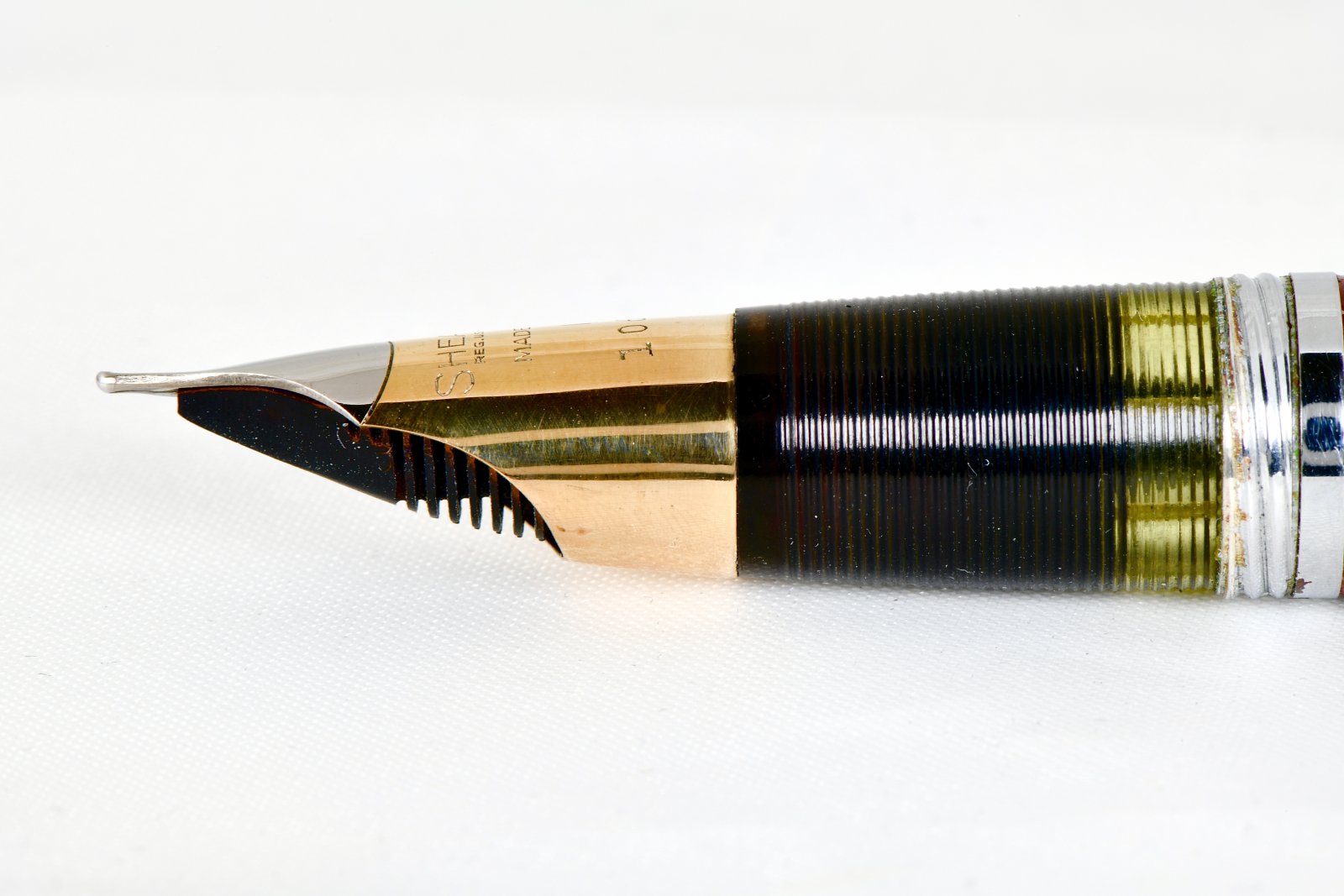
Lastly, I have a Sheaffer desk pen that will hold a converter, but I use it as dip only. It holds a LOT of ink when I use it that way.

Edited by Charles Rice
Link to comment
Share on other sites

+1 for a Dip Pen subforum.

It is enough of a specialty that it should have its own subforum.

Right now we have to dig for dip pen stuff in this or the penmanship subforums.

San Francisco Pen Show - August 28-30, 2020 - Redwood City, California

www.SFPenShow.com

Link to comment
Share on other sites

  • 4 months later...

I for one am a confessed fan of the dip pen nib. It has so much to offer/give and once you get used to it, its hard to go back to fountain pens, other than for convenience and not dipping. However, I looked at a chap's published book on U.S. Patents and there was one granted in 1790's for a fountain pen.


I have in my own collection what is called a 'penner' by the Brits. It is a traveling set, where an inkwell and writing staff/quill or nib is incorporated into one unit and can fit in a man's vest pocket.


Those having trouble with dip pen nibs, especially metal ones, I invite the use of Windex with Ammonia, a eye-glass cleaning towelette, of hand towelette given at KFC, etc., and wipe off the excess oil from the nib, as when they come from factory production a thin oil is applied as to retard rust. Our finger oils also add to the problem. In the old days people sucked on the new nib before wiping it and dipping however, this isn't a good practice. Spit in the palm of your hand and rub the nib in the palm vent hole/reservoir hole to the writing tip (feet).


I haven't worked with glass pens but, must wonder if hand oil is also an issue?


The factory oil will cause any ink to bead and drop ink as if straight from an eye-dropper. Makes a mess of things I might add. Some paper when holding it will extract finger oils and may cause an interruption of good writing. Cotton rag paper won't give issues but, its expensive for practice. A possible help is putting a paper under the edge of the writing hand as to act as a buffer between hand and writing surface. Once the oil has been stripped off a new nib, regardless how old the nib is, it may be old stock but unused and the oil remains still doing its job. Once ink can get into the pores of the steel nib, it will loose the beading behavior on the nib's top and underside and start writing smoothly. It will perform best with a light touch as was the purpose of flex nibs as to cause the shades with pressure. In teaching students with a dip pen at the very beginning is the weight of the pen staff is enough to make fine hair lines. By putting the staff in the web portion between the index and thumb, the pen will drag and make a mark. The rest is practice in timing when to press and release. Strokes down are usually ones that are shaded, the up strokes light. Much like a fast check-mark, the 'light caress lift' is the aim.


Majority of the nibs are made where the maximum flex is achieved at the lower third of the split in the nib, creating the two feet of the writing portion of the nib. Nibs do not need a hole. Many old gold nibs don't have a hole at all. The hole though acts as a reservoir. But, returning to flex -- under the hole to the writing tip, consider the safe zone of flex is the bottom third, using the measure between the hole/reservoir/top of split downward to the tip. Some nibs will be harder to flex than others. Just depends on the model of the nib and the inventor's reasonings. Nibs were made for different jobs, e.g. Banking, drafting, mapping, writing, etc.


I have also demonstrated in my classes, that often times using modern paper, it repels certain inks due to the chemicals they use making the paper, so a writer shouldn't fault themselves when it just could be a mis-match of ink and paper. Again, hand oil can also be a culprit as well. It hopefully will not prevent a person from their pursuit of writing with dip pens.


My current favorite nibs are old vintage nibs -- mostly out of production ones. I consider them my teachers, as these nibs were made when everybody wrote in what we consider fancy/calligraphy writing today.


The easiest nibs to find, though vintage and been out of production for over 60 years, is the Esterbrook 356 (drafting) nib. It is as close to the rare Gillott Principality nib, to which I own one. Again, the best performance is writing with a light hand. Guiding rather than forcing hand. The second being the Esterbrook 357 (Drafting). It is ever so slightly wider in tracking. Gillott 303 EF (blue steel) can be found in good supply at Paper & Ink Arts or John Neal Booksellers. Hunt 103 is my noodle nib. For such a small nib it has a very wide spread of flex. Hunt 100 is just as fine but, it does not have the 'wet noodle' flex as the 103. Esterbrook 354 is their flexy and Esterbrook 355 is a stiffer spring and equally fine as the Hunt 100 and 103. I recommend the Esterbrook 355 to left handed writers as they 'push' the nib rather than drag as right handed writers do. Being a bit stiffer, it doesn't fold under like a mud flap does dragging on the ground when a truck backs up. The 'snap' when the nib returns from other nibs, causes that spray that sprays ink outward and onto other's clothing or onto the paper.


I've found regardless of which nib I use, if it complains its usually justified. Lighten up and by using a straight pen holder (which I prefer as I write with a fountain pen and feather quills), you can adjust or 'tune in' putting both of the feet of the nib onto the paper evenly as to do what it was created to do. If its too far off bead, it complains as its got one foot bearing or too far off to the side as to be writing on it's edge/side where it can't flex or be fed its ink. In the beginning, I would hold in my hand the pen staff, use my free hand to twist the pen staff as I watched the point of the nib. When I got to the 'sweat spot' I learned to see what I needed to see how that nib was on paper for my hand. Because all hands aren't the same, you have to customize the writing hold on the pen staff.


If you use the middle finger on the pen staff, as I've seen some kids do--it adds additional weight to the writing staff and nib, so need to lift it up if insisting on writing with the middle finger.


Just my thoughts and opinions.


Maria

Link to comment
Share on other sites

Create an account or sign in to comment

You need to be a member in order to leave a comment

Create an account

Sign up for a new account in our community. It's easy!

Register a new account

Sign in

Already have an account? Sign in here.

Sign In Now


  • Most Contributions

    1. amberleadavis
      amberleadavis
      43972
    2. PAKMAN
      PAKMAN
      35520
    3. inkstainedruth
      inkstainedruth
      31117
    4. Ghost Plane
      Ghost Plane
      28220
    5. Bo Bo Olson
      Bo Bo Olson
      27746
  • Upcoming Events

    No upcoming events found
  • Blog Comments

    • stylographile
      Awesome! I'm in the process of preparing my bag for our pen meet this weekend and I literally have none of the items you mention!! I'll see if I can find one or two!
    • inkstainedruth
      @asota -- Yeah, I think I have a few rolls in my fridge that are probably 20-30 years old at this point (don't remember now if they are B&W or color film) and don't even really know where to get the film processed, once the drive through kiosks went away....  I just did a quick Google search and (in theory) there was a place the next town over from me -- but got a 404 error message when I tried to click on the link....  Ruth Morrisson aka inkstainedruth 
    • alkman
      There is still chemistry for processing regular chrome (positive) films like Kodak Ektachrome and Fuji Velvia, but Kodachrome was a completely different and multistep beast. 
    • Ceilidh
      Ah, but how to get it processed - that is the question. I believe that the last machine able to run K-14 (Kodachrome processing) ceased to operate some 15 or so years ago. Perhaps the film will be worth something as a curiosity in my estate sale when I die. 😺
    • Mercian
      Take a lot of photos!   If the film has deteriorated or 'gone off' in any way, you can use that as a 'feature' to take 'arty' pictures - whether of landmarks, or people, or whatever.
  • Chatbox

    You don't have permission to chat.
    Load More
  • Files


×
×
  • Create New...