Jump to content

Measuring line width?


meanwhile

Recommended Posts

Can anyone recommend a good but cheap tool for measuring lie width? I'm thinking that there must be some sort of transparent graduated sciencey-thing I can use a loupe???

- Jonathan

Link to comment
Share on other sites

  • Replies 10
  • Created
  • Last Reply

Top Posters In This Topic

  • KendallJ

    3

  • meanwhile

    2

  • Tweel

    2

  • BillTheEditor

    1

It would take longer than I have today to draw this, take a picture, and post the image, but there's a simple and cheap way to figure out line width that won't require any equipment beyond what you probably already have.


On a piece of paper (preferably graph paper, to help keep things aligned and straight), draw a series of lines, like this (and ignore the yellow dots if you can see them, I had to force the staggering):


..........__ (Continue making lines until you have a convenient number)

........__ (Lines are just touching each other, top and bottom)

......__ (Stagger the lines)

....__ *(Start with the bottom line)


When you have made five or ten lines, you will be able to measure the total distance from the bottom of the first line to the top of the last line and divide by the number of lines. It won't be "micrometer accurate" but it will be close enough for practical purposes.


Obviously, you have to take a little care when you draw those lines so that each is just tangent to the one before, and that the lines are reasonably straight (don't need a straightedge if you keep the lines short). If you like, you can do this several times and average the results.

Link to comment
Share on other sites

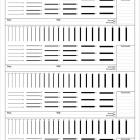
Um, Richard Binder used to have a pdf file that had various line widths shown so that you could write on the paper and compare line widths. It's actually fairly simple using this method to get within 0.1mm.


Richard, got that link handy? I have it at home. will try to post when I get there.

Kendall Justiniano
Who is John Galt?

Link to comment
Share on other sites

Let's see if this works. If not I can email the file to anyone who asks for it. One from Richard, and another from an unknown source.


I believe 100 = 1.0mm on this one.

Nib_Widths.pdf

Edited by KendallJ

Kendall Justiniano
Who is John Galt?

Link to comment
Share on other sites

  • 6 months later...

If you print these out on transparency film they are extremely easy to use. They are also a lot cheaper than the commercially made versions you can buy in a graphics art supply store.

Link to comment
Share on other sites

I have a couple of Parkers whose widths I'd like to know. One is a Super "21", which of course doesn't have a width marked on the nib, and the other is a "45". I have two nibs for the latter, both marked F on the collar, one of which is mis-marked. I'm wondering whether I have a M and a F, or a F and an XF.


Would anyone with "known" pens be willing to check them against the above PDFs and tell me the the measurements you get?


Thanks,

Brian

fpn_1375035941__postcard_swap.png * * * "Don't neglect to write me several times from different places when you may."
-- John Purdue (1863)

Link to comment
Share on other sites

I use my scanner and an image editor, in my case Adobe Photoshop Elements. I'm sure most other similar programs could be used. I just draw a line and scan it at a fairly high resolution. I use 1200 dpi. Then I import the scan into my image editor and zoom in until the line is pretty wide. Then I use a line drawing tool and adjust its width until it matches the scanned line. The program tells me the size in pixels of the line tool setting. Voila! My original line is now known to be X pixels wide at Y dpi with both X and Y known. A simple calculation gives me the width in inches of my original drawn line.

Bill Sexauer
http://bulk-share.slickpic.com/album/share/zyNIMDOgTcgMOO/5768697.0/org/p/PCA+++Logo+small.jpghttp://bulk-share.slickpic.com/album/share/zyNIMDOgTcgMOO/5768694.0/org/p/Blk+Pen+Society+Icon.jpghttp://bulk-share.slickpic.com/album/share/TE3TzMUAMMYyNM/8484890.0/300/p/CP04_Black_Legend%2C_Small.jpg
PCA Member since 2006

Link to comment
Share on other sites

I use my scanner and an image editor... Then I use a line drawing tool and adjust its width until it matches the scanned line.

That would work -- my own aphorism is that the shortest distance between two points is the one you take :P (maybe I should go analog, and buy some graticules for my microscope...).


I used the PDFs, which is probably good enough resolution for a scale of F, M, B, etc. On the "Anonymous" chart, my Super "21" is closest to 0.45mm, while on the "Binder"chart, it's closest to a F round nib.


My "45" nibs most closely match 0.35mm and 0.50mm on the "Anonymous" chart, and XF and F on the "Binder" chart.


Now the question is, what do someone else's pens measure as on those charts, whose nominal line widths are known? In other words, my "21" is F and my "45" is XF and F, as Richard Binder grinds nibs, but Parker may not agree.


Brian

fpn_1375035941__postcard_swap.png * * * "Don't neglect to write me several times from different places when you may."
-- John Purdue (1863)

Link to comment
Share on other sites

  • 1 year later...

The PDF above (Nib_Widths.pdf) printed out at actual size on my laser printer produced line widths that measured right what they should be. I used a Dumaurier 20X hand-held measuring microscope (a fabulous tool if you can find them); the 50X microscope starts to magnify too much to where you start to get a bit uncertain as to exactly where the line borders are.


If you know PostScript or other page description languages, these types of printouts are pretty easy to make. I'd be happy to make anyone a custom one (as long as it doesn't turn into a bunch of work).


Ideally, we'd get rid of the "fine", "medium", etc. nomenclature, as they are non-standard and mean different things to different people. The measurement of the line width is straightforward -- if you don't have a graduated microscope, you can put a rule with 1/2 mm graduations next to the line and, using e.g. a 4X magnifier, easily measure to within about 0.1 mm.


But the above PDF is so useful and fast, it's probably the tool of choice. A handy tool could be made by printing it on a transparency, then cutting out just the section with the vertical lines (oops, I see someone already mentioned that).

Link to comment
Share on other sites

Create an account or sign in to comment

You need to be a member in order to leave a comment

Create an account

Sign up for a new account in our community. It's easy!

Register a new account

Sign in

Already have an account? Sign in here.

Sign In Now


  • Most Contributions

    1. amberleadavis
      amberleadavis
      43972
    2. PAKMAN
      PAKMAN
      35652
    3. inkstainedruth
      inkstainedruth
      31616
    4. Ghost Plane
      Ghost Plane
      28220
    5. Bo Bo Olson
      Bo Bo Olson
      27747
  • Upcoming Events

  • Blog Comments

    • Misfit
      Oh to have that translucent pink Prera! @migo984 has the Oeste series named after birds. There is a pink one, so I’m assuming Este is the same pen as Oeste.    Excellent haul. I have some Uniball One P pens. Do you like to use them? I like them enough, but don’t use them too much yet.    Do you or your wife use Travelers Notebooks? Seeing you were at Kyoto, I thought of them as there is a store there. 
    • A Smug Dill
      It's not nearly so thick that I feel it comprises my fine-grained control, the way I feel about the Cross Peerless 125 or some of the high-end TACCIA Urushi pens with cigar-shaped bodies and 18K gold nibs. Why would you expect me or anyone else to make explicit mention of it, if it isn't a travesty or such a disappointment that an owner of the pen would want to bring it to the attention of his/her peers so that they could “learn from his/her mistake” without paying the price?
    • szlovak
      Why nobody says that the section of Tuzu besides triangular shape is quite thick. Honestly it’s the thickest one among my many pens, other thick I own is Noodler’s Ahab. Because of that fat section I feel more control and my handwriting has improved. I can’t say it’s comfortable or uncomfortable, but needs a moment to accommodate. It’s funny because my school years are long over. Besides this pen had horrible F nib. Tines were perfectly aligned but it was so scratchy on left stroke that collecte
    • stylographile
      Awesome! I'm in the process of preparing my bag for our pen meet this weekend and I literally have none of the items you mention!! I'll see if I can find one or two!
    • inkstainedruth
      @asota -- Yeah, I think I have a few rolls in my fridge that are probably 20-30 years old at this point (don't remember now if they are B&W or color film) and don't even really know where to get the film processed, once the drive through kiosks went away....  I just did a quick Google search and (in theory) there was a place the next town over from me -- but got a 404 error message when I tried to click on the link....  Ruth Morrisson aka inkstainedruth 
  • Chatbox

    You don't have permission to chat.
    Load More
  • Files


×
×
  • Create New...