Jump to content

Montblanc 234 1/2 Piston Repair


Kynaeilijae

Recommended Posts

Hi, everybody!


I am asking for help regarding a Montblanc 234 1/2. A nice pen, apart from the fact that the nut holding the seal to the piston shaft has separated and is rattling loose in the barrel. In addition, the piston is extremely stiff.


So, the piston will have to come out to be serviced. And therein lies the problem: how do you do it, and is it a DIY job?


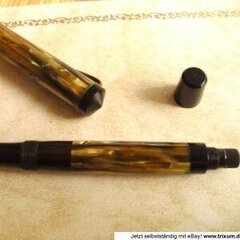
As you will surely note from the picture, the pen dates to the post-war / late fourties period. The barrel is in one piece and does not have a separate upper part that could be unscrewed in the manner of the pre-war and wartime versions. Only the blind cap is similar.


I have been surfing the Internet, but the info I've been able to get concern the older models (with the serrated ring) and does not apply.


So, does anyone know the answer to the following questions:


1. From which end should the piston be removed on this late model: the front/section end, or from the back?


2. If the piston is removed from the back, how does one remove the 4 mm long threaded part below the turning knob? The turning knob itself is fastened with a pin, and there is a narrow gap separating the threaded part from the barrel end. But are they meant to be separated? An old parts catalogue I found online (http://www.caprafico.com/pens-88/montblanc-repair-catalog-1956) shows the barrel and threaded rear part as one unit.


3. How much heat is sufficient to loosen joints on Montblancs?


4. Should I give up and leave it to the experts before I break something and ruin the pen?


Sincerely,


Martti

post-142174-0-34153800-1520859901_thumb.jpg

Link to comment
Share on other sites

  • Replies 10
  • Created
  • Last Reply

Top Posters In This Topic

  • siamackz

    4

  • Kynaeilijae

    3

  • farmdogfan

    2

  • fountainbel

    1

Top Posters In This Topic

Posted Images

Hi Martti,


Nice pen! I dont have a 234 1/2 but I feel like the section should unscrew and the the piston head should come out of the barrel end (just like my 334 1/2).


Whether or not you want to DIY is really a matter of whether or not learning restoration is of interest to you. I restore almost all my pens - irrespective of value, myself. I only give pens to the pros when I dont have specialised equipment without which the job is not possible. But, Im more interested in restoration than collecting or using, thats why I take the risk. There is always a risk, no matter how simple a job may seem.

My Restoration Notes Website--> link

Link to comment
Share on other sites

If you haven´t tried this before, i would leave it to a pro.


I think that on your model (where you can´t remove the piston assembly from the back) the section has to be removed, and that is a big chance to take if you haven´t done it before, the celluloid is very brittle and can very easily crack (or get deformed, if gets too hot).

Link to comment
Share on other sites

If you haven´t tried this before, i would leave it to a pro.


I think that on your model (where you can´t remove the piston assembly from the back) the section has to be removed, and that is a big chance to take if you haven´t done it before, the celluloid is very brittle and can very easily crack (or get deformed, if gets too hot).


Exactly, this is not an "early' telescopic piston version on which the complete filler unit can be disassembled from the back.

On this "later "version the section has to be removed allowing screwing the piston out at the front.

Francis

Link to comment
Share on other sites


Hi, and thanks.


If the piston has to be screwed out from the front, then the section has to come off. Which brings us back to question number 3 above:


How much heat, ie. what temperature, have you found suitable when loosening section joints on Montblancs? "Dry" heat or hot water?


Like "siamackz", I like DIY and would really like to give it a try. Partly because I save money by doing it myself, but most importantly because, if successful, the feeling of satisfaction will be sooo great.


Martti


Link to comment
Share on other sites

Dry heat, for the section (a hair dryer could be sufficient). Try it a little and often, rather than in one great burst. It should never be too hot to touch. While heating, twist/coax the section back and forth to try and break the 'seal' of the threads.


Don't expect it to work first time. Walk away and come back later and repeat. It should move eventually.

NEVER use too much force. Remember it is only a pen and hands are strong enough to break it.

Even when it has started to move, you may still need to apply heat and only move it a small amount at a time.

If in doubt: Stop.


This is an awful thing to say, but be prepared to wreck your pen. It's one of the risks of DIY.

Hopefully, this won't happen, but if you're not prepared to take that risk, send it out to a professional.

However, as pointed out, when it works, it's a great sense of achievement.


Good luck.

Link to comment
Share on other sites

Hi, and thanks. If the piston has to be screwed out from the front, then the section has to come off. Which brings us back to question number 3 above: How much heat, ie. what temperature, have you found suitable when loosening section joints on Montblancs? "Dry" heat or hot water? Like "siamackz", I like DIY and would really like to give it a try. Partly because I save money by doing it myself, but most importantly because, if successful, the feeling of satisfaction will be sooo great. Martti

Heres a post I wrote recently - the first part talks about how I removed a really stubborn section https://www.fountainpennetwork.com/forum/topic/330275-restoring-an-mb-146g-1950s-my-journey/. The second part might not be relevant as its to do with a telescopic piston. All the best and keep asking questions.

Edited by siamackz

My Restoration Notes Website--> link

Link to comment
Share on other sites

Dry heat, for the section (a hair dryer could be sufficient). Try it a little and often, rather than in one great burst. It should never be too hot to touch. While heating, twist/coax the section back and forth to try and break the 'seal' of the threads.


Don't expect it to work first time. Walk away and come back later and repeat. It should move eventually.

NEVER use too much force. Remember it is only a pen and hands are strong enough to break it.

Even when it has started to move, you may still need to apply heat and only move it a small amount at a time.

If in doubt: Stop.


This is an awful thing to say, but be prepared to wreck your pen. It's one of the risks of DIY.

Hopefully, this won't happen, but if you're not prepared to take that risk, send it out to a professional.

However, as pointed out, when it works, it's a great sense of achievement.


Good luck.

+1 to everything here!

My Restoration Notes Website--> link

Link to comment
Share on other sites

Hello again.


SUCCESS: My 234 1/2 G is in parts, not pieces - thank you all for giving me courage!


Through alternate heating the section threads with a hair dryer (approx. 70-80o C) and twisting between thumb and forefinger in a rocking motion, the section came loose! I also managed to force a thin shim (0.03 mm) into the groove, which I believe helped. Thanks for the advice!


The process took some three hours or so. At first I was perhaps too careful with the hair dryer, but when I increased the heating sessions to approx. 30 seconds before twisting, the section suddenly gave up its resistance. No cracking sound, amazing feeling!


It turned out there was a 1 mm bead of sealant around the edge, nothing in the threads.


After removing the turning knob, the piston parts just fell out. The pictures show all the parts: The screw is brass, as are the two pins, but otherwise it is all plastic. No 2-stage piston on this one!


Unfortunately, the black sleeve into which the brass screw goes seems to have shrunk so that the screw does not go in freely, which explains the stiffness I mentioned in my initial posting. I already tried lubricating with silicon grease, but to no effect.


Any ideas how to sort out the rod and sleeve discrepancy? A new sleeve might be hard to find.


Likewise, any ideas about the rubber seal as the current one is beyond redemption and will have to be replaced. Cork, perhaps?


Martti

post-142174-0-99363500-1520957230_thumb.jpg

post-142174-0-22704300-1520957242_thumb.jpg

Link to comment
Share on other sites

Well done. I have noticed that using some micromesh on the metal spindle removes rust. Then I apply silicone grease and it goes in smooth. You might find tips from my recent restoration of a similar piston https://www.fountainpennetwork.com/forum/topic/331791-restoring-an-mb-244-green-marbled/


As for the seal, yes, cork.


Well done! Its always good to see FP hobbyist taking restoration into their own hands :)

Edited by siamackz

My Restoration Notes Website--> link

Link to comment
Share on other sites

Create an account or sign in to comment

You need to be a member in order to leave a comment

Create an account

Sign up for a new account in our community. It's easy!

Register a new account

Sign in

Already have an account? Sign in here.

Sign In Now


  • Most Contributions

    1. amberleadavis
      amberleadavis
      43972
    2. PAKMAN
      PAKMAN
      35679
    3. inkstainedruth
      inkstainedruth
      31749
    4. Ghost Plane
      Ghost Plane
      28220
    5. Bo Bo Olson
      Bo Bo Olson
      27748
  • Upcoming Events

  • Blog Comments

    • Misfit
      Oh to have that translucent pink Prera! @migo984 has the Oeste series named after birds. There is a pink one, so I’m assuming Este is the same pen as Oeste.    Excellent haul. I have some Uniball One P pens. Do you like to use them? I like them enough, but don’t use them too much yet.    Do you or your wife use Travelers Notebooks? Seeing you were at Kyoto, I thought of them as there is a store there. 
    • A Smug Dill
      It's not nearly so thick that I feel it comprises my fine-grained control, the way I feel about the Cross Peerless 125 or some of the high-end TACCIA Urushi pens with cigar-shaped bodies and 18K gold nibs. Why would you expect me or anyone else to make explicit mention of it, if it isn't a travesty or such a disappointment that an owner of the pen would want to bring it to the attention of his/her peers so that they could “learn from his/her mistake” without paying the price?
    • szlovak
      Why nobody says that the section of Tuzu besides triangular shape is quite thick. Honestly it’s the thickest one among my many pens, other thick I own is Noodler’s Ahab. Because of that fat section I feel more control and my handwriting has improved. I can’t say it’s comfortable or uncomfortable, but needs a moment to accommodate. It’s funny because my school years are long over. Besides this pen had horrible F nib. Tines were perfectly aligned but it was so scratchy on left stroke that collecte
    • stylographile
      Awesome! I'm in the process of preparing my bag for our pen meet this weekend and I literally have none of the items you mention!! I'll see if I can find one or two!
    • inkstainedruth
      @asota -- Yeah, I think I have a few rolls in my fridge that are probably 20-30 years old at this point (don't remember now if they are B&W or color film) and don't even really know where to get the film processed, once the drive through kiosks went away....  I just did a quick Google search and (in theory) there was a place the next town over from me -- but got a 404 error message when I tried to click on the link....  Ruth Morrisson aka inkstainedruth 
  • Chatbox

    You don't have permission to chat.
    Load More
  • Files


×
×
  • Create New...