Jump to content

Eversharp Stenographers Bulb filler.


Bryant

Recommended Posts


Hello all,

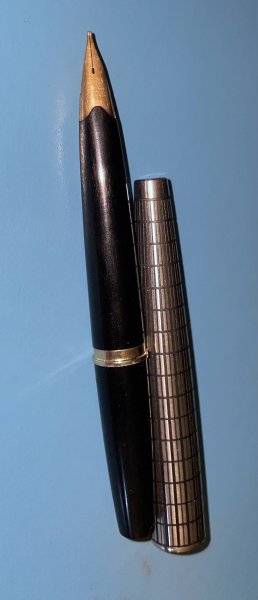
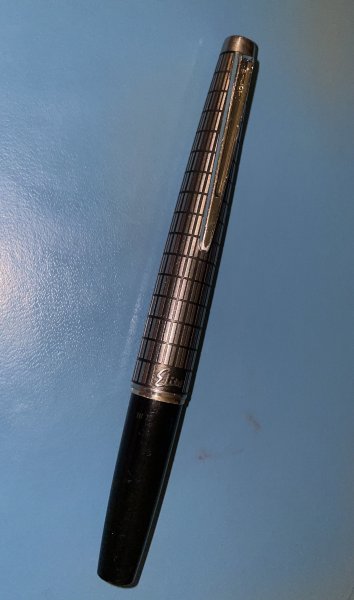
I just received a Eversharp Stenographers Doric Bulb filler. I think that’s what this is right?

Anyway… I noticed the nib was extra long, is it supposed to be this way, or is the nib and feed pulled out a little?


Also, any suggestions on getting the “gunk” off the nib, and what is a "fair" price for this? It does not matter to much to me, I am happy with my buy... I'm just curious...


Thanks and Cheers,


Bryant

Edited by Bryant

Chatterley Luxuries and Pentime


Web: Chatterleyluxuries.com


Email: Info@chatterleyluxuries.com


Follow us on...


Facebook


Instagram


Twitter


Link to comment
Share on other sites

  • Replies 7
  • Created
  • Last Reply

Top Posters In This Topic

  • Bryant

    4

  • Wahlnut

    2

  • sheafferkid

    2

Popular Days

Top Posters In This Topic

Wow! You're one of the only people I've seen with one of these neat pens, although, I'm sure Syd has one. I don't know if this is typical with a stenographer's pen, but mine has a flexible fine nib on it. What kind does yours have? It should be marked on the underside of the feed. Not really being able to look at the feed, I can't really say if its out too far, but it looks fine. Getting the gunk off...hmm..well, if you have a rouge cloth, it might buff it off, but if its dried ink, some diluted ammonia might be the best thing. Hopefully Syd will post about the price, as I'm not really sure. They're really neat pens, aren't they?


Evan

Sheaffer all the way!

Link to comment
Share on other sites

Wow! You're one of the only people I've seen with one of these neat pens, although, I'm sure Syd has one. I don't know if this is typical with a stenographer's pen, but mine has a flexible fine nib on it. What kind does yours have? It should be marked on the underside of the feed. Not really being able to look at the feed, I can't really say if its out too far, but it looks fine. Getting the gunk off...hmm..well, if you have a rouge cloth, it might buff it off, but if its dried ink, some diluted ammonia might be the best thing. Hopefully Syd will post about the price, as I'm not really sure. They're really neat pens, aren't they?


Evan

They are for sure, I'm excited to re-sac and give it a test run. It says MN-F on the bottom of the feed. I'm assuming the F is for fine... Do you know what the MN is for? Medium___________?

Just from testing it with out ink it seems to have a medium flex. What do you mean by a rough cloth? (sorry if thats a silly question).

Cheers,

Bryant

Chatterley Luxuries and Pentime


Web: Chatterleyluxuries.com


Email: Info@chatterleyluxuries.com


Follow us on...


Facebook


Instagram


Twitter


Link to comment
Share on other sites

Wow! You're one of the only people I've seen with one of these neat pens, although, I'm sure Syd has one. I don't know if this is typical with a stenographer's pen, but mine has a flexible fine nib on it. What kind does yours have? It should be marked on the underside of the feed. Not really being able to look at the feed, I can't really say if its out too far, but it looks fine. Getting the gunk off...hmm..well, if you have a rouge cloth, it might buff it off, but if its dried ink, some diluted ammonia might be the best thing. Hopefully Syd will post about the price, as I'm not really sure. They're really neat pens, aren't they?


Evan

They are for sure, I'm excited to re-sac and give it a test run. It says MN-F on the bottom of the feed. I'm assuming the F is for fine... Do you know what the MN is for? Medium___________?

Just from testing it with out ink it seems to have a medium flex. What do you mean by a rough cloth? (sorry if thats a silly question).

Cheers,

Bryant


I'm not sure what the MN-F is..WAIT A SEC! I bet it means manifold fine! That has to be it. Although that wouldn't explain why it is a medium flex.... <_< A rouge (as in the French name for red), not rough, cloth is a cloth that jeweler's use that has this red powder in it that polishes metal quite well. Anyways, I hope this helps!


Evan


Sheaffer all the way!

Link to comment
Share on other sites

Hello all,

I just received a Eversharp Stenographers Doric Bulb filler. I think that’s what this is right?

Anyway… I noticed the nib was extra long, is it supposed to be this way, or is the nib and feed pulled out a little?


Also, any suggestions on getting the “gunk” off the nib, and what is a "fair" price for this? It does not matter to much to me, I am happy with my buy... I'm just curious...


Thanks and Cheers,


Bryant


The 8 sided Doric Steno Pen (as opposed to the 12 sided Dorics was made for that purpose (sometimes it was also called an accountant's pen) The nib is slender and long on purpose. Built that way the stenographer gets a good look at what the nib is putting down and can see that the shorthand being written looks right as it goes down. Same is true for the accountant user who was posting entries on columnar sheets and needed to be sure to get the numbers in the little boxes accurately placed.


Actually from the early 20's on Wahl made, Steno, Bookkeeper, and Posting nibs. This Steno pen is from the period 1931-1934. The nib is indeed semi-flex and usually not not a manifold. The F on a Wahl Eversharp feed, means slender or #2 size and the MN, I have to look up, but I do know that SN stood for Stenographer in the 20's, and M usually stood for midget. MN would be midget steno? There is nothing midget about the length of these pens, as they are 5 1/2" long but they are very slender like a midget diameter. Like I say I have to look that part up.


The pen in restored "near mint to mint condition has run a wide gamut over the past 3-4 years running all the way from about $190 to a high of $325, depending on the given day and condition on eBay. They are not terribly rare but rare enough to demand a premium price . They came in the color you show, as well as red (garnet), medium charcoal gray with white flecks (Burma) and maybe green. I don't ever recall seing it in Blue. They also came with matching pencils.


That's about all I can recall off the cuff at this moment.


All of my Accountant friends go "ape" over this pen.


Here is the pen and pencil set in Garnet dis-assembled showing the sac which was a simple squeeze bulb filler:

http://i9.photobucket.com/albums/a75/wahlnut/IMG_1179.jpg

and assembled:

http://i9.photobucket.com/albums/a75/wahlnut/IMG_1178-1.jpg


See how long the nib is?

Syd

Syd "the Wahlnut" Saperstein

Pensbury Manor

Vintage Wahl Eversharp Writing Instruments

Pensbury Manor


The WAHL-EVERSHARP Company

www.wahleversharp.com

New WAHL-EVERSHARP fountain and Roller-Ball pens

Link to comment
Share on other sites

Hello all,

I just received a Eversharp Stenographers Doric Bulb filler. I think that’s what this is right?

Anyway… I noticed the nib was extra long, is it supposed to be this way, or is the nib and feed pulled out a little?


Also, any suggestions on getting the “gunk” off the nib, and what is a "fair" price for this? It does not matter to much to me, I am happy with my buy... I'm just curious...


Thanks and Cheers,


Bryant


The 8 sided Doric Steno Pen (as opposed to the 12 sided Dorics was made for that purpose (sometimes it was also called an accountant's pen) The nib is slender and long on purpose. Built that way the stenographer gets a good look at what the nib is putting down and can see that the shorthand being written looks right as it goes down. Same is true for the accountant user who was posting entries on columnar sheets and needed to be sure to get the numbers in the little boxes accurately placed.


Actually from the early 20's on Wahl made, Steno, Bookkeeper, and Posting nibs. This Steno pen is from the period 1931-1934. The nib is indeed semi-flex and usually not not a manifold. The F on a Wahl Eversharp feed, means slender or #2 size and the MN, I have to look up, but I do know that SN stood for Stenographer in the 20's, and M usually stood for midget. MN would be midget steno? There is nothing midget about the length of these pens, as they are 5 1/2" long but they are very slender like a midget diameter. Like I say I have to look that part up.


The pen in restored "near mint to mint condition has run a wide gamut over the past 3-4 years running all the way from about $190 to a high of $325, depending on the given day and condition on eBay. They are not terribly rare but rare enough to demand a premium price . They came in the color you show, as well as red (garnet), medium charcoal gray with white flecks (Burma) and maybe green. I don't ever recall seing it in Blue. They also came with matching pencils.


That's about all I can recall off the cuff at this moment.


All of my Accountant friends go "ape" over this pen.


Here is the pen and pencil set in Garnet dis-assembled showing the sac which was a simple squeeze bulb filler:

http://i9.photobucket.com/albums/a75/wahlnut/IMG_1179.jpg

and assembled:

http://i9.photobucket.com/albums/a75/wahlnut/IMG_1178-1.jpg


See how long the nib is?

Syd

Wow Syd! Thanks for the info; I do feel better about my purchase now. (Not that I didn’t before, but it’s nice to know I paid a fair price) Is the material Celluloid? It almost has a mother of pearl look to it. It’s definitely a very unique pen… At least for my collection. I’m glad I got it.

Cheers!

Bry


Chatterley Luxuries and Pentime


Web: Chatterleyluxuries.com


Email: Info@chatterleyluxuries.com


Follow us on...


Facebook


Instagram


Twitter


Link to comment
Share on other sites

Wow Syd! Thanks for the info; I do feel better about my purchase now. (Not that I didn’t before, but it’s nice to know I paid a fair price) Is the material Celluloid? It almost has a mother of pearl look to it. It’s definitely a very unique pen… At least for my collection. I’m glad I got it.

Cheers!

Bry


It is was Pyroxalin Plastic, what Wahl called "Pyralin" plastic. The plastics were usually made for Wahl-Eversharp (and other makers too,) by the DuPont Viscaloid company. The history of plastics is a fascinating subject all by itself of course, but it bears heavily on the supplying of pens stock for machining into pens in the 20's and 30's


This is more than you asked for but...


According to the Plastics Museum: In 1925, DuPont purchased the Viscoloid Co. of Leominster, Massachusetts, changing the name to DuPont Viscoloid Co., Inc. In that same year the DuPont Poughkeepsie plant was closed and its Pyralin product line of collars, cuffs, and toiletware was transferred to the DuPont Viscoloid facility in Leominster...By 1915, the Arlington company was the largest manufacturer of pyroxylin plastic in the United States, producing nearly 40% of the total American output (Celluloid produced 25%; Fiberloid 25%; and Viscoloid 10%). In December of 1915, E.I. DuPont de Nemoures and Co. purchased the Arlington Company for the cash price of $6,700,000. At the same time, DuPont also bought the Norwich Paper Company of Connecticut; as tissue paper was the form of cellulose used in the making of Pyralin. I believe the pen stock was made at their New Jersey Plant.


Wahl went into plastic pens by machining these plastic rod stocks into pens in 1926 and introducing their plastic pens to the world in 1927.


No matter what the trade name it was cellulose nitrate. Some makers called their product cellulose plastic, Xylonite, Zilonite, etc etc. There were many makers. There is a long history of plastics gong back to the mid 19th century

Edited by Wahlnut

Syd "the Wahlnut" Saperstein

Pensbury Manor

Vintage Wahl Eversharp Writing Instruments

Pensbury Manor


The WAHL-EVERSHARP Company

www.wahleversharp.com

New WAHL-EVERSHARP fountain and Roller-Ball pens

Link to comment
Share on other sites


It is was Pyroxalin Plastic, what Wahl called "Pyralin" plastic. The plastics were usually made for Wahl-Eversharp (and other makers too,) by the DuPont Viscaloid company. The history of plastics is a fascinating subject all by itself of course, but it bears heavily on the supplying of pens stock for machining into pens in the 20's and 30's


This is more than you asked for but...


According to the Plastics Museum: In 1925, DuPont purchased the Viscoloid Co. of Leominster, Massachusetts, changing the name to DuPont Viscoloid Co., Inc. In that same year the DuPont Poughkeepsie plant was closed and its Pyralin product line of collars, cuffs, and toiletware was transferred to the DuPont Viscoloid facility in Leominster...By 1915, the Arlington company was the largest manufacturer of pyroxylin plastic in the United States, producing nearly 40% of the total American output (Celluloid produced 25%; Fiberloid 25%; and Viscoloid 10%). In December of 1915, E.I. DuPont de Nemoures and Co. purchased the Arlington Company for the cash price of $6,700,000. At the same time, DuPont also bought the Norwich Paper Company of Connecticut; as tissue paper was the form of cellulose used in the making of Pyralin. I believe the pen stock was made at their New Jersey Plant.


Wahl went into plastic pens by machining these plastic rod stocks into pens in 1926 and introducing their plastic pens to the world in 1927.


No matter what the trade name it was cellulose nitrate. Some makers called their product cellulose plastic, Xylonite, Zilonite, etc etc. There were many makers. There is a long history of plastics gong back to the mid 19th century


Good to know, I always wondered what the exact material it is in so many pens… You are just a wealth of information!


Thanks again for the info!

Bryant

Edited by Bryant

Chatterley Luxuries and Pentime


Web: Chatterleyluxuries.com


Email: Info@chatterleyluxuries.com


Follow us on...


Facebook


Instagram


Twitter


Link to comment
Share on other sites

Create an account or sign in to comment

You need to be a member in order to leave a comment

Create an account

Sign up for a new account in our community. It's easy!

Register a new account

Sign in

Already have an account? Sign in here.

Sign In Now


×
×
  • Create New...