Jump to content

Conklin Glider C1944-1946


PenHero

Recommended Posts

Hi, Folks,

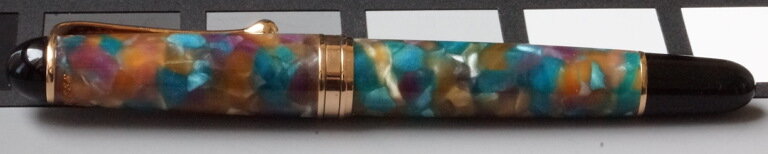
Been looking through my collection of Conklin Gliders and have noticed a few things. First, there are three variations of the pen. This photo shows the largest pen, which also has a wide cap band. It's not shown in either of the two Conklin Glider ads that I have.
http://penhero.com/Temp/ConklinGlider_1280_02.jpg
The 1944 ad describes the Glider as a new pen that features the 14 karat gold Cushon Point nib for a $2.75 price, $3.95 with the matching pencil. It features a clear Visink section and were offered in Dichro-plastic striped inlay patterns. Another 1944 ad shows the pen in four striped colors.
The best features of these pens are the high quality nibs and the vivid cap and barrel. Unfortunately the gold plating was very thin and many examples of the pens show lots of plating loss.
It's unknown to me if there was any premium for the larger pen with the wide cap band.
Thanks!
Link to comment
Share on other sites

  • 10 months later...
  • Replies 8
  • Created
  • Last Reply

Top Posters In This Topic

  • PenHero

    6

  • miwishi63

    3

Hi, Folks!


This is a large size, wide cap band Conklin Glider fountain pen in green striped celluloid c. 1944-1946. It was made in three versions, this being the largest pen, which is the only one with a 3/8 inch wide gold plated cap band. The gold plating on these pens is notoriously thin, in contrast with the very high quality pens Conklin made in the previous decade. It features a 14 karat gold Cushon Point nib and a clear Visink ink view section. Conklin advertisements from 1944 describe the Glider as a new fountain pen selling for $2.75 and $3.95 in a set with the matching pencil. Four different “dichro-plastic” striped inlay pattern colors were shown, in shades of green, blue, brown and red.

http://www.penhero.com/Temp/ConklinGlider_1280_04.jpg
Thanks!
Link to comment
Share on other sites

  • 8 months later...

Hi, Folks!

This is the slender size Conklin Glider fountain pen in blue striped celluloid c. 1944-1946. It was made in three versions. The other two are wider in diameter and differ by one having a narrow gold plated cap band and the other a 3/8 inch wide gold plated cap band. The gold plating on these pens is notoriously thin, in contrast with the very high quality pens Conklin made in the previous decade. This example not only shows plating loss but pitting in the metal. It features a 14 karat gold Conklin Toledo nib instead of the standard Cushon Point nib and the clear Visink ink view section has completely lost its black coating that creates the ink view window and reveals the full nib and feed. Conklin advertisements from 1944 describe the Glider as a new fountain pen selling for $2.75 and $3.95 in a set with the matching pencil. Four different “dichro-plastic” striped inlay pattern colors were shown, in shades of green, blue, brown and red.

http://www.penhero.com/Temp/ConklinGliderBlue_1280_05a.jpg

Thanks!

Link to comment
Share on other sites

Sure looks like it! :)


Thanks! I'm ashamed to admit that I did not know its vintage, although I knew it was a Conklin. I bought it awhile back and restored it. I'll be putting into rotation soon.


-Mike

Link to comment
Share on other sites

The pen I have has the Chicago imprint and a Toledo nib. The info on your website seems to indicate that it is a fairly early model. Is that correct?


-Mike

Link to comment
Share on other sites

The pen I have has the Chicago imprint and a Toledo nib. The info on your website seems to indicate that it is a fairly early model. Is that correct?


-Mike


The information in the article on PenHero.com is out of date. I will need to revise it in the next couple weeks.

Link to comment
Share on other sites

Hi, Folks!


This is the slender size Conklin Glider fountain pen in green striped celluloid c. 1944-1946. It was made in three versions. The other two are wider in diameter and differ by one having a narrow gold plated cap band and the other a 3/8 inch wide gold plated cap band. The gold plating on these pens is notoriously thin, in contrast with the very high quality pens Conklin made in the previous decade. This example shows complete plating loss on the clip and lever. It features a 14 karat gold Conklin Toledo nib instead of the standard Cushon Point nib. It has the Visink ink view section. Conklin advertisements from 1944 describe the Glider as a new fountain pen selling for $2.75 and $3.95 in a set with the matching pencil. Four different “dichro-plastic” striped inlay pattern colors were shown, in shades of green, blue, brown and red.


http://www.penhero.com/Temp/ConklinGlider_1280_06.jpg


Thanks!

Link to comment
Share on other sites

Create an account or sign in to comment

You need to be a member in order to leave a comment

Create an account

Sign up for a new account in our community. It's easy!

Register a new account

Sign in

Already have an account? Sign in here.

Sign In Now


  • Most Contributions

    1. amberleadavis
      amberleadavis
      43972
    2. PAKMAN
      PAKMAN
      35328
    3. inkstainedruth
      inkstainedruth
      30393
    4. Ghost Plane
      Ghost Plane
      28220
    5. Bo Bo Olson
      Bo Bo Olson
      27744
  • Upcoming Events

  • Blog Comments

    • inkstainedruth
      Thanks for the info (I only used B&W film and learned to process that).   Boy -- the stuff I learn here!  Just continually astounded at the depth and breadth of knowledge in this community! Ruth Morrisson aka inkstainedruth 
    • Ceilidh
    • Ceilidh
      >Well, I knew people who were photography majors in college, and I'm pretty sure that at least some of them were doing photos in color,<   I'm sure they were, and my answer assumes that. It just wasn't likely to have been Kodachrome.  It would have been the films I referred to as "other color films." (Kodachrome is not a generic term for color film. It is a specific film that produces transparencies, or slides, by a process not used for any other film. There are other color trans
    • inkstainedruth
      @Ceilidh -- Well, I knew people who were photography majors in college, and I'm pretty sure that at least some of them were doing photos in color, not just B&W like I learned to process.  Whether they were doing the processing of the film themselves in one of the darkrooms, or sending their stuff out to be processed commercially?  That I don't actually know, but had always assumed that they were processing their own film. Ruth Morrisson aka inkstainedruth   ETA: And of course
    • jmccarty3
      Kodachrome 25 was the most accurate film for clinical photography and was used by dermatologists everywhere. I got magnificent results with a Nikon F2 and a MicroNikkor 60 mm lens, using a manually calibrated small flash on a bracket. I wish there were a filter called "Kodachrome 25 color balance" on my iPhone camera.
  • Chatbox

    You don't have permission to chat.
    Load More
  • Files


×
×
  • Create New...