Jump to content

To Repair Or Not To Repair


berlinairlift

Recommended Posts

I have a nice Sheaffer and after removing the barrel I cleaned and tested it and noticed that it worked just fine. There is an excellent vacuum, the pen has very good draw and does not leak. Looking closely at the washer, it is pliable and there is no particle debris in the chamber to indicate a part is starting to break up.


Is it worthwhile to take it apart and replace components which are seemingly fine in a vintage pen?


25362949121_2a5040e4c4_c.jpg


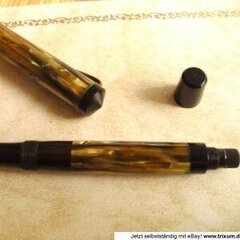
Looking closely I noticed that there seems to be two backing washers, one of which is made of the striated green material Sheaffer used in a number of Sheaffer pens.


Has anyone seen this before?

25160230710_a1f0ab3818_c.jpg


Thanks,


Jon

Link to comment
Share on other sites

  • Replies 8
  • Created
  • Last Reply

Top Posters In This Topic

  • berlinairlift

    3

  • Ron Z

    1

  • Sasha Royale

    1

  • 3rdlakerobert

    1

Top Posters In This Topic

If it was mine, I'd just go on using it until it doesn't work any more. Best of luck, nice pen.

Link to comment
Share on other sites

As an engineer with OCD... i'd say take it apart!

However if it works fine, dont screw with it. There are too many things that can go wrong

Edited by titrisol
Link to comment
Share on other sites

Thanks for the responses. I'm going to leave it as is and put it into my rotation. I find this type of vac-fil somewhat more difficult to repair than others because of the removal of the nib and feed. I have a couple of others of this type and they do need repair so I am thinking about the best approach.

Link to comment
Share on other sites

That's from the end of the Vac-Fil period I'd say--probably 1948. I've been restoring Vac-Fil pens for a year, probably done 50-75 for resale on eBay, and I've not seen anything like that washer. I've seen a few with that striated material used to make the cup that holds the barrel-end gasket, but never anything where this one is.

Link to comment
Share on other sites

Sheaffer used any kind of scrap material that was handy for small parts that wouldn't bee seen. I've seen inner caps made out of carmine celluloid, backing washers made out any color celluloid available. Yours happens to be green striped material.


If it continues to work, use it. But it will fail with use. The head gasket is graphite impregnated rubber, which hardens and turns brittle. The packing material is made of grease impregnated felt and rubber washers. The grease has usually dried out by now, and the felt wears. The first clue that there is a problem is ink on the rod. Replacing the head gasket and packing material will take care of both. With the right 0-ring and head gasket material, the pen will be usable for years, maybe even decades.


The rod is a problem. If it has failed as one of the pictures shows, it won't be long before the rest of the celluloid covering fails. It will need a replacement rod. There are something like 11 different sizes of rod and I though I have a list of lengths for the pens I can't, an don't try to, keep the models straight. I make them out of stainless steel for each pen to the proper length as needed, using the existing rod as a model.


One important note. The most difficult part is getting the nib out without breaking it. I've done hundreds of these pens (I know how many orders of 0-rings I've had, so no exaggeration there), and can tell you that without the right tools, your chances of getting the nib out without damage is 50% at best. With the right tool or tools, your chances of success are near certainty. Fountainbel here on FPN sells a nib removal tool. It'll pay for itself with the first couple of pens.

spacer.png
Visit Main Street Pens
A full service pen shop providing professional, thoughtful vintage pen repair...

Please use email, not a PM for repair and pen purchase inquiries.

Link to comment
Share on other sites

  • 3 weeks later...

One important note. The most difficult part is getting the nib out without breaking it. I've done hundreds of these pens (I know how many orders of 0-rings I've had, so no exaggeration there), and can tell you that without the right tools, your chances of getting the nib out without damage is 50% at best. With the right tool or tools, your chances of success are near certainty. Fountainbel here on FPN sells a nib removal tool. It'll pay for itself with the first couple of pens.


Ron,


I have the tool from Fountainbel and it's great. One still has to use a lot of caution with the nibs but I cannot imagine not using it and having the same success rate.


Jon

Link to comment
Share on other sites

It works fine ! Use it in good health ! If ever you have to penetrate the pen to replace seals, washers, etc. DO THEM ALL at that time ! Including cleaning and servicing. Then, your pen will give reliable service for twenty years. Meanwhile, pay attention to the "old guy" and write with joy.

Auf freiem Grund mit freiem Volke stehn.
Zum Augenblicke dürft ich sagen:
Verweile doch, du bist so schön !

Link to comment
Share on other sites

Create an account or sign in to comment

You need to be a member in order to leave a comment

Create an account

Sign up for a new account in our community. It's easy!

Register a new account

Sign in

Already have an account? Sign in here.

Sign In Now


  • Most Contributions

    1. amberleadavis
      amberleadavis
      43972
    2. PAKMAN
      PAKMAN
      35347
    3. inkstainedruth
      inkstainedruth
      30417
    4. Ghost Plane
      Ghost Plane
      28220
    5. Bo Bo Olson
      Bo Bo Olson
      27744
  • Upcoming Events

  • Blog Comments

    • inkstainedruth
      Thanks for the info (I only used B&W film and learned to process that).   Boy -- the stuff I learn here!  Just continually astounded at the depth and breadth of knowledge in this community! Ruth Morrisson aka inkstainedruth 
    • Ceilidh
    • Ceilidh
      >Well, I knew people who were photography majors in college, and I'm pretty sure that at least some of them were doing photos in color,<   I'm sure they were, and my answer assumes that. It just wasn't likely to have been Kodachrome.  It would have been the films I referred to as "other color films." (Kodachrome is not a generic term for color film. It is a specific film that produces transparencies, or slides, by a process not used for any other film. There are other color trans
    • inkstainedruth
      @Ceilidh -- Well, I knew people who were photography majors in college, and I'm pretty sure that at least some of them were doing photos in color, not just B&W like I learned to process.  Whether they were doing the processing of the film themselves in one of the darkrooms, or sending their stuff out to be processed commercially?  That I don't actually know, but had always assumed that they were processing their own film. Ruth Morrisson aka inkstainedruth   ETA: And of course
    • jmccarty3
      Kodachrome 25 was the most accurate film for clinical photography and was used by dermatologists everywhere. I got magnificent results with a Nikon F2 and a MicroNikkor 60 mm lens, using a manually calibrated small flash on a bracket. I wish there were a filter called "Kodachrome 25 color balance" on my iPhone camera.
  • Chatbox

    You don't have permission to chat.
    Load More
  • Files


×
×
  • Create New...