Jump to content

Fade Test of Some of my Inks, Mostly J. Herbin and Waterman


Ovidius

Recommended Posts

This is my first review, so I hope that everything works properly. I am not sure if this is the proper place to post a fade test of several inks, if it is not, please tell me.


I used Q-tips to make colour swabs, cut the page in half, put one half in my window for three weeks and the other half in a book. After three weeks I put them side by side and here is the result. For comparison, I added a few none fountain pens, (Sharpie Marker, Roller Ball, Gel, etc...).


Scientific Disclaimer: This is just a general comparison, but by no means scientifically accurate. I generally passed the Q-tip over the paper five times, but occasionally I did more passes. Additionally, I am in a more northerly area and it is still winter, (Less sun, Fewer UVs) so it might take less time to reach these levels of fading with more sun. Regardless, it does provide an example of the fade resistence of some inks.


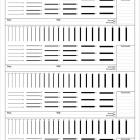
post-5023-1206804659_thumb.jpg


1: Red Pilot Roller Ball

2: Blue Sharpie

3: Yellow Highlighter

4: Lamy Blue Cartridge (in pen, not Q-tip)

5: Aurora Black

6: Omas Sepia

7: J. Herbin Eclat de Saphir

8: Waterman Red

9: J. Herbin Bleu Nuit

10: Waterman Blue Black

11: Waterman Green

12: Waterman Florida Blue

13: Parker Washable Blue Quink

14: Pilot Black VPen Disposable FP

15: J. Herbin Blue Azure

16: J. Herbin Terre de feu

17: Waterman South Seas Blue

18: Parker Gel Refill for ball points

"Gutta cavat lapidem, non vi sed saepe cadendo". --Publius Ovidius Naso

Link to comment
Share on other sites

  • Replies 14
  • Created
  • Last Reply

Top Posters In This Topic

  • Ovidius

    5

  • MicheleB

    2

  • kurzman

    2

  • Iridium

    1

Top Posters In This Topic

Posted Images

This is a fascinating experiment. Thanks.

We can trust the heart of a man by his treatment of animals. - Immanual Kant

Link to comment
Share on other sites

It is a fun experiment, not too hard to do. I am really curious to know which inks survive better. The Waterman Red faired out much better than I would have expected, while the J. Herbins did worse than I would have expected. In practical terms, I suppose that fade resistance is only important if your writing is going to be exposed to large amounts of direct sunlight, but I like to know as much as I can about the ink that I am using. I still have the paper in my window, so I might post the extended results in a few weeks if they are interesting.

"Gutta cavat lapidem, non vi sed saepe cadendo". --Publius Ovidius Naso

Link to comment
Share on other sites

Thank you for the link, I can see that it will prove very useful in selecting an ink with good lightfast qualities. The results in the link seem to confirm my "findings".

"Gutta cavat lapidem, non vi sed saepe cadendo". --Publius Ovidius Naso

Link to comment
Share on other sites

  • 3 weeks later...

Here is an update to my previous posting. This picture was taken at about six weeks in my window (the first image was taken at about three weeks).


post-5023-1208483879_thumb.jpg

"Gutta cavat lapidem, non vi sed saepe cadendo". --Publius Ovidius Naso

Link to comment
Share on other sites

  • 3 months later...

Some of the fading produced really interesting effects. Great test, thanks!


*I used to do that with my acrylic and watercolor paints*

My latest ebook.   And not just for Halloween!
 

My other pen is a Montblanc.


Link to comment
Share on other sites

Two things surprised me in that fade test:

-- How well Waterman Red performed, and

-- How poorly the blue Sharpie performed.

CharlieB


"The moment he opened the refrigerator, he saw it. Caponata! Fragrant, colorful, abundant, it filled an entire soup dish, enough for at least four people.... The notes of the triumphal march of Aida came spontaneously, naturally, to his lips." -- Andrea Camilleri, Excursion to Tindari, p. 212

Link to comment
Share on other sites

Wow great test, before reading it I thought you were doing a water resistance test. I have several certificates that the ink is long gone from florescent lights. I'd love the see the bulletproof inks tested like this!

PAKMAN

minibanner.gif                                    

        My Favorite Pen Restorer                                            


Link to comment
Share on other sites

Two things surprised me in that fade test:

-- How well Waterman Red performed, and

-- How poorly the blue Sharpie performed.


In tests I've done in the past, only the black Sharpie was strongly fade- and chemical-resistant. Some brands of gel pens also base their "bulletproof" reputations on the performance of the black ink alone, while the other colors prove to be much less stable. In fact, most gel inks are not fraud-proof, contrary to popular belief (especially Parker gel refills). Wikipedia says they are, but it's wrong, and it usually doesn't take more than a little water, alcohol, or sunlight to prove it.

Link to comment
Share on other sites

  • 4 weeks later...

Thank you very much for all the posts that people have added, I am glad to know that there is some interest in the fade resistance of various inks. Just as a matter of curiosity, I left the sample in my window for six months, I have now removed it, and I am adding an image in case anyone is curious to see the results. I don't think that many people leave ordinary or important documents in direct sunlight for six months, so the overall usefulness of this test in selecting an everyday ink is limited. Having said that, it is nice to know which inks will hold up against UVs if you are using them in an area which is exposed to direct light.


On a separate note, I was very surprised to see how well the Waterman Red withstood the exposure to sunlight, but having done other such tests, I used the Blue Sharpie as a control of sorts, knowing that it would fade an lose its vibrancy. I have not tried the black Sharpie, but I would hope for better results as blacks are usually the most "bullet proof" of any ink line.


post-5023-1220303805_thumb.jpg

"Gutta cavat lapidem, non vi sed saepe cadendo". --Publius Ovidius Naso

Link to comment
Share on other sites

Thanks for doing this and for the update! This is very interesting--it corroborates what I've heard about the light-fastness (or lack thereof) of J. Herbin inks. :( It's too bad--they're such pretty colors!

Inks currently in pens: Noodler's La Reine Mauve, Rachmaninov, Prime of the Commons Blue-Black, Naval Orange, MN Whaleman's Sepia, Verdun Green, Majestic Orange; J. Herbin Violette Pensée, Rose Cyclamen, Orange Indien


Blog Twitter Facebook

Link to comment
Share on other sites

Create an account or sign in to comment

You need to be a member in order to leave a comment

Create an account

Sign up for a new account in our community. It's easy!

Register a new account

Sign in

Already have an account? Sign in here.

Sign In Now


  • Most Contributions

    1. amberleadavis
      amberleadavis
      43972
    2. PAKMAN
      PAKMAN
      35351
    3. inkstainedruth
      inkstainedruth
      30440
    4. Ghost Plane
      Ghost Plane
      28220
    5. Bo Bo Olson
      Bo Bo Olson
      27744
  • Upcoming Events

  • Blog Comments

    • inkstainedruth
      Thanks for the info (I only used B&W film and learned to process that).   Boy -- the stuff I learn here!  Just continually astounded at the depth and breadth of knowledge in this community! Ruth Morrisson aka inkstainedruth 
    • Ceilidh
    • Ceilidh
      >Well, I knew people who were photography majors in college, and I'm pretty sure that at least some of them were doing photos in color,<   I'm sure they were, and my answer assumes that. It just wasn't likely to have been Kodachrome.  It would have been the films I referred to as "other color films." (Kodachrome is not a generic term for color film. It is a specific film that produces transparencies, or slides, by a process not used for any other film. There are other color trans
    • inkstainedruth
      @Ceilidh -- Well, I knew people who were photography majors in college, and I'm pretty sure that at least some of them were doing photos in color, not just B&W like I learned to process.  Whether they were doing the processing of the film themselves in one of the darkrooms, or sending their stuff out to be processed commercially?  That I don't actually know, but had always assumed that they were processing their own film. Ruth Morrisson aka inkstainedruth   ETA: And of course
    • jmccarty3
      Kodachrome 25 was the most accurate film for clinical photography and was used by dermatologists everywhere. I got magnificent results with a Nikon F2 and a MicroNikkor 60 mm lens, using a manually calibrated small flash on a bracket. I wish there were a filter called "Kodachrome 25 color balance" on my iPhone camera.
  • Chatbox

    You don't have permission to chat.
    Load More
  • Files


×
×
  • Create New...