Jump to content

41, The Red & Black,


rhr

Recommended Posts

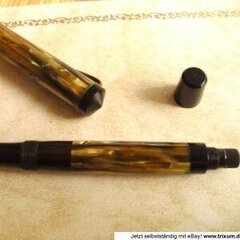
This is about the Black Top, the Duofold color scheme, red with black tips. Here are all the Duofold trademarks. Parker's trademark no. 155,044 from May 16, 1922, but used since Sept 1, 1921, is for the word "Duofold" used for "Fountain Pens". It was registered by William Fink Palmer, at this time the treasurer of the Parker Pen Co., but at other times also secretary and president. There is no certificate on the USPTO website for trademark no. 163,481 from Jan 16, 1923, but said to be used since Aug 25, 1921, Parker's trademark for the Duofold pen color scheme, which is a shame because it's such a pretty image. I got a hardcopy version of the trademark, and it shows a cross-hatched, black-and-white rendition of a red hard rubber pen body with two black hard rubber ends. It was advertized with the phrase "Rivals the beauty of the Scarlet Tanager". And here's another usual reverse situation, a trademark issued after the fact. The word "Duofold" was trademarked again on Nov 4, 1924, but was said to be used since Sept 1, 1923, no. 191,306 for "Pens And Pencils". This is not a typo for 1921, but rather a re-trademarking of the name after the inclusion of pencils in the Duofold line. The usual reverse situation is that a trademark is issued after, and sometimes well after, the fact of the commercial use of the name or mark. These trademarks were part of Parker's unsuccessful attempt to stop all the Duofold look-alike pens in the 1920s, pens such as the red hard rubber Diamond Point Pen Co. "Tucolor Fill E-Z" pen with its black hard rubber cap and barrel tips. And last but not less red, trademark no. 943,258 is for the Parker Pen Co. name "Big Red" for their Duofold-tribute felt-tip and ballpoint pen, issued on Sept 19, 1972, but used since Apr 10, 1970. See also the underwear, or "softwear", in trademark nos. 195,873, 784,484, and 857,073, and patent no. 709,734. The name "Dudfold" [sic] mentioned in the last trademark, but only in TESS in the USPTO website, is a misspelling, or optical-character-recognition problem, but a spelling that's quite apropos for clothing. ;~)


George Kovalenko.


:ninja:


If you want to perform the trademark searches, simply cut and paste, or type the trademark numbers into the search window in the Trademark Document Retrieval Portlet.

Edited by rhr

rhrpen(at)gmail.com


Link to comment
Share on other sites

  • Replies 0
  • Created
  • Last Reply

Top Posters In This Topic

  • rhr

    1

Popular Days

Top Posters In This Topic

Create an account or sign in to comment

You need to be a member in order to leave a comment

Create an account

Sign up for a new account in our community. It's easy!

Register a new account

Sign in

Already have an account? Sign in here.

Sign In Now


  • Most Contributions

    1. amberleadavis
      amberleadavis
      43972
    2. PAKMAN
      PAKMAN
      35328
    3. inkstainedruth
      inkstainedruth
      30393
    4. Ghost Plane
      Ghost Plane
      28220
    5. Bo Bo Olson
      Bo Bo Olson
      27744
  • Upcoming Events

  • Blog Comments

    • inkstainedruth
      Thanks for the info (I only used B&W film and learned to process that).   Boy -- the stuff I learn here!  Just continually astounded at the depth and breadth of knowledge in this community! Ruth Morrisson aka inkstainedruth 
    • Ceilidh
    • Ceilidh
      >Well, I knew people who were photography majors in college, and I'm pretty sure that at least some of them were doing photos in color,<   I'm sure they were, and my answer assumes that. It just wasn't likely to have been Kodachrome.  It would have been the films I referred to as "other color films." (Kodachrome is not a generic term for color film. It is a specific film that produces transparencies, or slides, by a process not used for any other film. There are other color trans
    • inkstainedruth
      @Ceilidh -- Well, I knew people who were photography majors in college, and I'm pretty sure that at least some of them were doing photos in color, not just B&W like I learned to process.  Whether they were doing the processing of the film themselves in one of the darkrooms, or sending their stuff out to be processed commercially?  That I don't actually know, but had always assumed that they were processing their own film. Ruth Morrisson aka inkstainedruth   ETA: And of course
    • jmccarty3
      Kodachrome 25 was the most accurate film for clinical photography and was used by dermatologists everywhere. I got magnificent results with a Nikon F2 and a MicroNikkor 60 mm lens, using a manually calibrated small flash on a bracket. I wish there were a filter called "Kodachrome 25 color balance" on my iPhone camera.
  • Chatbox

    You don't have permission to chat.
    Load More
  • Files


×
×
  • Create New...