Jump to content

Glass Nibs


wspohn

Recommended Posts

So we all know how a metal nib feeds ink - with the slit tip and often a breather hole in the top of the nib and the feed from the reservoir. And dip pens had the same sort of nib, generally speaking (with no feed of course), which held a small drop of ink in the slit and hole, if any.


But how the heck do glass nibs (used on some older dip pens , which are not slit, feed ink? Does it just stick to the nib? In which case I have trouble believing that you'd get many words per dip......

Bill Spohn

Vancouver BC

"Music is the wine that fills the cup of silence"


Robert Fripp

https://www.rhodoworld.com/fountain-pens.html

Link to comment
Share on other sites

  • Replies 14
  • Created
  • Last Reply

Top Posters In This Topic

  • RichKen

    3

  • Oxonian

    3

  • *david*

    2

  • wspohn

    1

It does just stick to the nib - but on good glass nibs, there are spiral swirls in the glass that give a lot of surface area for the ink to stick to.

Link to comment
Share on other sites

Actually, the magic of a glass nib is the same magic that makes a metal nib --and its feed! -- work. Follow this link the explanation in my site's glossary.


http://www.richardspens.com/images/ref_info/glossary/marxton_glass.jpg

sig.jpg.2d63a57b2eed52a0310c0428310c3731.jpg


Link to comment
Share on other sites

Hey thanks Richard - glad to be wrong. I think that some glass nibs are not made this way, and they write rather poorly as a result.

Link to comment
Share on other sites

Hi,


The capillary action of the glass nibbed fountain pen is responsibe for the flow.


Glass nibs tend to be VERY reliable.


Dillon

Stolen: Aurora Optima Demonstrator Red ends Medium nib. Serial number 1216 and Aurora 98 Cartridge/Converter Black bark finish (Archivi Storici) with gold cap. Reward if found. Please contact me if you have seen these pens.

Please send vial orders and other messages to fpninkvials funny-round-mark-thing gmail strange-mark-thing com. My shop is open once again if you need help with your pen.

Link to comment
Share on other sites

Sometimes glass nibs were used as a replacement for gold nibs, when the use of gold for civil purposes was outruled, like in some countries during the pre-war and WWII-era, e.g in Italy.


In the early 90s Visconti fitted glass nibs onto some of their 'Ragtime' FPs, which nowadays pop up very rarely on ebay.

Link to comment
Share on other sites

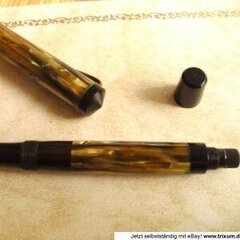
I found this the other day in an antique shop. A piston filler imprinted Student on the cap.


http://i46.photobucket.com/albums/f130/RichKen/Student%20FP/Student-FP-.jpg


Opened I was surprised to see a glass nib.


http://i46.photobucket.com/albums/f130/RichKen/Student%20FP/Student-FP-opn.jpg


I have lots of questions about this find. Is it a frankenpen or was the glass nib original to the pen? The nib is a simple friction fit twisted into the point section. Does anyone know about Student pens?

Link to comment
Share on other sites

Hello Richken,


Beyond the general observation that it is probably German and very likely to be from the mid 30's based on its its styling and the fact that it has quite a large percentage of what look like Vulcanite (Black hard rubber) in its make up.


The fact that it is a piston filler means that it is after 1925'ish. There was a firm, Spohr who did glass nibbed pens but I haven't seen one of theirs as a piston filler.


Student is not a name I have come across, there were a few makers who used the glass nib in early 30's Germany, like many of the less widely known makers of conventional pens , very few of them signed their work or else they weren't around long enough for anyone to get to know anything about them or become familiar with their name.

The problem of identity isn't helped by the way that many makers assembled pens from parts made by others. I have more than a few conventional metal nibbed pens from the same period with no names on them, they all look as though they could have come from the same maker and nibs, caps etc all share the same pattern and threads, even the clips look like derivatives of a basic shape


The fly in the ointment is that several firms made pens to earlier designs during the shortages in the immediate post war years and some East German companies made pens based on pre-war designs well into the 50's although I haven't yet run across post war glass nibbed pens from East Germany.


Sorry not to have more info to help you, I am sure that someone on FPN will know more, Cheers, John

Link to comment
Share on other sites

Hello Oxonian,


Thank you for the comments. So from what you say it may be possible that the glass nib is original to this pen. That's interesting. I was leaning toward frankenpen before reading your comments. Regards, Richard

Link to comment
Share on other sites

Hi Rich Ken,


Both frankenpen and original are still in the frame and it is likely that the absolute truth about the pen will never be known.


Some of the small makers would, at times when the money was tight, start assembling a batch of pens with metal nibs only to change to glass nibs if a supply shortage occurred and then back again when more metal nibs become available.


It is also possible that the pen started life with a metal nib and due to damage this was replaced with a glass one because the owner couldn't get his hands on a replacement metal one, in other pens the reverse is also possible.


Fountain pens were of course widely available in the 20's and 30's and some were relatively cheap but even they were not regarded as disposable and would be repaired if they were damaged rather than replaced and if a glass nib was all that was available then it would be used to keep the pen in use.


Glass nibs weren't as common or popular as metal nibs but they did put in an appearance in many places over the first part of the 20th century Melbi and Spohr are probably the best known makers who used ceramic nibs in Europe and exported to the US and some may even have been made there.

In the UK there were makers who supplied glass/ceramic nibbed pens, Rex being one of them and the one of which I have seen most.

There were makers in Japan inspired by the import of Spohr pens in the early 1900's or even a few years earlier, there are examples of crescent fillers looking like Conklins, until the cap ir removed.

Spohr were the earliest and largest mass maker of glass nibs as far as I know but I wouldn't swear to that someone may well know better.


All of these and other glass nibbed pens appear for sale from time to time.


If the filller on your pen works or if you just dip it, give it a try, the experience is different but not as wierd as you might expect, I have a Rex and quite like it.

Cheers, John

Link to comment
Share on other sites

do pen companies still make glass nibbed pens? where can i get one? i just recently purchased an herbin glass pen from pendemonium and i think its gorgeous...i love it...and i know theyre not the same thing (after reading the ink above), but i still think its cool to kinda bring around the (almost) the same thing around for fun...

i solemnly swear that i am up to no good.

Link to comment
Share on other sites

Hello Richard and John

The "Student" marked FP is actually a German. It belongs to a product line which had also been marked with "Adjutant" and "Admiral". Alas, I do not yet know who made them. I think the pen was produced from a small firm in the late 30th, I don`t think, that the glass nib is original. During the war most of the noble metal nibs were removed.

Hans Roggenbuck from the German ex-province Oberschlesien, which since after ww2 belongs to Poland, produced exclusively FPs with glass nibs. (HARO)

Today there are a few firms which produce glass nib dip pens, *from Venice*.

You can find seveal of vintage and new at the bay, Germany. (ebay.de ;then search: Glasfeder)

Kind Regards

Thomas

Edited by Kaweco
Link to comment
Share on other sites

Hello Thomas,


Many thanks for the information, Central European pens, particularly piston fillers interest me and glass nibbed pens have crossed my path from time to time but it is unusual to find a name on them.


Trying to find out about some of the companies is very hard work even with family connections to Poland and Germany and any information is always gratefully received and much appreciated. In my desk I have a small box marked 'Unknown makers- need research' with 10 or so pens in it, some have been there for several years and I still no no more about them than I did when I got them.


Haro was the name that I was trying to think of along with Spohr when I first replied but I had one of those mental blanks.


Cheers, John

Link to comment
Share on other sites

Hello Thomas,


So my "Student" appears to be German. Since I am a great fan of vintage Pelikans, I noticed the similarity of the "Student" to a Pelikan 100 or 100N primarily in size - not quality. Thank you for adding to our history of my "Student". I thought it would be a fun pen to own when I found it, the exchange of information is a real bonus.


Regards,

Richard

Link to comment
Share on other sites

Hello Thomas,


So my "Student" appears to be German. Since I am a great fan of vintage Pelikans, I noticed the similarity of the "Student" to a Pelikan 100 or 100N primarily in size - not quality. Thank you for adding to our history of my "Student". I thought it would be a fun pen to own when I found it, the exchange of information is a real bonus.


Regards,

Richard

Well, some italian penmakers (like Walter Engele, a German who lived and worked in Italy) would assemble pens using mostly German parts. In addition, during the late '30s and in the WW2 years many italian pens were fitted with glass nibs. So, while the original birthplace of the parts that make up your pen is probably Germany, it may have been assembled and fitted with a glass nib in Italy.

http://s26.postimg.org/fp30mhy6x/signature.jpg

In punta di penna.....

Link to comment
Share on other sites

Create an account or sign in to comment

You need to be a member in order to leave a comment

Create an account

Sign up for a new account in our community. It's easy!

Register a new account

Sign in

Already have an account? Sign in here.

Sign In Now


×
×
  • Create New...