Search the Community
Showing results for tags 'vacuum-fill'.
Found 5 results
-
A little backstory so you could understand: My first pen is a Pilot mr and now I'm currently looking for a step up. I have been looking for Pelikan and sailor pens, but also TWSBI (for it's relatively low price). The pen I'll get will be my workhorse pen and for Twsbi I'm between the 580 and the vac700r. I want to hear the experience of people who have used these pens for prolonged writing, if they recommend TWSBI and if yes, which one of them. Note: I know the difference between european and japanese nibs
-
I started my Japanese pen journey with a Sailor pro gear slim (F) a fun but finicky small pen. Quickly a Platinum #3776 Century (SF) and a Sailor 1911 large (MF) followed. I discovered that Japanese fine nibs really suit my handwriting. I eyeballed this Pilot Custom 823 for quite a while before I decided to buy it. I painstakingly read reviews and watched many videos of other people talking about this pen, both loving and disliking it. Due to Covid restrictions I couldn’t visit a brick-and-mortar store to test it out, so instead I turned to the web shop of my favorite Dutch retailer, Akkerman in Den Haag. I know that if I disliked the pen, I could return it without any problem. So, the facts: Manufacturer: Pilot Model: Custom 823 Material: Semi translucent amber acrylic (injection molded) Nib: Pilot #15 14kt Gold (F) Filling system: Vacuum-filler Capped: 149 mm Uncapped: 133 mm Posted: 162 mm Section: 10 - 11 mm ______________________________________________________________________ Appearance & Design - Classic cigar-shaped design At a glance the pen has the same classic cigar-shaped design as so many others. The material is semi translucent and that gives you a nice view on the pen’s inner workings. The details on this pen really stand out. The big ball on the clip end seemed quite odd to me but actually, it’s very practical. The engraving on the cap band is filled with black enamel which makes the letters crisp and stand out. The glossy finish is prone to catch fingerprints easily. Normally I’m not that fond of gold trimmings but with the amber acrylic is really works for me. Construction & Quality - Japanese precision The pen feels more solid than it looks, my first visual impression was that of a flimsy plastic pen but looks can deceive. The pen feels solid in the hand, and everything works and fits well. The threads on the blind cap as well as on the cap are smooth. There is a small stepdown to the cap treading (which is unintrusive) but it’s small enough not to be in the way. The injection molding seems are visible on the threading and on the top rim of the section. On the barrel and section, they are not visible. The pen posts very securely due to the step-ups in the cap. The cap comes off with just over 1¾ turn, which is not bad but not great eighter. Weight & Dimensions - Slender yet comfortable The length and weight of the pen suits me quite well, I can comfortably use it unposted. When posted it is still well balanced and not too long or back weighted. The section is a bit on the slim side for my licking, it could do with a bit more girth. So, I hold the pen a bit closer to the barrel to solve this. Nib & Performance - Glorious The 14kt gold #15 (equivalent of a #6 nib) fine nib writes like a dream. It’s the smoothest nib I currently own and lays down a good amount of ink on the paper, but isn’t a gusher by any means. It has a lovely design and is a joy to look at. So far, I only used this pen with Montblanc Toffee Brown and Akkerman #23 Bekakt Haags as I really like to have a brown ink in this pen. And with both these inks it performs well, never had a hard start or any skipping. The nib is not flexible but had a decent amount of bounce to it. It always puts a smile on my face when I put this nib to paper. Filling System & Maintenance – Smooth vacuum-filler The vacuum filling system works well and operates smoothly. With some effort you can easily fill this pen to the brim and then it holds close to 2,5 ml of ink. This is great if, like me, you don’t like to change inks a lot. But is bad news for those who like to write with a different ink every day. Especially if you know that cleaning out this pen is quite the hassle. Pilot provides no tools or instructions on taking this pen apart. No, instead of that they void you warranty if you tinker with this pen. (a TWSBY wrench of a VAC-700 fits this pen, just a tip. Do with it what you will, at your own risk). So yeah, maintenance and cleaning of this pen is a thing to think about before you decide to buy this pen. Cost & Value – Well, it’s not cheap I’ve got this pen for just a little over € 315,- and that makes quite an expensive pen. But considering the joy of writing with this pen due to its glorious nib in my opinion it’s worth it. If it would break, I would most certainly replace it and that say’s a lot for me. Conclusion – One of my favorites As a daily carriage I have a 4-pen rotation, and this is one of the two pens that are always in there (the other is my Sailor 1911 large with a 21kt MF nib). If I go somewhere without my pen pouch this pen is in my shirt pocket. So yeah, I really like it.

-
desaturated.thumb.gif.5cb70ef1e977aa313d11eea3616aba7d.gif)
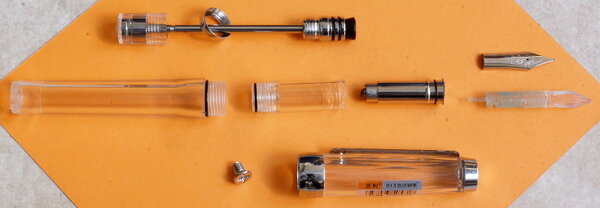
Exploded view of a fully disassembled Pali 013 / Wing Sung 3013
A Smug Dill posted a gallery image in FPN Image Albums
From the album: Chinese pens
The Pali 013 (shown) is essentially the same as the Wing Sung 3013. It can be fully disassembled as shown for cleaning and tinkering, if the user is so inclined. The nib can be replaced with a Pilot steel nib from a Prera, MR, 78G, Kakuno, Penmanship or Plumix pen.© A Smug Dill
- 0 B
- x
-

First Attempt On Pen Turning, A Stipula Etruria Lookalike
Hardy08 posted a topic in Pen Turning and Making
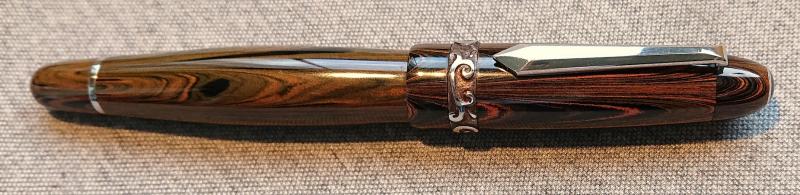
I was frustrated on a pen I bought: a Stipula Etruria Gallicana in Oronero color with a stiflexnib. This pen was gorgeous at first sight, but some drawbacks refrained me from using it daily: -It could only hold a small amount of ink: it is a CC filler. -The feed was a disaster as it was not suitable for a flex nib like the stiflex nib. -The pen was made of acrylic and i love the warm feeling of ebonite. After months of drawing plans and attempting on making parts for the pen I finally succeeded! This pen is made from ebonite rods from Nikko ebonite in ripple orange. The filling system is a Vac-Fill, a copy of the Wahl-Eversharp Doric second generation filling system. The cap doesn't post. The clip is sculpted from solid 316L stainless steel. Cap jewel and end barrel jewel are made of a gem grade rhodolite garnet embedded in 316L stainless steel. The cap ring is made of a solid rod of 316L stainless steel, engraved by hand with carbide tipped burr, with an artificially rusted finish. The nib is an original 14k Stiflex nig from Globus (Stipula) and is quite a wet noodle. The feed is in hard rubber from a destroyed Omas 360. Here are the pictures, it is now my daily writer!
-
I am trying to rescue an estate-sale Sheaffer and am a little puzzled about what I'm finding. My main reference is the material at http://t.richardspens.com/ref/anatomy/vacfil.htm. This is my first Sheaffer teardown, so novice confusion is a possibility and I won't be insulted to be told I've misunderstood something. I'm going to try to make it clear what I've done. It looks to be a black Heritage Autograph Lifetime Balance with a vacuum filler. It has a clip ball with a flat top, a big "LIFETIME" conventional nib (with serial number) and feed, and an engraved signature on the 14K cap ring that matches the family name of the estate. The blind cap turned stiffly, and then came off, leaving a threaded stainless plunger rod sticking out, unmoved from the fully-down position. I see no hint of a brass rod-end or an aluminum lock nut, so it appears this pen had the plunger screwed directly into a threaded hole in the blind cap, as in the pictures on the page above. I presume the plastic female threads in the cap are now stripped; I'm not too worried about that. The rod does not move at all, though. I soaked the pen for a while with the blind cap off. I think I did get a little water into the barrel (probably through the feed) during this soaking; I can see liquid moving around in the barrel through the view striations, and it doesn't seem thick or dark enough to just be old ink. The nib was slightly misaligned sideways on the feed, but I was easily able to shift it back to center with gentle finger pressure. I got it to write nicely with the resulting ink reconstituted from what had dried in the feed and section. I tried just pulling the nib and feed out with my fingers, without success. No surprise. After a 24-hour soak in water with a little detergent in it, the nib and feed seemed reasonably clean, but the rod still wouldn't budge. I tried both pulling on the rod end with my fingers (not much force available there) and clamping it between wood blocks in a vise and pulling moderately on the barrel, in both cases trying to extend the rod as though starting to fill the pen. I didn't want to try too hard. Neither effort produced any motion at all. I warmed the section and lower barrel with a hair dryer, trying the section for motion every minute or so. After maybe five minutes of warming, it gave, and then smoothly unscrewed with modest torque. Nothing seemed amiss; the threads are in good shape (both section and barrel), and there was no sudden snapping, no indication of anything breaking, and no loose plastic bits. The face of the plunger looks as I expect: a conical plastic piece, not quite protruding from the end of the barrel. After a few hours of soaking, I'm still unable to persuade the plunger to move out of the barrel by pressing the back of the plunger rod down against a hardwood block. I am unable to move the conical cap nut even slightly sideways when I push at it with a nail set. When I poke at the rubber gasket with a pin, it has a little give, so I don't think it's completely hard. I suspect that the plunger is stuck because the hard conical backing washer is glued with old dried ink to the inside of the barrel right at the shoulder where the barrel ID changes. (If it was stuck only at the rear packing, I would be able to push the cone sideways at the section end.) I have not resorted to any other sort of press to push it harder; I'd rather try soaking that old ink for longer. Here's the main mystery: I expected to see a "center feed" piece, intended to deflect the plunger cap nut sideways, sticking out of the rear of the section. That's what appears in pictures 1, 4, 5, and 6 at http://t.richardspens.com/ref/anatomy/vacfil.htm. But I see no such thing. Looking into the section from the rear, I see a moderately complicated geometry, but no protruding piece; it's all basically concave. As far as I can tell the conical cap nut (plunger head) wouldn't be touching anything from the section at all. I also don't see a deep hole that a narrow center feed would have slipped into. Is it possible I could have broken that center feed off without knowing it? Did Sheaffer make a version with a conical plunger cap nut but no deflecting protrusion from the feed? Is it likely somebody has replaced the feed with a different one, or broken that bit and reassembled the pen without fixing it? Might I have misidentified the pen altogether? I'm happy to hear advice about getting the plunger unstuck, but I would even more appreciate suggestions about why the section doesn't look as expected. Thanks, George.